


 About SPORTIVO Network
8 Best Automation Testing Companies in India That Enterprises Actually Trust
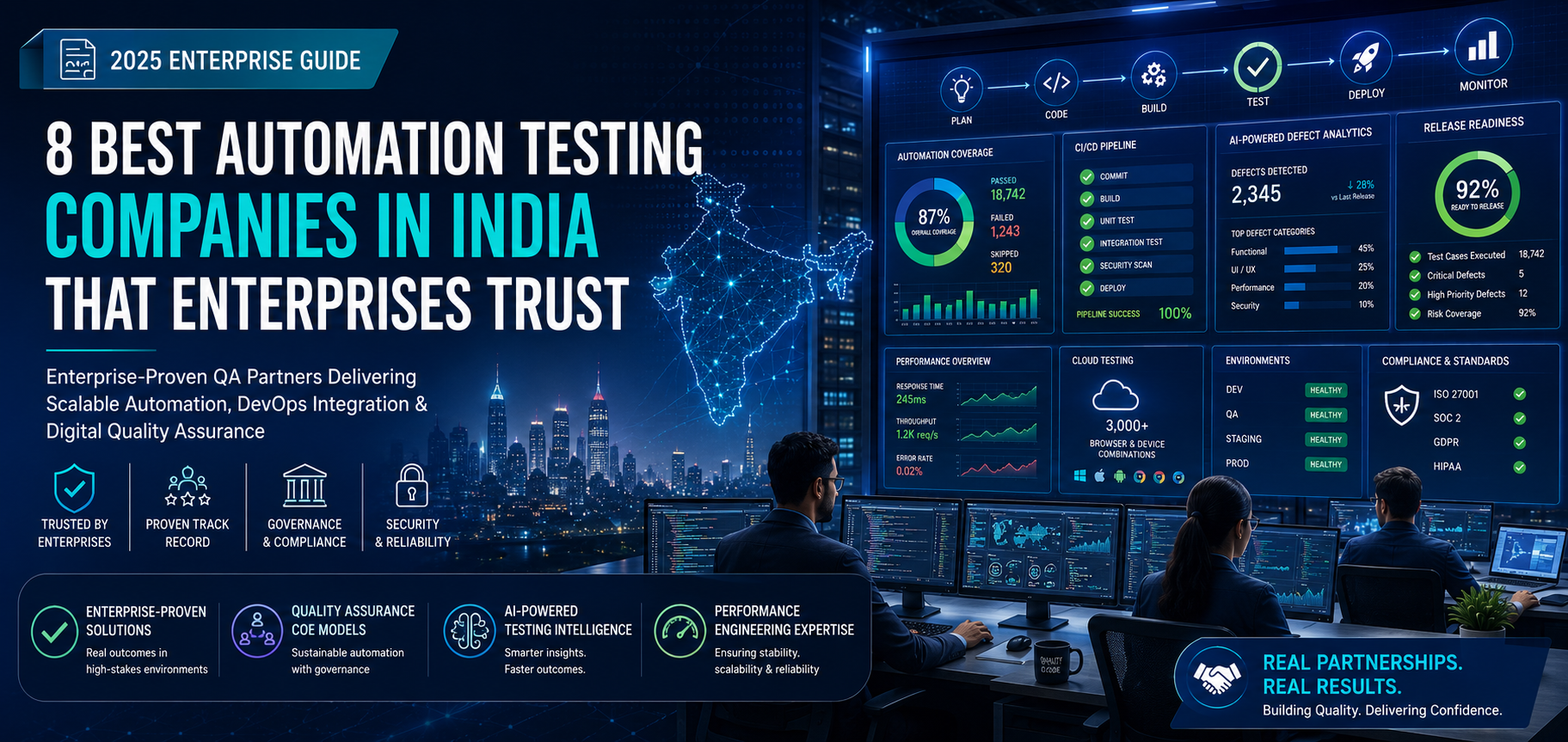
Most enterprise software teams have had at least one bad experience with an automation testing vendor. The promises were good. The execution was not. Test scripts broke after every deployment, coverage was superficial, and the frameworks required constant hand-holding.
The companies on this list have a track record that goes beyond demos and pitch decks. These are firms that have delivered real automation programs in high-pressure, high-stakes environments.
1. Avekshaa Technologies
When an enterprise application cannot afford downtime and every release carries business risk, Avekshaa is the kind of partner that handles the pressure well. Their automation testing practice is built around application performance engineering, which means they think about how automation impacts not just functionality but also system stability and scalability.
Their Quality Digital Assurance COE model is particularly valuable for enterprises that need ongoing governance rather than a one-off testing engagement. With over 60 leading enterprise customers and 600,000 hours of delivery experience, they bring a maturity level that is difficult to find in the mid-market.
They also invest heavily in AI and machine learning for automated root cause analysis, which shortens the feedback loop between a failed test and a resolved issue significantly. Enterprises managing complex distributed systems can further benefit from their application performance monitoring and performance testing and engineering capabilities, both of which integrate closely with their automation practice.
2. Cigniti Technologies
Cigniti has built one of the most respected pure-play testing brands in India. Their focus on test intelligence through BlueSwan gives enterprise clients data-driven insight into where their testing programs have gaps. Particularly strong in retail, healthcare, and financial services.
3. Capgemini India
Capgemini's scale and structured COE approach make them a reliable choice for multinational enterprises running large-scale automation programs across multiple geographies. Their Intelligent Testing framework accelerates test design through reusable components and shared libraries.
4. Wipro Digital
Wipro's Digital Quality Engineering practice has matured considerably over the last few years. Their QTAAS offering reduces the upfront investment in automation tooling and infrastructure while delivering consistent test coverage for agile and DevOps teams.
5. Mphasis
Mphasis is a strong choice for enterprises in the financial services space. Their automation testing approach is tightly coupled with cognitive AI capabilities, which helps in reducing false positives and improving the signal-to-noise ratio in test results.
6. Mastech Digital
Mastech Digital brings focused automation expertise for mid-to-large enterprises looking for a leaner, more agile partner than the Tier-1 players. Their test automation capabilities cover both web and mobile platforms with strong API testing depth.
7. NIIT Technologies (Coforge)
Coforge, formerly NIIT Technologies, has built a strong automation testing practice with particular depth in insurance, travel, and banking domains. Their test automation factory model provides a cost-effective way for enterprises to maintain large regression suites.
8. Tata Elxsi
For product companies and engineering-intensive enterprises, Tata Elxsi brings hardware-software integration testing expertise alongside conventional automation capabilities. Especially strong in automotive, healthcare devices, and media technology.
Why Enterprises Need More Than Just Automation Scripts
Automation scripts alone are not enough. The difference between a good automation testing partner and an average one comes down to three things: framework maintainability, integration quality, and the ability to scale test coverage as the application evolves. Enterprises should look for partners who treat test automation as a living program, not a project deliverable that gets handed over and forgotten.
The companies above have demonstrated, in real client environments, that they can manage this complexity. The right choice depends on your industry, stack, and the maturity of your existing QA function. For enterprises wanting to go deeper, Avekshaa's independent testing and quality assurance practice offers a comprehensive model that covers the full SDLC, from development through production, and their digital experience monitoring capabilities extend quality assurance into real user environments.
FAQ
Q1. What makes an automation testing company suitable for enterprise use? Enterprise-grade automation requires framework scalability, CI/CD integration, cross-platform coverage, and the ability to maintain test suites as applications evolve. COE models tend to work best for enterprise clients.
Q2. Is automation testing cost-effective for large enterprises? Yes. For enterprises running frequent releases across complex applications, automation testing delivers significant ROI by reducing regression testing time, catching defects earlier, and freeing up manual testers for exploratory work.
Q3. How long does it take to set up an automation testing framework? Initial setup typically takes four to twelve weeks depending on application complexity and the maturity of the existing QA process. Ongoing automation expansion is a continuous activity.
Q4. Can automation testing replace manual testing entirely? No. Automation handles repetitive, high-volume test scenarios well. Manual testing remains essential for exploratory testing, usability evaluation, and edge case discovery.

 Czech
Czech
 English
 Arabic
 French
 Spanish
 Portuguese
 Deutsch
 Turkish
 Dutch
Dutch
 Italiano
 Russian
 Romaian
 Portuguese (Brazil)