


 About SPORTIVO Network
How to Solve Detective Riddles Faster Using Simple Logic Techniques
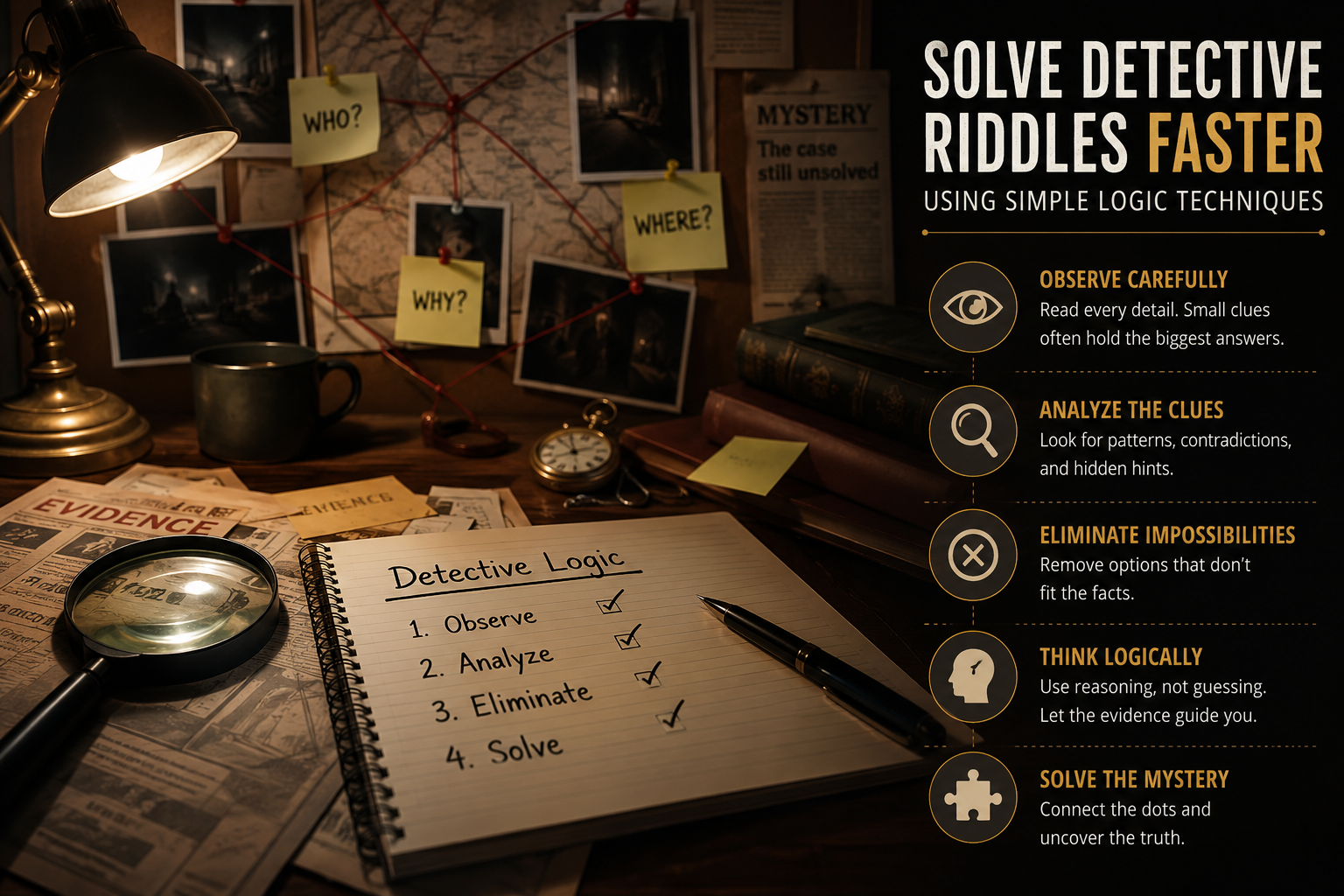
Have you ever finished reading a detective riddle, felt completely convinced you had the answer, and then discovered you were nowhere close?
Most people have.
That's what makes detective riddles so interesting. They rarely test how much information you know. Instead, they test how carefully you pay attention. A clue that seems unimportant at first can completely change the answer, while an obvious-looking detail might be there purely to distract you.
The good news is that solving detective riddles isn't a talent that some people are born with. Like any skill, it gets easier when you understand the process behind it. The people who solve mysteries quickly usually aren't making wild guesses. They're following a simple chain of logic and looking at the clues in a different way.
Whether you enjoy mystery detective riddles, detective riddles with answers, or online puzzle challenges, a few practical habits can help you reach solutions much faster.
Stop Looking for the Answer Immediately
A mistake many beginners make is trying to solve the mystery before they've fully understood it.
Imagine reading a story about a stolen diamond. Within seconds, your brain starts searching for the thief. Was it the butler? A family member? A stranger?
The problem is that once you form a theory, you start reading the remaining clues through that theory. Anything that supports your idea stands out. Anything that doesn't often gets ignored.
Good puzzle solvers do the opposite. They collect information first and build theories later.
Think of yourself as someone gathering evidence rather than someone trying to win a guessing game.
Treat Every Detail Like It Matters
One thing you'll notice after solving enough detective riddles is that writers love hiding important clues in ordinary sentences.
A line about muddy shoes.
A clock showing the wrong time.
A witness mentioning the weather.
Individually, these details don't seem important. Together, they often point directly to the solution.
When you read a riddle, slow down enough to notice these small pieces of information. Ask yourself why the writer included them. If a detail serves no purpose, there's a good chance it actually serves a very important one.
Learn to Question Assumptions
This is where many mysteries become surprisingly simple.
For example, if a story says a window was broken during a burglary, most readers immediately assume the thief entered through the window.
But did the riddle actually say that?
Maybe the window was broken afterward. Maybe it was unrelated. Maybe it was staged to mislead investigators.
Detective riddles often rely on assumptions that readers make automatically. The fastest way to improve is to separate what the story says from what you think it says.
That small shift in thinking can completely change how you approach a puzzle.
Pay Attention to What Feels Strange
Sometimes a clue doesn't fit naturally with the rest of the story.
Maybe everyone at a dinner party heard a loud noise except one person.
Maybe a witness remembers tiny details but forgets something important.
Maybe a suspect's explanation sounds reasonable, yet one small part doesn't quite add up.
Those moments are worth investigating.
In many detective riddles, the solution isn't hidden in the most dramatic clue. It's hidden in the clue that feels slightly out of place.
Think Like an Investigator, Not a Reader
Readers often focus on the story.
Investigators focus on evidence.
There's a difference.
Instead of asking, "Who did it?" ask questions such as:
-
What facts do I know for certain?
-
Which statements can be verified?
-
Is anyone making a claim that doesn't match the evidence?
-
What explanation requires the fewest assumptions?
These questions help cut through distractions and bring attention back to the clues that actually matter.
Experience Matters More Than Talent
People often assume that good riddle solvers are naturally gifted.
In reality, most of them have simply solved hundreds of puzzles.
Over time, you begin spotting familiar patterns. You notice misleading wording, false alibis, timeline errors, and hidden clues more quickly than before.
The process becomes less about luck and more about recognition.
That's why a mystery that seems impossible today might feel surprisingly easy six months from now.
Final Thoughts
The next time a detective riddle leaves you scratching your head, don't rush to find the answer. Read carefully. Look for assumptions. Question details that seem unusual. Most importantly, trust the clues more than your first impression.
The interesting thing about detective riddles is that the answer is usually hiding in plain sight. Once you start approaching puzzles with a logical mindset, you'll often wonder how you missed it the first time.
And that's part of the fun. Every solved mystery teaches you something that makes the next one a little easier.

 Czech
Czech
 Arabic
 French
 Spanish
 Portuguese
 Deutsch
 Turkish
 Dutch
Dutch
 Italiano
 Russian
 Romaian
 Portuguese (Brazil)
 Greek
Greek