


 About SPORTIVO Network
AI and Machine Learning in Sports Prediction: What the Technology Actually Does
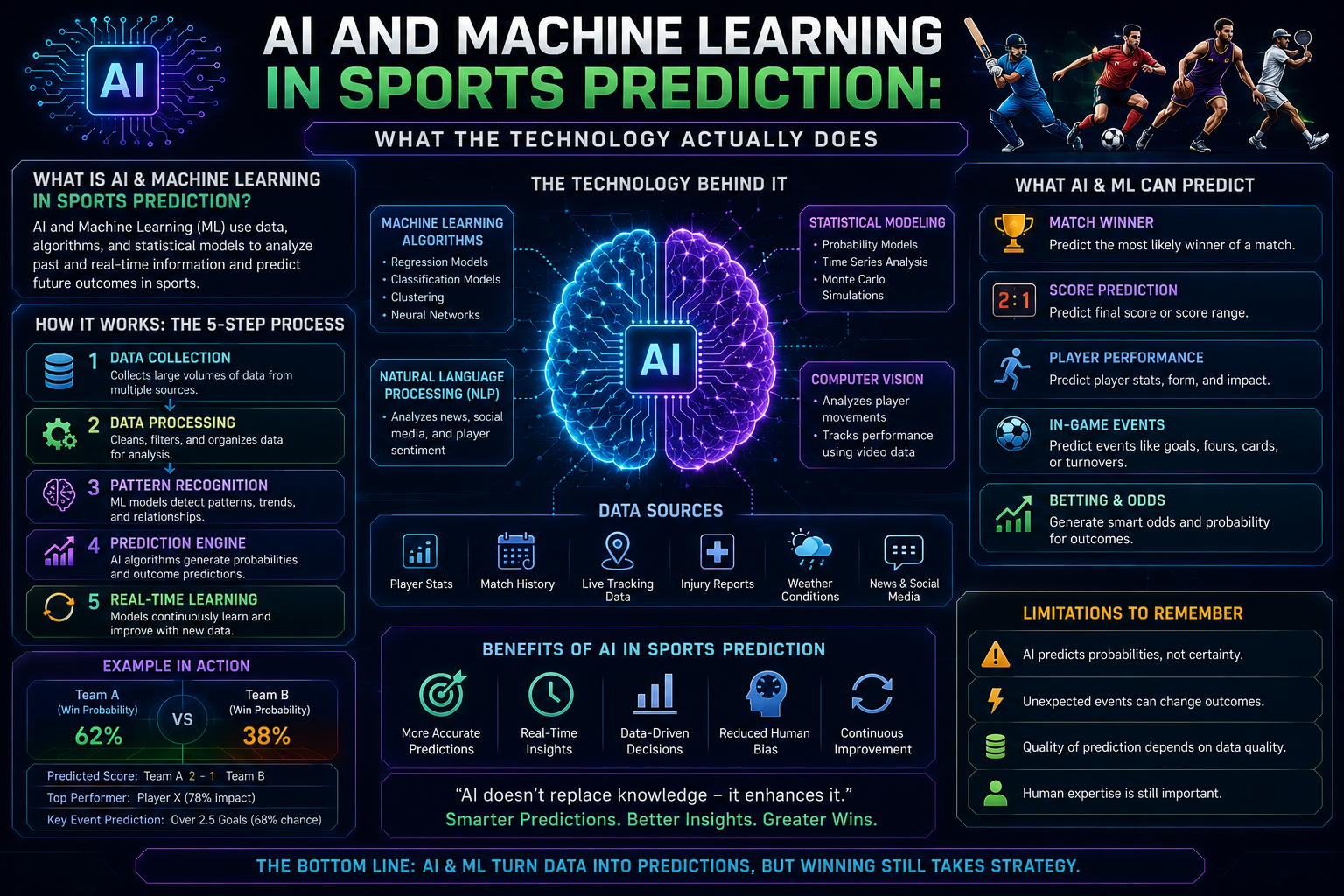
Artificial intelligence and machine learning have become ubiquitous terms in gaming platform marketing. Platforms routinely claim that their "AI-powered" recommendations will revolutionise your team selection, that their "machine learning algorithms" have uncovered unique statistical insights, and that their technology gives you an edge unavailable anywhere else.
Some of these claims are substantive. Others are marketing language attached to statistical techniques that have existed for decades. For players who want to understand what they are actually using when they engage with AI-assisted team selection tools, and for those evaluating platforms on the basis of their technology claims, this guide provides an honest, technically grounded account of what AI and machine learning do — and do not do — in sports prediction.
Lords exchange uses machine learning at several points in its platform experience, and this guide uses those specific implementations as concrete examples of what the technology actually achieves in practice.
What Machine Learning Actually Is in This Context
Machine learning, in the context of sports prediction, refers to statistical models that learn patterns from historical data and use those patterns to make predictions about future events. The term "AI" is often used interchangeably with "machine learning" in consumer contexts, though AI is a broader category.
The specific machine learning techniques used in sports prediction platforms include:
Regression models — Predict a continuous outcome (how many runs will a player score in the next match?) based on historical patterns in input variables (recent form, venue, opposition quality, weather). Linear regression is the simplest form; gradient boosting models (XGBoost, LightGBM) are the most commonly used high-performance variants in sports analytics.
Classification models — Predict a categorical outcome (will a player score above or below X runs?) as a probability. Classification models underpin the probability estimates in lords exchange's player recommendation interface.
Recommendation systems — Collaborative filtering and content-based filtering models that identify which contest types and player selections are most relevant to a specific player based on their history and the patterns of similar players.
Anomaly detection — Statistical models that identify unusual patterns in data, used both for fraud detection (unusual account behaviour) and for player intelligence (identifying when a player's recent performance represents a genuine form change versus statistical variance).
What Lords Exchange AI Tools Actually Do
Lords exchange's AI-assisted team selection uses gradient boosting models trained on historical IPL, international cricket, and other competition data to produce per-player expected score estimates for each upcoming match.
What these models actually do:
Input variables — The model receives as inputs: the player's recent form (rolling averages over 3, 5, and 10 match windows), historical performance at the specific venue, historical performance against the specific opposition, current team batting/bowling order position, pitch condition indicators, weather forecasts, player injury/rest history, and comparative team quality metrics.
Model output — For each player, the model outputs an expected fantasy point score and a confidence interval around that expectation. A player with a narrow confidence interval (the model is relatively certain) is a safer selection; a player with a wide interval has higher variance in either direction.
Calibration — The lords exchange model is regularly recalibrated as new match data becomes available, so the predictions reflect the most recent patterns rather than anchoring to older data that may no longer represent current form.
What these models cannot do:
Predict genuine randomness — A significant proportion of cricket outcomes is genuinely stochastic. No model can reliably predict which deliveries will produce edges to slip cordon versus clean drives through the covers. Models predict expected values, not individual event sequences.
Incorporate truly private information — Models built on publicly available data cannot incorporate information available only to team insiders (a player's private fitness concerns, a team selection decision not yet announced). Models that claim this capability are making claims that cannot be substantiated.
Replace domain expertise — A high-quality model is a tool that enhances the analytical process, not a substitute for cricket knowledge. Players who use model outputs in combination with their own domain expertise consistently outperform those who follow model recommendations mechanically.
The Limits of Historical Data in Sports Prediction
Machine learning models are only as good as the data they are trained on, and historical data has inherent limitations in sports prediction contexts:
Non-stationarity — Sports statistics are not stationary over time. A batsman's performance profile at age 24 may differ substantially from their profile at age 30. Tournament conditions change (T20 cricket has evolved significantly in the past decade, making data from 2014 less relevant to 2026 predictions than data from 2022). Models must weight recent data appropriately without discarding relevant longer-term patterns.
Sample size constraints — A player who has played 15 IPL matches has a statistically thin record for reliable performance modelling. Models applied to players with limited data should produce wider confidence intervals that reflect this uncertainty.
Context specificity — A player's performance record in the IPL is a better predictor of their next IPL performance than their Test cricket record, because the game context is more similar. Models that aggregate across context boundaries without controlling for context differences produce less reliable estimates.
Regime change events — A significant injury, a coaching change, a franchise trade, or a substantial technical change in a player's game can render historical data partially irrelevant. No model can automatically account for information about recent changes that has not yet been expressed in match performance data.
Lords exchange addresses these limitations by implementing separate models for different competition types (T20, ODI, Test), weighting recent data more heavily than older data through exponential decay functions, and providing confidence intervals that widen appropriately when player data is thin.
Responsible Use of AI Tools in Fantasy Sports
Using AI tools responsibly means understanding what they can and cannot contribute to your analytical process:
Use AI outputs as starting points, not conclusions — Model recommendations provide a useful quantitative baseline, but your domain knowledge (recent form impressions not yet captured in statistics, team selection rumours, pitch inspection observations) should modify that baseline.
Understand what the model is optimising for — Lords exchange admin AI recommendations are calibrated to minimise prediction error on expected fantasy points. They are not calibrated for differential value in large contest fields. You need to apply your own differential strategy analysis on top of model recommendations.
Track model performance — If you use AI-assisted selection systematically, track how model-recommended selections perform compared to your own deviations from those recommendations. This lets you identify where the model adds value and where your domain expertise outperforms it.
Maintain your own learning — Over-reliance on model recommendations atrophies your own analytical skills. Use the tools, but continue developing your own cricket analytical understanding independently.
Frequently Asked Questions
Does lords exchange AI have access to information that is not publicly available?
No. Lords exchange AI models are trained on publicly available historical match data and current public player information. They do not incorporate proprietary or insider information.
How accurate are lords exchange AI team recommendations?
Across a large sample, lords exchange AI-recommended selections produce above-average fantasy scores compared to the platform average, but the margin varies significantly by competition type and match uncertainty. The AI recommendations are useful tools; they do not guarantee top-field finishes.
Can AI guarantee profitable fantasy sports outcomes?
No. No AI system can guarantee profitable outcomes in skill gaming because a significant proportion of outcomes involves genuine stochastic variance that is not predictable regardless of analytical quality. AI tools improve the expected value of selections; they do not eliminate variance.
How often are the lords exchange AI models updated?
Model weights are updated weekly during active competition seasons to incorporate the most recent match data. The underlying model architecture undergoes major revision between major competition seasons.
Conclusion
AI and machine learning in sports prediction are genuine tools with genuine value — not magic, not false advertising, but rigorous statistical methods that process more data more consistently than human analysis can achieve alone. Lords exchange has built its AI capabilities with an honest view of what they can contribute: expected score estimates that improve average player selection quality, confidence intervals that communicate uncertainty honestly, and recommendation tools that enhance rather than replace player expertise. Players who understand what these tools actually do are better positioned to use them effectively — as one input in a broader analytical process, not as a replacement for the cricket knowledge and strategic thinking that distinguishes consistent fantasy sports performers.

 Czech
Czech
 English
 Arabic
 French
 Spanish
 Portuguese
 Turkish
 Dutch
Dutch
 Italiano
 Russian
 Romaian
 Portuguese (Brazil)
 Greek
Greek