


 About SPORTIVO Network
Why exhibitors are asking event organizers for better lead data
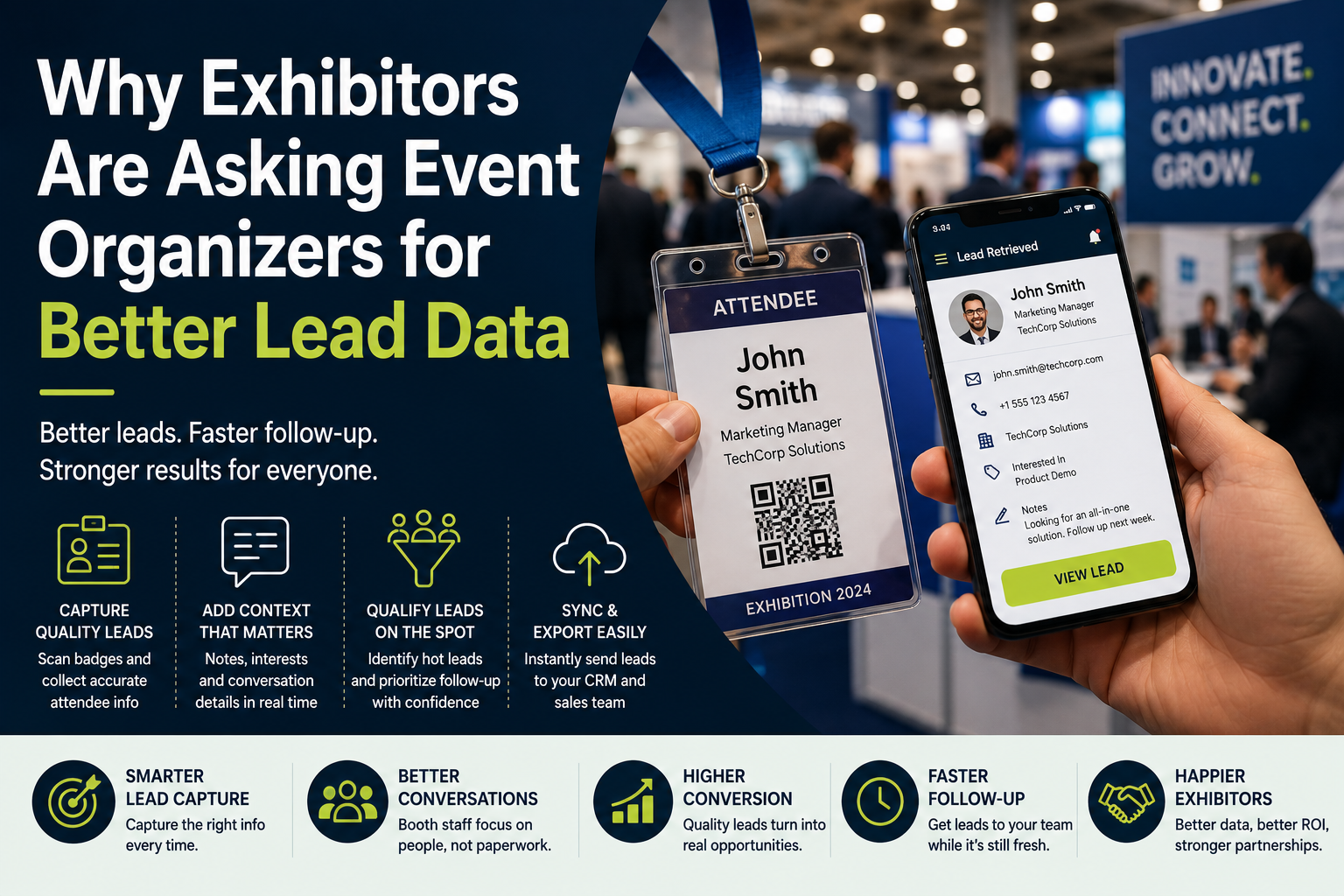
Exhibitors invest significant time and money in conferences, trade shows, and exhibitions.
They pay for booth space. Teams travel to the venue. Marketing materials are prepared. Product demonstrations are planned. Staff members may spend several days speaking with attendees.
When the event ends, one question becomes important.
What did we actually get from the event?
For many exhibitors, answering that question is harder than expected.
A busy booth may feel successful, but foot traffic alone does not tell exhibitors which conversations could turn into business opportunities.
This is why better lead data is becoming an important part of the exhibitor experience.
A badge scan is only the beginning
Scanning an attendee badge can make lead capture faster.
However, a list of names and email addresses provides limited context.
An exhibitor may speak with hundreds of attendees during a large trade show. A few days later, remembering the details of every conversation becomes difficult.
Who requested a product demonstration?
Which attendee was researching a solution for next year?
Who was an existing customer?
Which conversation required an immediate follow-up?
Without additional information, sales teams may receive a long contact list but little guidance about where to begin.
Modern lead retrieval software needs to help exhibitors capture context as well as contact information.
Paper forms create follow-up problems
Some exhibitors still use notebooks, business cards, or printed lead forms.
These methods can work for a small number of conversations.
At a busy booth, the process becomes harder to manage.
Business cards can be misplaced. Handwritten notes may be difficult to understand. Different booth staff members may record information in different ways.
The data also needs to be transferred into another system after the event.
By the time the information is organized, several days may have passed.
For sales teams, that delay can affect follow-up.
Exhibitors need to qualify leads during conversations
Not every booth visitor has the same level of interest.
One attendee may be actively evaluating a product.
Another may simply be curious about the booth.
A current customer may stop by to speak with their account manager.
Treating every interaction as an identical lead makes post-event follow-up less efficient.
A lead retrieval app can allow exhibitors to add notes or qualification details while the conversation is still fresh.
Depending on the event and lead capture setup, exhibitors may categorize a contact based on interest, follow-up priority, or another relevant factor.
This gives sales teams more information when they review event leads.
Faster follow-up requires organized event data
The days immediately following an event can be important for exhibitors.
Attendees may have spoken with several competing companies.
Their inboxes may quickly fill with event follow-up emails.
Exhibitors that spend days cleaning spreadsheets and organizing contact information may lose valuable time.
Structured lead data can make the handover from booth teams to sales teams easier.
Instead of trying to reconstruct conversations after the event, teams can review information captured during the interaction.
The objective is not to send more emails.
It is to help sales teams understand why a follow-up conversation may be relevant.
Lead retrieval affects the exhibitor experience
Event organizers often focus heavily on the attendee experience.
The exhibitor experience deserves similar attention.
Exhibitors are important stakeholders at trade shows and conferences. Their decision to return to a future event may depend partly on whether they believe their participation produced measurable value.
Providing an effective lead capture process can help organizers support this expectation.
Platforms such as Eventify include lead retrieval capabilities alongside event registration, attendee engagement, networking, and event analytics.
A connected approach can help event teams provide exhibitors with technology designed around the wider event environment rather than treating lead capture as an isolated activity.
More scans do not always mean better leads
Lead volume is an easy metric to measure.
An exhibitor captured 500 leads.
Another captured 1,000.
These numbers may look impressive, but they do not explain lead quality.
An exhibitor with 100 relevant conversations may generate more business value than a booth that scans every attendee walking past.
Event teams and exhibitors should be careful about treating the number of badge scans as the only measure of success.
Useful lead data should help answer deeper questions.
Were attendees genuinely interested?
What topics or products generated conversations?
Which leads require follow-up?
Did the event attract the audience exhibitors expected?
These insights provide more context than scan volume alone.
Exhibitors are becoming more data-focused
Marketing teams are under increasing pressure to understand the results of event participation.
Trade shows and conferences compete with other marketing investments for budget.
When event results are difficult to measure, defending future event spending can become harder.
This does not mean every booth conversation needs to be connected directly to immediate revenue.
Events can support brand awareness, partnerships, customer relationships, and long-term sales opportunities.
However, better lead data gives exhibitors more information to evaluate those outcomes.
Event organizers can help exhibitors demonstrate value
The relationship between organizers and exhibitors should not end when the exhibition floor closes.
Organizers can improve the exhibitor experience by considering how companies capture, organize, and use attendee interactions.
A practical trade show lead retrieval app can reduce manual data collection and give booth teams a more structured way to record conversations.
For exhibitors, the value is not simply scanning event badges faster.
The real value comes from leaving the event with clearer information about who they met, why the conversation mattered, and what should happen next.
For event organizers, helping exhibitors answer those questions may become increasingly important when encouraging sponsors and exhibitors to return for the next event.

 Czech
Czech
 Arabic
 French
 Spanish
 Portuguese
 Deutsch
 Turkish
 Dutch
Dutch
 Italiano
 Russian
 Romaian
 Portuguese (Brazil)
 Greek
Greek