


 About SPORTIVO Network
AI Readiness in 2026: What Every Business Leader Should Know
Imagine you are a business leader in 2026. Your competitors are using AI to answer customer questions, automate routine work, analyze data, and help employees make faster decisions.
You know your business should use AI too. But where do you start?
Buying an AI tool is easy. Making sure your business is ready to use that tool safely and effectively is much harder. This is where AI Readiness becomes important.
For businesses, being ready for AI is not only about having the latest technology. It is about having the right data, people, security, processes, and goals in place.
At Rubixe, we see AI as a business transformation opportunity, not simply another software investment. The companies that prepare carefully are more likely to get useful results from their AI investments.
What does AI Readiness mean in 2026?
AI Readiness means having the people, data, technology, processes, and security needed to adopt AI successfully. In 2026, it also means knowing where AI can create real business value and where it may not be the right solution.
Many leaders think AI readiness starts with choosing a model or buying an AI platform. In reality, the process should begin with a simple question.
What problem are we trying to solve?
For example, a company may want to reduce customer support response times. Another may want to automate repetitive office work. A recruitment business may want to find suitable candidates faster.
The technology should come after the business goal.
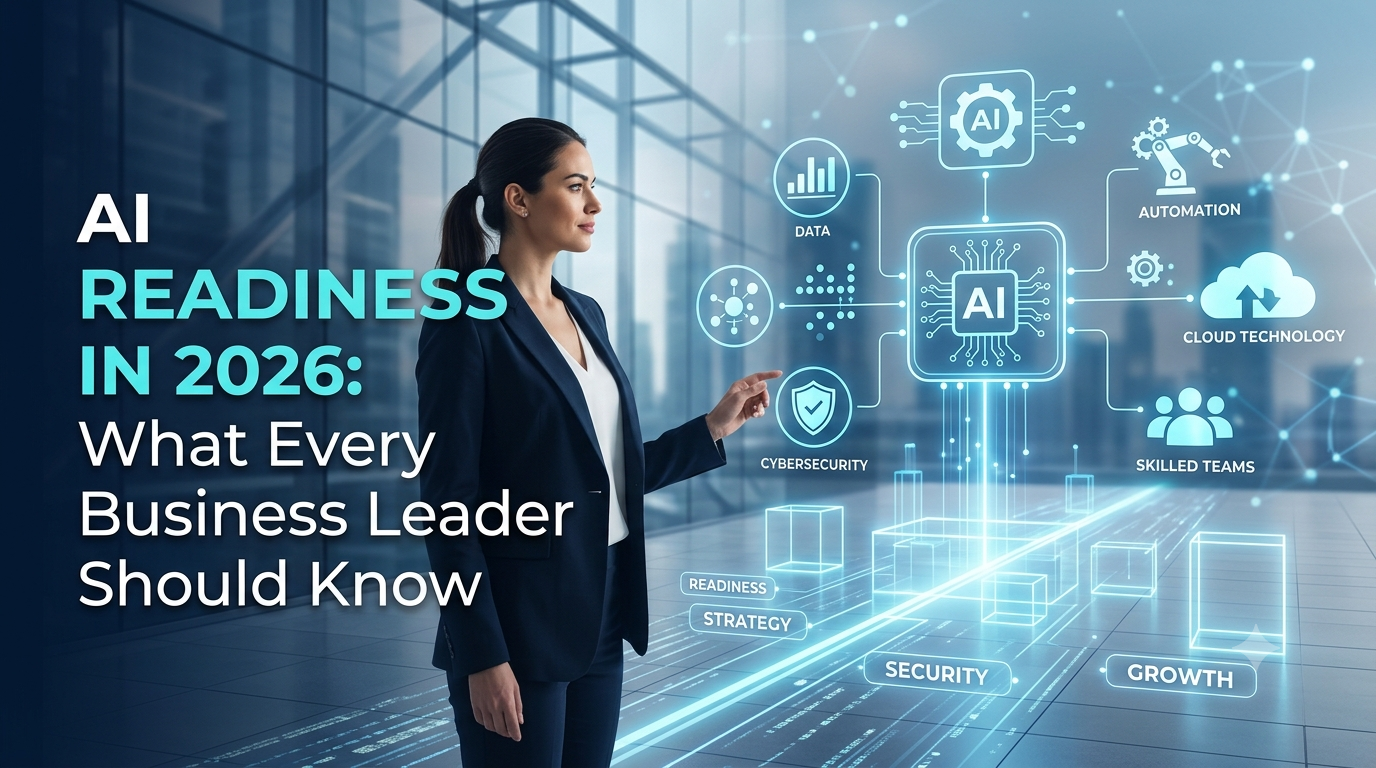
A strong AI strategy usually considers five areas:
-
Business goals and expected outcomes
-
Data quality and availability
-
Technology and infrastructure
-
Employee skills and AI Staffing needs
-
Security, privacy, and governance
A business that is strong in all five areas has a much better foundation for successful AI adoption.
Why is AI Readiness becoming more important for businesses?
AI is moving from experimentation into everyday business operations. Companies are now exploring AI for customer service, marketing, finance, operations, software development, recruitment, and decision support.
This creates both opportunities and risks.
A business may save time by automating a repetitive task. However, if the data is poor, the result may also be poor. If employees do not understand how to use the system, adoption may be low. If security is ignored, sensitive information could be exposed.
Research from McKinsey has shown that organizations are increasingly using generative AI across business functions, while many are still working to move from experimentation to meaningful business impact.
This is an important lesson for leaders. Using AI is not the same as using AI well.
The real goal is to build a business where AI supports people, improves processes, and creates measurable value.
How can an AI Readiness Assessment help your business?
An AI Readiness Assessment helps a business understand how prepared it is for AI adoption. It identifies strengths, gaps, risks, and areas that need improvement before major investments are made.
Think of it like checking a car before a long journey. You would check the fuel, tires, brakes, and engine before driving hundreds of kilometers.
The same idea applies to AI.
An assessment may examine:
|
Area |
Key Question |
What Leaders Should Check |
|
Data |
Is our data ready? |
Quality, access, accuracy, privacy |
|
Technology |
Can our systems support AI? |
Infrastructure, integrations, scalability |
|
People |
Do we have the right skills? |
AI knowledge, training, AI Staffing |
|
Security |
Can we protect AI systems? |
Access control, threats, data protection |
|
Processes |
Where can AI help? |
Repetitive tasks, workflows, bottlenecks |
|
Strategy |
Why are we using AI? |
Business goals, ROI, success measures |
The result should not simply be a technical report. It should help leaders make better business decisions.
What should an AI Readiness Audit check first?
An AI Readiness Audit should first examine business goals, data quality, technology, people, security, and governance. These areas form the foundation for responsible AI adoption.
A useful audit can help answer questions such as:
-
Which business problems are suitable for AI?
-
What data is available?
-
Is the data accurate and secure?
-
Which processes can be automated?
-
Do employees have the required skills?
-
What security risks could AI introduce?
-
How will success be measured?
One common mistake is starting with a technology instead of a problem.
For example, a company may purchase an expensive AI platform because it seems impressive. Later, the team discovers that its data is scattered across different systems and employees are not trained to use the platform.
The technology was not necessarily bad. The business simply was not prepared for it.
An AI Readiness Audit can help identify these gaps before they become expensive problems.
How do data and technology affect AI readiness?
Good AI depends heavily on good data and reliable technology. If your data is incomplete, outdated, or poorly organized, even advanced AI systems may produce unreliable results.
This is one of the most important lessons for business leaders in 2026.
Before adopting AI, businesses should understand:
-
Where their data is stored
-
Who can access it
-
How accurate it is
-
Whether it contains sensitive information
-
How different systems share data
-
How data quality is maintained
Technology infrastructure also matters.
An AI solution may need to connect with existing CRM systems, finance software, HR platforms, websites, or internal databases. If these systems cannot communicate properly, the AI project may become difficult to manage.
This is why AI and ML projects should be planned around real business systems, not developed in isolation.
Why is AI Cybersecurity essential in 2026?
AI Cybersecurity is essential because AI systems can introduce new security, privacy, and compliance risks. Businesses must protect both the AI system and the data it uses.
For example, employees may accidentally share confidential information with an AI tool. An attacker may try to manipulate an AI system. A poorly secured application may expose sensitive business data.
Leaders should consider:
-
Data privacy
-
Identity and access controls
-
Secure AI applications
-
Monitoring and logging
-
Third party vendor risks
-
Employee awareness
-
Compliance requirements
Security should not be added after an AI system is launched. It should be part of the planning process from the beginning.
This is especially important for businesses working with customer data, financial information, healthcare information, intellectual property, or other sensitive records.
AI can create value, but responsible use must remain a priority.
How important are people and AI Staffing in AI adoption?
People are just as important as technology. AI Staffing helps businesses find or build the talent needed to develop, manage, and use AI solutions effectively.
A business may have a strong AI strategy but still struggle if nobody knows how to implement it.
Depending on the project, businesses may need skills in areas such as:
-
Data science
-
Machine learning
-
AI engineering
-
Cloud technology
-
Cybersecurity
-
Data engineering
-
Automation
-
AI governance
However, not every business needs a large AI team.
Some companies may train existing employees. Others may hire specialists for specific roles. Some may work with external experts for complex projects.
The right approach depends on the company's size, budget, goals, and existing skills.
The important point is to plan for people early instead of treating talent as an afterthought.
Where can AI Consulting help business leaders?
AI Consulting can help leaders identify practical AI opportunities, choose suitable technologies, and create a roadmap for adoption.
A good consulting process should begin with the business, not the technology.
For example, imagine a mid sized company that receives thousands of customer emails every month. The leadership team wants to use AI to improve support.
A consultant might first study the current workflow. They may discover that employees spend most of their time answering the same ten questions.
Instead of building a complex AI system immediately, the business could start with a focused solution that helps classify requests and suggest responses.
This smaller project could then be measured using clear goals such as:
-
Faster response times
-
Reduced repetitive work
-
Better employee productivity
-
Improved customer satisfaction
This approach reduces unnecessary risk and creates a clearer path to growth.
How does Automation fit into AI readiness?
Automation helps businesses reduce repetitive manual work, while AI can make automated processes more flexible and intelligent. Together, they can improve speed, efficiency, and consistency.
However, businesses should not automate every process.
A good candidate for automation is usually repetitive, rule based, time consuming, and easy to measure.
Examples include:
-
Moving data between systems
-
Generating routine reports
-
Sorting customer requests
-
Scheduling tasks
-
Processing simple documents
-
Sending routine notifications
AI can add another layer by helping systems understand text, summarize information, classify requests, or support decisions.
The key is to improve a process before automating it.
Automating a broken process can simply make the problem happen faster.
What are the biggest AI readiness mistakes leaders should avoid?
The biggest mistakes include starting without a clear goal, ignoring data quality, underestimating security risks, and focusing only on technology.
Here are some common mistakes:
1. Starting with hype
Not every new AI tool will solve a meaningful business problem.
2. Ignoring employees
People need training and support to use AI effectively.
3. Treating security as an afterthought
AI systems need strong security and clear rules from the beginning.
4. Expecting instant ROI
Some AI projects may show quick benefits. Others require testing, improvement, and time.
5. Trying to transform everything at once
Starting with one focused use case can be safer and easier to measure.
6. Forgetting human oversight
AI can make mistakes. Important decisions may still require human review.
Leaders who understand these limitations are better positioned to make responsible decisions.
What should businesses do to become AI ready in 2026?
Businesses should start with a clear roadmap that connects AI investments to measurable business goals. The best approach is usually to assess the current situation, identify opportunities, test small projects, and scale what works.
A practical roadmap could look like this:
Step 1: Define the business problem
Identify the challenge you want to solve.
Step 2: Review your current capabilities
Examine data, systems, people, processes, and security.
Step 3: Complete an AI Readiness Assessment
Identify gaps that could prevent successful adoption.
Step 4: Prioritize use cases
Choose opportunities based on business value, cost, risk, and feasibility.
Step 5: Run a pilot
Start small and measure the results.
Step 6: Improve and scale
Learn from the pilot before expanding across the organization.
Step 7: Monitor continuously
AI systems need regular review because business needs, technology, and risks change over time.
This approach helps businesses avoid large investments based on assumptions.
What does the future of AI readiness look like?
AI readiness will become an ongoing business capability rather than a one time project. As AI becomes part of everyday operations, companies will need to continuously review their skills, systems, data, security, and processes.
The future will not belong only to companies with the biggest AI budgets.
It will also belong to companies that know how to use AI responsibly and effectively.
A small business with clean data, trained employees, secure systems, and a clear goal may achieve better results than a larger company that adopts AI without preparation.
This is where Rubixe can support organizations exploring AI Consulting, AI Cybersecurity, Automation, AI and ML solutions, and AI Staffing. The focus should always remain on solving real business problems and building practical AI capabilities.
Frequently Asked Questions About AI Readiness
What is AI Readiness?
AI Readiness is the level of preparation a business has for adopting and using AI successfully. It includes data, technology, people, processes, security, and business strategy.
Why is an AI Readiness Assessment important?
An AI Readiness Assessment helps identify gaps before a business invests heavily in AI. It can reveal problems related to data, infrastructure, skills, security, and business goals.
What is an AI Readiness Audit?
An AI Readiness Audit is a structured review of a company's ability to adopt AI. It examines areas such as data quality, technology, employee skills, security, governance, and potential use cases.
Does every business need an AI team?
No. The right approach depends on the company's goals and resources. Some businesses may train existing employees, while others may use AI Staffing or external specialists for specific needs.
Can AI guarantee business growth?
No. AI does not guarantee growth. Results depend on factors such as data quality, implementation, employee adoption, business strategy, and ongoing management. AI should be viewed as a tool that can support business outcomes when used correctly.
Final Thoughts
AI is changing how businesses work, but successful adoption starts long before the technology is deployed.
In 2026, leaders should ask a simple question: Are we truly prepared to use AI, or are we simply excited about it?
The answer requires an honest look at data, technology, people, security, and business goals.
A strong AI strategy does not begin with buying the newest tool. It begins with understanding the business, identifying the right opportunities, preparing the organization, and measuring results.
For leaders planning their next step, an AI Readiness Assessment can be a practical starting point. It can help turn uncertainty into a clear roadmap and help businesses move from AI curiosity to responsible action.
The future of AI belongs to businesses that are prepared to use it wisely, safely, and with a clear purpose.

 Czech
Czech
 Arabic
 French
 Spanish
 Portuguese
 Deutsch
 Turkish
 Dutch
Dutch
 Italiano
 Russian
 Romaian
 Portuguese (Brazil)
 Greek
Greek