


 About SPORTIVO Network
Why Should I Learn How to Say "Happy Birthday" in Japanese?
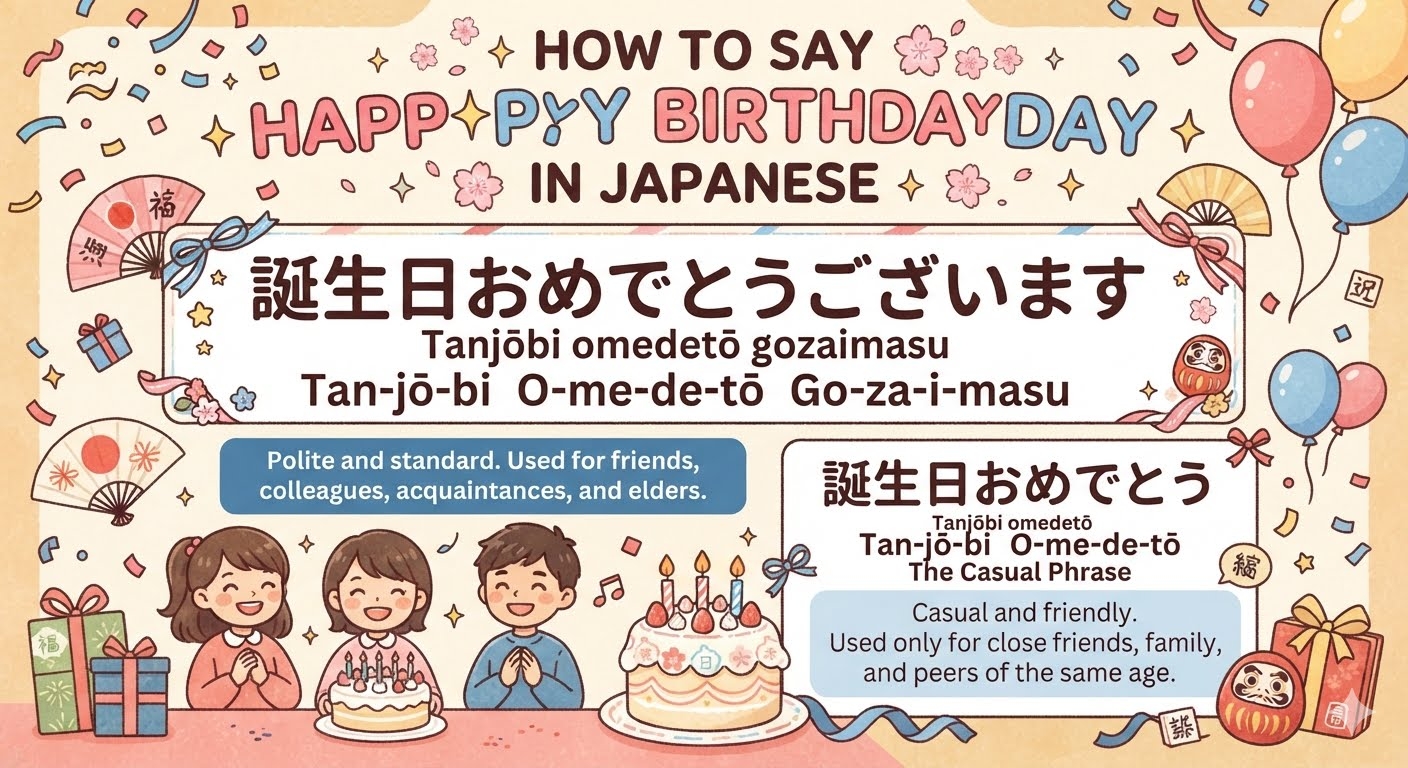
Learning a single phrase in another language might seem like a small thing. It's not a full conversation, it won't get you through a job interview, and it certainly won't make you fluent. But "Happy Birthday" Otanjoubi omedetou (お誕生日おめでとう) is one of those rare phrases that punches far above its weight. Here's why it's worth adding to your vocabulary, even if you never plan to study Japanese seriously.
It's a Low-Effort, High-Reward Phrase
Most language learning requires sustained effort: grammar rules, verb conjugations, vocabulary drills. Learning to say "Happy Birthday" requires none of that. It's a single, memorable phrase you can learn in minutes and use for the rest of your life. Few investments in language learning offer that kind of return. You say five words, and you get instant, visible impact: a smile, a moment of surprise, a connection.
It Signals Genuine Effort and Care
When you say "Happy Birthday" to someone in their native language, you're communicating something beyond the words themselves. You're telling them: I thought about you specifically. I didn't just default to the easiest option. This matters enormously in cross-cultural friendships, workplaces, and families. If you have Japanese friends, colleagues, in-laws, or pen pals, a birthday message in their language shows a level of thoughtfulness that a generic "Happy Birthday!" simply can't match. It's a small gesture that often gets remembered far longer than you'd expect.
How to Say Happy Birthday in Japanese
Learning how to say Happy Birthday in Japanese is a wonderful way to celebrate someone’s special day with cultural appreciation. The most common phrase is お誕生日おめでとう (Otanjoubi Omedetou), while the more polite version is お誕生日おめでとうございます (Otanjoubi Omedetou Gozaimasu). Whether you're greeting a friend, family member, or colleague, using these expressions can make your birthday wishes more meaningful and memorable.
It Opens a Door Into Japanese Culture
Birthdays aren't celebrated the same way everywhere, and learning how the Japanese approach birthdays gives you a small but genuine window into the culture. Traditionally, birthdays in Japan were less central than in Western countries for centuries; everyone's age advanced together on New Year's Day, a system called kazoedoshi, rather than each person aging up on their own birthday. Modern Japan has fully embraced individual birthday celebrations, complete with cake, parties, and gifts, but that history reveals something about how differently the same universal life event can be understood across cultures. One phrase becomes a doorway to a much bigger, more interesting conversation.
It's a Natural Entry Point Into Language Learning
If you've ever wanted to learn Japanese but felt intimidated by the writing systems (hiragana, katakana, and kanji) or the grammar, starting with a phrase like this is a gentle, low-pressure way in. You get to experience small wins learning to pronounce a phrase correctly, understanding its structure, maybe even learning to write it without committing to years of study. Many people who eventually become serious language learners started with exactly this kind of small, practical phrase that had real-world use.
Understanding the phrase itself also teaches you something about how Japanese works. Omedetou is a general word for "congratulations," used not just for birthdays but for graduations, weddings, and other happy milestones. Attach it to different words: Akemashite omedetou for New Year, Sotsugyou omedetou for graduation, and you start to see a pattern. Suddenly, one phrase has taught you a reusable structure you can apply elsewhere.
It Helps You Stand Out
In a world where translation apps can produce a passable "Happy Birthday" in seconds, actually knowing the phrase yourself and being able to say it confidently, without pulling out your phone, carries more weight. It shows initiative. It shows you value the relationship enough to commit something to memory. This applies whether you're building a friendship, strengthening a business relationship with Japanese partners, or simply trying to be a more thoughtful global citizen.
It's Part of Being a More Curious, Connected Person
There's also a broader case to be made here: learning small phrases in other languages, collected over time, makes you a more curious and connected person. Each phrase is a tiny piece of cultural literacy. Knowing how to greet someone, thank them, or wish them well in their own language even if you can't hold a full conversation signals openness and respect for a wider world. Over a lifetime, these small phrases add up to something meaningful: a genuine, if modest, fluency in showing care across cultural lines.
The Takeaway
You don't need to become fluent in Japanese to make someone's day. Learning Otanjoubi omedetou costs you almost nothing a few minutes of practice but it can mean a great deal to the person who hears it. It's respectful, memorable, culturally interesting, and a genuinely easy way to build a bridge, however small, between yourself and someone else's world. Sometimes the most meaningful language learning isn't about mastering grammar; it's about knowing exactly the right five words to say, at exactly the right moment.

 Czech
Czech
 English
 Arabic
 French
 Spanish
 Deutsch
 Turkish
 Dutch
Dutch
 Italiano
 Russian
 Romaian
 Portuguese (Brazil)
 Greek
Greek