


 About SPORTIVO Network
How to Calculate the Volume of a Box for Packaging and Shipping
To get a parcel ready to ship sounds straightforward. But only until you realise you have no idea whether the box is the right size for what is going inside. Too big and the product moves around. The packaging is too small and nothing fits. In the both scenarios it costs money and create problems.
Knowing how to calculate the volume of a box is the most practical skill a business owner can have. It takes thirty seconds once you know formula. It saves a significant amount of time, cost, and packaging waste.
What Is Box Volume and Why Does It Matter
Volume is the amount of three dimensional space inside a box. In packaging terms, it tells you exactly how much room is available for the product and any protective material around it.
Getting volume right matters for several reasons:
- It ensures the product fits without excessive movement.
- It helps calculate the right amount of void fill or padding needed.
- It directly affects dimensional weight charges applied by UK couriers.
- It reduces packaging waste by avoiding unnecessarily oversized boxes.
The Three Measurements You Need
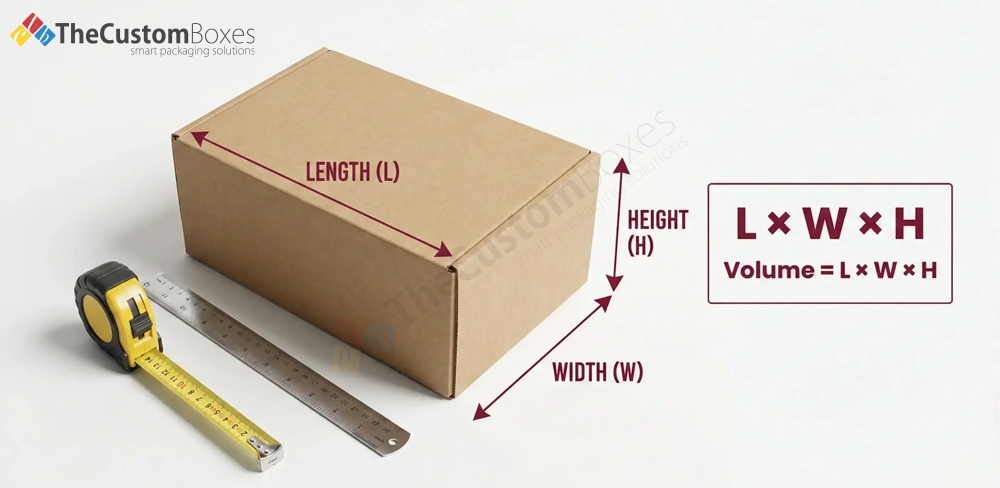
To work out how to determine the volume of a box, you need exactly three measurements. Nothing more.
Those measurements are:
- Length, the longest side of the box.
- Width, the shorter side measured from the same viewpoint.
- Height, how tall the box stands upright.
Always measure the internal dimensions if you are checking whether a product fits inside. Use external dimensions when calculating courier charges as carriers typically work from the outside of the box.
Measure everything in the same unit. Centimetres for metric calculations, inches if working in imperial. Mixing units is the most common mistake people make and it throws every result off completely.
The Formula: How Do We Calculate Volume of a Box
Below is the formula written simply.
V = L x W x H
Multiply the three measurements together. And the result is the volume expressed in cubic units. Cubic centimetres if measuring in centimetres. Cubic inches if measuring in inches.
Example:
Say a box measures
- 40 cm long.
- 25 cm wide.
- And 20 cm tall.
Multiply L x W x H. The volume of box is 20,000 cubic cm.
This is how do you figure volume of a box every single time re. The numbers change but process stays identical.
Length Width Height Box: Getting the Order Right
One question that comes up regularly is whether the order of the measurements matters. For the volume calculation itself, it does not. Multiplying length by width by height gives the same result regardless of which order you work in.
Where the length width height box order does matter is in courier and packaging specifications. Most custom packaging suppliers list dimensions as first length, then width and height.
How Do I Calculate the Volume of a Box for Courier Pricing
UK couriers use dimensional weight pricing, sometimes called volumetric weight, to calculate shipping charges for larger but lighter parcels.
The dimensional weight formula used by most UK carriers is:
Length x Width x Height divided by 5,000 for cm measurements.
If the dimensional weight is higher than the actual weight of the parcel. The courier charges based on the dimensional weight. This is why oversized boxes can cost more to ship than well fitted ones. Even when the product inside is light.
Knowing how to calculate the volume of a box accurately helps businesses choose packaging that keeps those charges as low as possible.
The Custom Boxes works with UK businesses to find packaging in the right dimensions for their products, reducing both material costs and shipping charges through better fitted boxes.
A Quick Reference Summary
|
Measurement |
What It Means |
Where to Measure |
|
Length |
Longest horizontal side |
Internal for fit, external for shipping |
|
Width |
Shorter horizontal side |
Internal for fit, external for shipping |
|
Height |
Vertical measurement |
Internal for fit, external for shipping |
|
Volume |
L x W x H |
Always in consistent units |
Conclusion
Understanding how to determine the volume of a box is a genuinely useful skill that saves businesses time and money every single day. The formula is simple. The application is immediate. And the impact on packaging costs and product protection is real.
Whether the challenge is finding the right box size for a new product or reducing courier costs through better fitted packaging, starting with accurate volume calculations puts everything else on a much stronger footing.
Get in touch with The Custom Boxes today for help finding packaging built around the exact dimensions your products need. It is a straightforward conversation that makes a practical difference from the very first order.
Frequently Asked Questions:
How to calculate the volume of a box?
First multiply the box's length × width × height using the same unit. The result is the box volume in cubic units.
Should I measure the inside or outside of the box?
Use the internal dimensions to check product fit. And the external dimensions when calculating shipping or courier costs.
Why is box volume important for shipping?
Accurate box volume helps reduce shipping costs. It improves product protection and prevents paying for unnecessary space.
Can the right box size save money?
Yes, A well sized box uses less packaging material, lowers charges, and reduces the risk of damage during transit.
Where can I get expert guidance on choosing the right box size?
The Custom Boxes helps businesses select the right packaging dimensions. This makes shipping more efficient. And reducing waste and unnecessary costs.

 Czech
Czech
 Arabic
 French
 Spanish
 Portuguese
 Deutsch
 Turkish
 Dutch
Dutch
 Italiano
 Russian
 Romaian
 Portuguese (Brazil)
 Greek
Greek