


 About SPORTIVO Network
Website Speed & Core Web Vitals for Dubai Real Estate Websites: What They Mean and Why They Cost You Leads
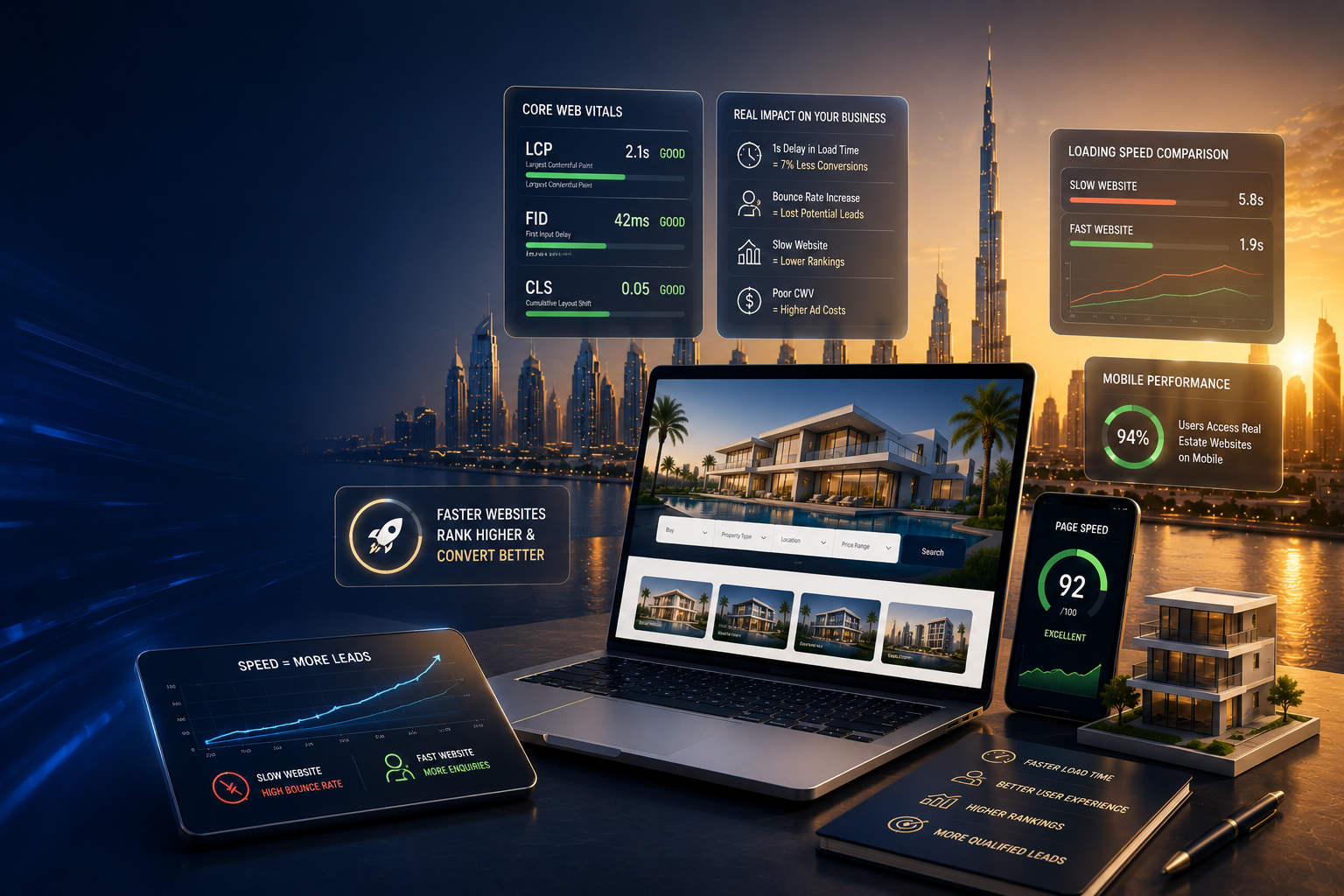
When Dubai property businesses evaluate web design cost in Dubai, they typically focus on design quality and listing features. Almost nobody asks about Core Web Vitals, the performance metrics Google uses to rank websites. Yet for a real estate website where a buyer is browsing multiple listings on mobile, a 2-second difference in load time can be the difference between a lead and a bounce. This blog explains what these metrics mean, why they matter specifically to property websites, and exactly how to fix them.
Picture this: a potential property buyer in Dubai searches "2-bedroom apartment for sale in JVC" on their phone. Google returns 10 results. They tap the first one. It takes 6 seconds to load. They tap back immediately and try the second link. That second link is your competitor's website, and it loads in 2.1 seconds. The lead is gone before a single photo has loaded.
This happens thousands of times a day across Dubai's property market, and most real estate businesses have no idea it's costing them qualified buyers. Core Web Vitals are the reason, and understanding them gives you a direct competitive edge.
What are Core Web Vitals?
Core Web Vitals are a set of three specific performance metrics that Google officially uses as ranking factors. Introduced in 2021 and continuously updated, they measure real-world user experience, not just raw speed. Here's what each one means for a real estate website:
Why real estate websites in Dubai fail Core Web Vitals more than most
Property websites have specific characteristics that make them inherently harder to optimise for Core Web Vitals:
Large, high-resolution property images: Buyers expect to see crystal-clear photos of apartments, villas, and floor plans. Uncompressed, these images are 3–8MB each. A listing page with 15 photos that haven't been converted to WebP format will have an LCP score well above 4 seconds, a failing grade in Google's eyes.
Heavy map integrations: Google Maps or custom property map layers add significant JavaScript that must be loaded, parsed, and executed before the page feels interactive. Poorly implemented map scripts are the #1 cause of INP failures on Dubai real estate portals.
Dynamic listing feeds: When listing data is pulled from an API (Bayut, Property Finder, or a CRM), it often causes layout shifts as content loads asynchronously, directly causing CLS failures.
Video background headers: Many Dubai developer websites use auto-playing video headers to showcase properties. These add enormous page weight and consistently destroy LCP scores unless served from a CDN and lazy-loaded properly.
How Dubai real estate sites typically score, and where the gaps are
7 fixes that actually improve Core Web Vitals on Dubai property websites
A real result from Dubai's property market
A Dubai property developer's website had a PageSpeed score of 31 on mobile, well into the failing range. High-resolution renders of off-plan units, an unoptimised Google Maps embed, and a video header were the culprits. BootesNull ran a full Core Web Vitals audit, converted all images to WebP, lazy-loaded the map, replaced the mobile video header with a static image, and moved the site to LiteSpeed hosting. The PageSpeed score rose to 84. Organic traffic increased 28% over the following 90 days as rankings improved, and average session duration increased by 41 seconds as pages that previously showed blank screens while loading now appeared almost instantly.
FAQs
Q1. How do I check my real estate website's Core Web Vitals right now?
Go to pagespeed.web.dev, enter your URL, and run the test on mobile. Google will show you your LCP, INP, and CLS scores with a pass/fail rating and specific recommendations. Do this for your homepage and your most important listing page, they often have very different scores.
Q2. Do Core Web Vitals actually affect my Google rankings for Dubai property searches?
Yes, Google confirmed Core Web Vitals as a ranking signal in 2021 and has strengthened their weight since. For competitive searches like "apartments for sale in Dubai Marina," the difference between a passing and failing score can mean several positions in rankings, which in real estate translates directly to lead volume.
Q3. Is it worth spending on Core Web Vitals if I'm already running Google Ads?
Absolutely, for two reasons. First, Google Ads Quality Score is partially influenced by landing page experience, which includes load speed. A faster page reduces your cost-per-click. Second, every organic lead from improved rankings costs you nothing in ad spend. The two channels compound each other.
Q4. How often do Core Web Vitals thresholds change?
Google updates them periodically. The most recent significant change was replacing FID with INP in March 2024. Subscribe to Google Search Central Blog for updates, or ask your web agency to flag any threshold changes that affect your site's status.
Q5. Can improving Core Web Vitals hurt my website's design?
Not if done correctly. Most Core Web Vitals optimisations are invisible to the visitor; image compression, code deferral, and hosting upgrades improve what's happening behind the scenes without changing what the user sees. The only trade-off is video headers on mobile, where a static image is genuinely better for both performance and user experience.
Dubai's property buyers are impatient, mobile-first, and comparing multiple sites simultaneously. A slow real estate website doesn't just rank lower on Google; it loses buyers in the first 3 seconds before they've seen a single listing. Understanding web design cost in Dubai means including performance optimisation in your budget from day one, not as an afterthought when you notice your rankings have dropped.

 Czech
Czech
 English
 Arabic
 French
 Portuguese
 Deutsch
 Turkish
 Dutch
Dutch
 Italiano
 Russian
 Romaian
 Portuguese (Brazil)
 Greek
Greek