


 About SPORTIVO Network
Transform Modern Landscapes with a Durable FRP Rectangular Planter
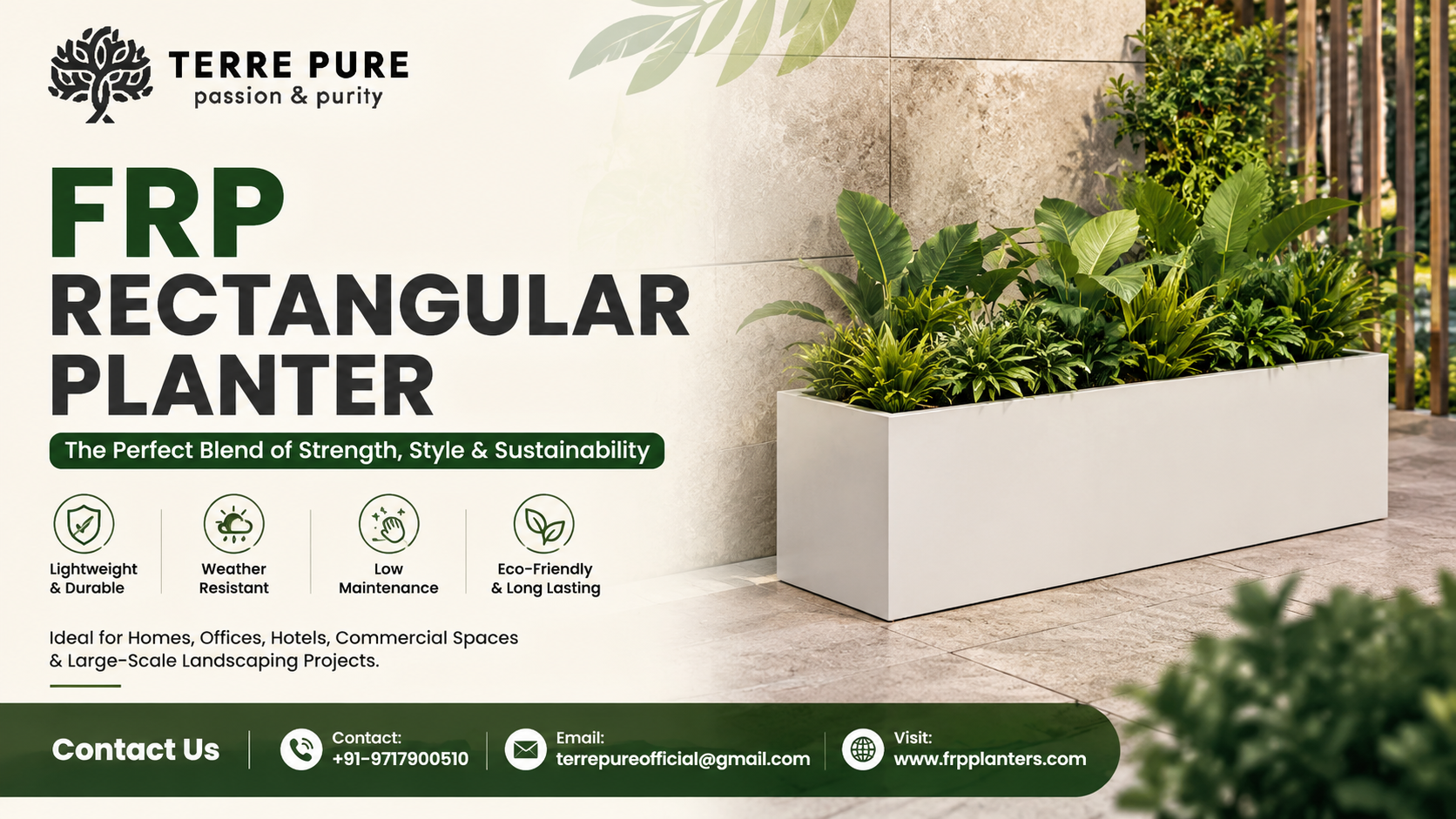
A landscape design firm in Bengaluru specced terracotta planters for a villa project in 2022. By the second monsoon, four of the twelve had hairline cracks running from the drainage hole up the side wall. The replacement order went to FRP instead, and none have cracked since. That's the quiet reason FRP Rectangular Planter units keep showing up in commercial and premium residential landscaping briefs — they solve for the failure mode nobody budgets time to think about until it's already happened. Most buyers evaluate planters on how they look in a showroom. Very few evaluate them on how they'll behave after eighteen months outdoors, and that's exactly the gap this material was built to close.
Let's get into what actually determines whether a planter holds up or falls apart.
The Layup and Finish Details That Actually Matter
Two planters can look identical on a shelf and behave completely differently after a year outside. The difference is almost never visible from the outside.
Material Layup
An FRP Rectangular Planter is built from woven fibreglass matting saturated with polyester or vinyl ester resin, cured, then finished with a UV-stabilised gel coat. For outdoor commercial applications, wall thickness should run 4–6mm; anything thinner tends to flex under sustained soil pressure and stress-crack at the corner joints — corners fail before flat panels do, which catches most buyers off guard.
Available Formats
Rectangular planters: generally between 20-inch smalls and 60-inch-large retailer and hospitality landscaping, but is individually fabricated to the architect and landscaper’s requirements. Coat finishes: matte, gloss, stone textured, metallic powder-style. However, gloss finish reveals surface defects more visibly in large panels than a matte finish.
What Gets Missed at the Ordering Stage
Base drainage design relative to the actual planting medium. A planter with the right dimensions and finish can still waterlog and kill root systems if the drainage hole count and placement weren't matched to the soil mix and irrigation method planned for the site. Request a drainage spec sheet before production starts, not after installation.
Five Checks Before You Sign a Purchase Order
Don't evaluate a supplier on their brochure. Evaluate them on how specifically they answer these five questions.
-
What resin type and fibreglass ratio do you use? A bad answer is "premium quality materials." A supplier worth working with names the resin type and ratio without needing to check with someone else.
-
What's the expected UV fade timeline? A bad answer is "our finish is fade-resistant, full stop." Every gel coat degrades under sun exposure eventually — an honest supplier gives you a realistic timeline and the stabiliser they use to extend it.
-
What's your process if a shipment arrives damaged? A bad answer is "we'll figure it out together." That's not a policy, it's a delay waiting to happen once the shipment is already at your site.
-
Can I see a completed project of comparable scale? A bad answer is a rendered image instead of a photograph. If there's no real installation to point to, that tells you something about their actual order history.
-
What's your realistic lead time at current capacity? A bad answer is a fixed number that doesn't change with order size or season. Lead time shifts with backlog — a supplier who won't discuss that isn't giving you real information.
What This Material Protects on Your Side of the Deal
The designers are concerned about how a particular planter looks. The buyers and procurement department are concerned about the impact to the purse and subsequent standing with the client when six months have gone by.
Most FRP planters are 60-70 % lighter than similar-sized terra-cotta or concrete planters, substantially reducing the freight bill on high-volume orders and eliminating the structural weight issue for installation on balconies or rooftops. The UV-stabilised gel coating maintains the exact colour much longer than site-painted metal or fibre-cement, curbing the early repaint cycle that can erode profit margins on large multi-year hospitality projects. Cast mould manufacturing also achieves a more precise dimensional standard from batch to batch than hand-cast stone, desirable on projects where fixed spacing is specified on the architectural drawings. Maintenance expenses become close to zero after the plant‘s installation, owing to the absence of a chemical sealing or repainting cycle that comes with terra-cotta or finished-metal, a significant benefit for hotel developers responsible for the ongoing facility operating costs. Its non-absorptive matrix, also helps to prevent the tendencia la roca a una fisuración de congelación in in in the northern india in in in.
A trade-off that should be mentioned directly: gel coat scuffs when exposed to prolonged abrasive contact, hence FRP isn‘t ideal in areas with high-traffic loading environments, such as trolley bays. Use reinforced concrete or metal that can stand that
Sourcing Decisions: Why the Manufacturer's Location Isn't a Footnote
When buyers are looking for the right FRP Rectangular Planter suppliers in India, they often ignore the location right until the delivery arrives a few days late.
Packaging will be easy, as manufacturing is concentrated around Delhi NCR, Gujarat and Maharashtra; most factory will be within a two to four days freight window around large metro project locations (which could be a saving if planting time is pegged to an event or handover date). For international orders with buyers sourcing FRP Rectangular Planters from India, a west-coast port proximity will shorten the container transit time in comparison to using an inland-only plant.
Another regional anomaly for the hardened connoisseur: prolonged humidity gradients impact how well gel coat sets, an imaginative factory without dedicated climate-monitoring curing rooms will produce two clearly different sets of surface textures, same mould, monsoon vs. dry. Might be worth following up on directly.
About Us
We started manufacturing FRP planters in 2013 from a single facility, and today we operate 3 production units shipping to 31 countries. What we've learned came mostly from getting things wrong early and fixing them. In 2021, three buyers in Gulf-region markets flagged premature fading on a batch using our older polyester resin — we switched to a vinyl ester formulation with higher UV stabiliser content and held pricing steady on existing contracts through the transition, even though the new resin cost more per unit. Our quality inspection team still rejects around 4% of finished pieces before they ever reach packaging, not because the mould failed but because getting gel coat consistency right at scale is genuinely difficult, every batch. We'd rather absorb that loss internally than let a flawed unit become someone else's installation problem.
Request Your Quote — Here's What to Send Us
Email your required dimensions, quantity, finish preference, and intended installation setting to our team at . Custom rectangular orders carry a 20-unit MOQ; standard catalogue sizes ship with no minimum order. We return a formal quote with a realistic lead-time estimate within 24 business hours, and we'll send a physical gel coat sample before you commit to full production. That's the standard we hold ourselves to at FRP Planters, order after order.
Conclusion
A well-specified FRP Rectangular Planter earns its cost in the years after installation, not in how it photographs on delivery day. Get the wall thickness, resin grade, and supplier accountability right upfront, and the replacement calls simply stop coming. The next landscape project that treats this as a structural decision instead of a cosmetic one will be the one still standing unchanged in five years.
FAQs
How is an FRP Rectangular Planter different from a moulded fibreglass pot?
The construction process — FRP specifically refers to fibreglass layers reinforced with resin in a controlled layup, which generally produces stronger, more consistent walls than a simpler moulded fibreglass piece.
What load can an FRP Rectangular Planter handle once filled with soil?
It depends on wall thickness and base reinforcement, but a properly built 36-inch unit generally handles 60–80kg of filled soil without stress cracking. We'd rather you check the spec sheet for your exact size than rely on a general number.
Do FRP Rectangular Planter manufacturers in India support custom colour runs?
Most do, though custom gel coat colours usually require a minimum batch size to justify the mixing cost — confirm that threshold before finalising a bespoke shade.
Is an FRP Rectangular Planter a good fit for rooftop installations?
Yes, and it's one of the stronger use cases given how much lighter it is than concrete — just verify the base reinforcement rating against your filled weight before ordering.
How does pricing compare to concrete planters over time?
FRP typically costs more upfront but less over a five-year window once concrete's repair and replacement costs are factored in — worth running the actual numbers for your project rather than assuming either way.

 Czech
Czech
 Arabic
 French
 Spanish
 Portuguese
 Deutsch
 Turkish
 Dutch
Dutch
 Italiano
 Russian
 Romaian
 Portuguese (Brazil)
 Greek
Greek