


 About SPORTIVO Network
One Person Company Registration Eligibility, Documents, Fees & Process
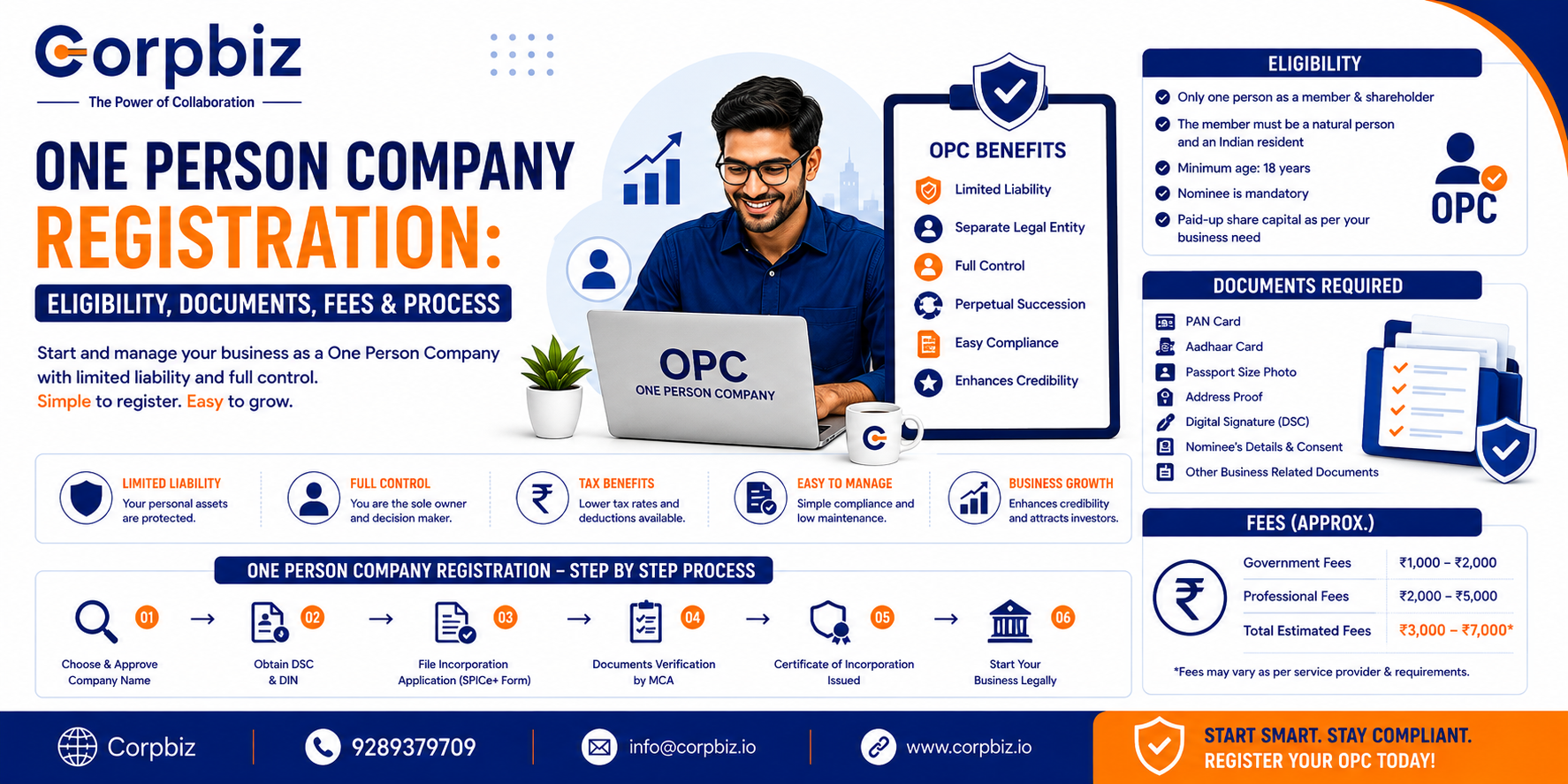
Starting a business alone can feel exciting, but choosing the right business structure is an important decision. If you want to run a business by yourself while still enjoying the benefits of a company structure, One Person Company Registration can be a useful option.
An OPC allows one person to start and manage a company. It is especially helpful for small business owners, entrepreneurs, and professionals who want to work independently but also want their business to have a separate legal identity.
What Is a One Person Company?
A One Person Company, commonly called an OPC, is a type of company that can be started with only one member. The person who starts the company becomes its shareholder and can also act as its director.
The company has a separate legal identity from its owner. This means the business and the owner are treated as two different legal entities.
For example, if you are starting a small online business and want complete control over it, an OPC can give you a more formal business structure.
Who Can Register an OPC?
Not everyone can register an OPC. Generally, an individual who is an Indian citizen and resident in India can form an OPC, subject to the applicable legal requirements.
Some important eligibility points include:
-
The company must have only one member.
-
A nominee must be appointed.
-
The nominee can take over the company in certain situations, such as the death or incapacity of the member.
-
The company should follow the applicable requirements under the Companies Act.
-
The proposed business name must meet the naming requirements.
Before starting the registration process, it is always better to check the current rules and eligibility requirements.
Documents Required for One Person Company Registration
The documentation is usually straightforward. Some commonly required documents include:
-
PAN card of the proposed director and member
-
Aadhaar card or another valid identity document
-
Address proof
-
Passport-size photograph
-
Residential address proof
-
Proof of registered office address
-
NOC from the property owner, where applicable
-
Digital Signature Certificate (DSC)
-
Details of the nominee
-
Consent of the nominee
The exact documents may vary depending on the applicant and registered office situation.
One Person Company Registration Process
The registration process can be completed online through the Ministry of Corporate Affairs (MCA) system.
Step 1: Obtain Digital Signature
The proposed director generally needs a Digital Signature Certificate to sign electronic forms and documents.
Step 2: Apply for Name Approval
A suitable company name is selected and checked according to the applicable naming rules. The proposed name should be unique and should not create confusion with an existing company or trademark.
Step 3: Prepare the Required Documents
Identity proofs, address proofs, registered office documents, nominee details, and other required papers are prepared.
Step 4: File the Incorporation Application
The required incorporation forms and supporting documents are submitted through the MCA portal.
Step 5: Verification by the Authorities
The submitted information and documents are examined by the concerned authority. If everything is correct, the application moves forward.
Step 6: Receive the Certificate of Incorporation
After approval, the company receives its Certificate of Incorporation. The OPC officially comes into existence from this point.
How Much Does OPC Registration Cost?
The cost of One Person Company Registration is not the same for everyone. It can depend on factors such as government fees, stamp duty, professional fees, and the state where the registered office is located.
Therefore, instead of looking at one fixed amount, business owners should consider all applicable charges before starting the registration.
Benefits of One Person Company Registration
An OPC can offer several advantages to a solo entrepreneur.
1. Separate Legal Identity:
The company has a separate identity from its owner.
2. Limited Liability:
The member's liability is generally limited to the amount invested in the company, subject to applicable law.
3. Complete Control:
Since there is only one member, the owner can make business decisions without having multiple shareholders.
4. Better Business Image:
An OPC can provide a more formal business structure compared with operating only as an individual.
5. Easy Expansion:
As the business grows, the owner may explore other company structures according to the applicable rules and business needs.
OPC vs Other Business Structures
When starting a business, you may come across different options.
Sole Proprietorship Registration is generally suitable for an individual who wants a simple business structure with direct control.
Partnership Firm Registration is useful when two or more people want to run a business together and share responsibilities and profits.
One Person Company Registration, on the other hand, is designed for a single person who wants to operate through a company structure.
Similarly, company registration covers the process of legally setting up different types of companies under applicable company law.
The right choice depends on your business size, number of owners, liability requirements, future plans, and compliance needs.
Final Thoughts
Starting a business alone does not mean you have to compromise on having a formal business structure. One Person Company Registration can be a practical choice for an entrepreneur who wants individual control along with the advantages of a company.
However, registration is only the first step. After incorporation, an OPC must follow applicable annual filings, accounting, tax, and other compliance requirements.
If you are unsure whether an OPC is right for your business, professional guidance can help you understand the requirements and choose the structure that fits your plans.
Corpbiz helps entrepreneurs and businesses with company registration, licenses, registrations, and compliance-related services in India.
Author Profile
Gaurav Sharma is a legal consultant and business compliance professional with extensive experience helping entrepreneurs and companies with registrations and regulatory requirements in India. He focuses on making complex legal and business processes simple and easy to understand. Through his work with Corpbiz, he helps business owners make informed decisions and stay compliant.

 Czech
Czech
 English
 Arabic
 French
 Spanish
 Portuguese
 Deutsch
 Turkish
 Dutch
Dutch
 Russian
 Romaian
 Portuguese (Brazil)
 Greek
Greek