


 About SPORTIVO Network
Spice Board Registration in India: Your Gateway to the Global Spice Trade
INTRODUCTION
India is renowned for its spices. well before the world became interested in India's spirituality. People were drawn to our country by the scent of our spices. Furthermore, India is currently a major player in the global spice trade. For many people, exporting spices has become a highly profitable business. Under government regulations, any company that produces or exports any of the 52 listed spices, including cardamom, must register with the Spice Board.
To prevent fraudulent abuse of the exporting industry, the Spice Board of India issues Spice Board Registration to those who wish to begin trading in spices.
WHAT IS SPICE BOARD REGISTRATION
The Spices Board of India issues the required Spice Board Registration, commonly known as the Certificate of Registration as an Exporter of Spices (CRES). For the 52 planned spices, the Board itself serves as the official Export Promotion Council. India is praised for its superior-quality, wide variety of spices, and is acknowledged as the world's leading exporter of spices.
Spice Board certificate ensures compliance with international market requirements, quality standards, and export laws. Exporters must have a current Import-Export Code (IEC) obtained from the official portal of the Directorate General of Foreign Trade (DGFT) to apply for Spice Board Registration. Obtaining this registration facilitates trade, fosters international trust, and allows your company to grow internationally.
WHY IS SPICE BOARD REGISTRATION MANDATORY
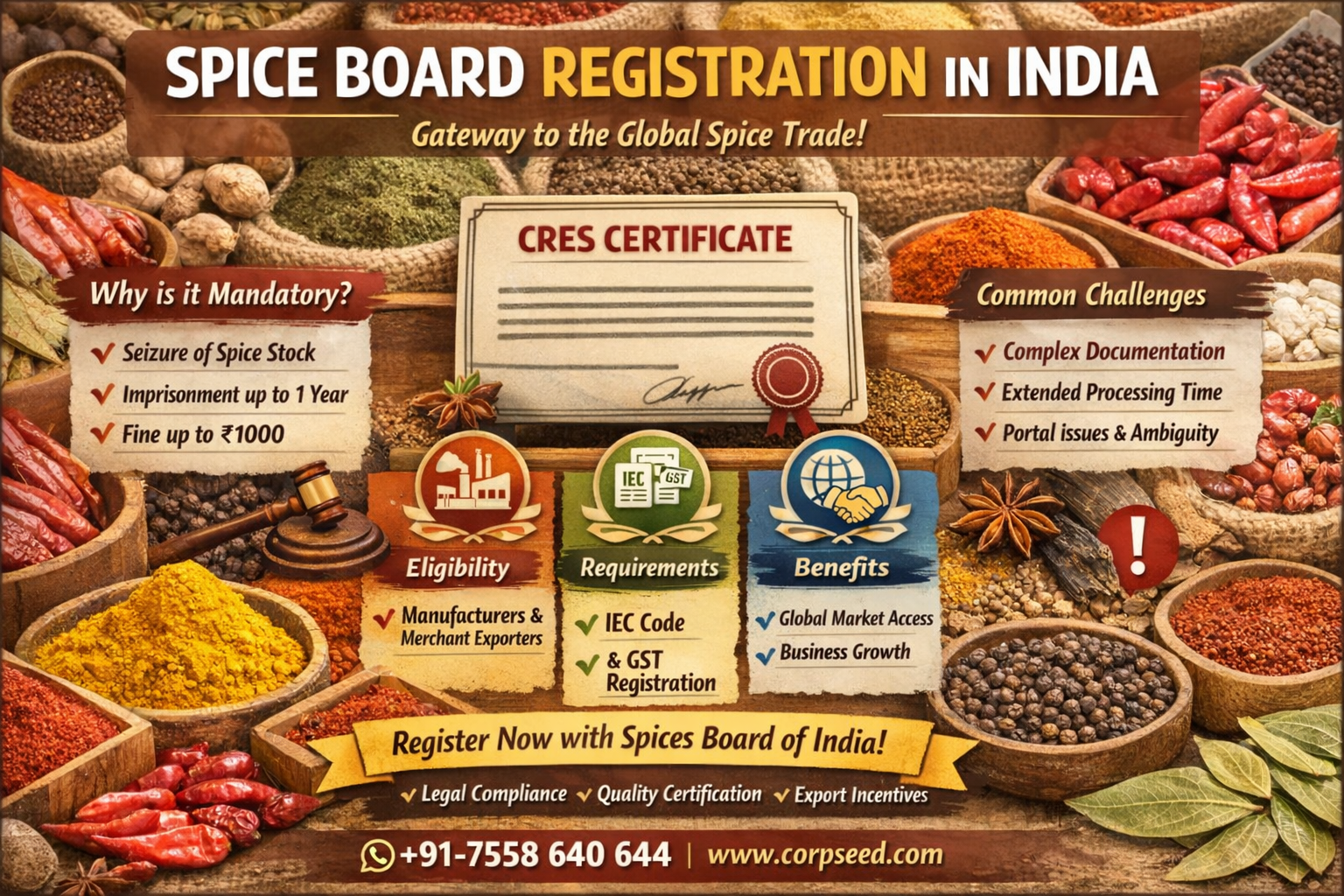
Section 11 of the SPICES BOARD ACT, 1986 states that no company may begin or continue to export spices from India without first registering with the Spice Board. It is crucial to remember that exporting spices without registering with the Spice Board could lead to-
-
Seizure of the available spice stock.
-
Imprisonment for a maximum of one year.
-
A fine of up to one thousand rupees.
ELIGIBILITY CRITERIA FOR SPICE BOARD REGISTRATION
Below are the eligibility criteria for Spice Board registration:
-
Manufacturer Exporters and Merchant Exporters are eligible to get Spice Board registration.
-
Exporters who want to export any of the listed 52 spices from India.
-
Must have an import export code license.
-
Must have GST Registration in the name of the applicant firm.
BENEFITS OF SPICE BOARD REGISTRATION IN INDIA
Some key advantages of successfully registering a spice board are worth noting. So, below are a few of them-
-
International Credibility: Obtaining Spice Board Registration greatly enhances your business's reputation and fosters confidence among suppliers and customers worldwide.
-
Possibilities for Business Growth: The Spice Board credential enables you to build relationships with prospective clients, legislators, and business partners worldwide, helping you achieve your long-term objectives.
-
Market Intelligence and Data Accessibility: These are essential for foreign importers and exporters. By registering, they can access important market data, including consumer preferences, current trends, and contact information.
-
Streamlined Export Process: The CRES certificate works as the obligatory Registration Cum Membership Certificate (RCMC) for spice exporters. This makes compliance easier because you don't need to contact another authority to obtain a separate RCMC.
FUNCTION OF SPICE BOARD REGISTRATION
Below is the following function of spice board registration, which is as follows-
-
The goal of the non-profit Spices Board (Ministry of Commerce and Industry, Government of India) is to manufacture and sell Indian spices worldwide.
-
The Board serves as a liaison between overseas importers and Indian exporters of spices.
-
In addition, the Spices Board is the driving force behind Indian Spices' pursuit of excellence and the successes of each of the company's divisions.
-
The development of small and large cardamom, the promotion, development, and regulation of spice exports, and the quality control of spices for export are all part of the Spice Board's functions.
-
The Spices Board also carries out research on both small and large cardamom under the direction of the Indian Cardamom Research Institute.
SPICES COVERED UNDER THE SPICE BOARD OF INDIA
The Spices Board of India is responsible for the overall development and export promotion of 52 spices listed in the Schedule of the Spices Board Act, 1986. It includes- Cardamom (Small), Cardamom (Large), Pepper (Black & White), Chilli, Ginger, Turmeric, Coriander, Cumin, Fennel, Fenugreek, Celery, Aniseed, Ajowan (Carom Seeds), Caraway, Dill, Cinnamon, Cassia, Clove, Garlic, Allium sativum, Curry Leaf, Nutmeg, Mace, Vanilla, Saffron, Allspice, Asafoetida, Bay Leaf, Basil, Rosemary, Thyme, Oregano, Tamarind, Poppy Seed, Star Anise, Mint, Mustard.
PENALTY FOR VIOLATION OF SPICE BOARD CERTIFICATE
In case of violation of any provisions set against the commencement of trading without obtaining the Spice Board Certificate, specific penalties would be imposed –
-
Imprisonment, which may extend to a year
-
Fine that may extend up to INR 1000.
COMMON CHALLENGES IN SPICE BOARD REGISTRATION
-
Complex Documentation & Compliance: Applicants frequently experience delays or rejections due to their inability to compile the lengthy list of required documents and ensure strict compliance with all relevant legislation, which includes FSSAI and GST.
-
Extended Processing Times: Processing an application may occasionally take longer than anticipated, affecting export plans and business schedules even when all the documentation is in order.
-
Ambiguity in Regulatory needs: Certain standards or criteria may lack clarity, leading to confusion among applicants regarding specific requirements or eligibility interpretations.
-
Technical Problems with Online Portal: Issues with the online application portal, such as payment gateway failures, upload issues, or system outages, may make it challenging to submit applications.
-
Appropriate Business Entity Classification: It may be challenging to determine whether a company is classified as a "manufacturer" or a "merchant," as this classification affects relevant fees and specific compliance requirements.
CONCLUSION
In conclusion, it guarantees legal compliance and access to several government incentives. Spice Board registration is an essential prerequisite for companies engaged in the export, production, or trading of spices in India. In addition to increasing credibility in both home and foreign markets, registration enables exporters to obtain quality certification, market development support, and promotional aid. Businesses can increase their position in the international spice trade, improve customer trust, and streamline operations by adhering to the Spice Board of India's laws and regulations.
FAQs
What is the Spices Board registration renewal, and when is it required?
Spices Board registration renewal is required to keep the exporter’s registration valid and compliant for continued export of spices.
Why is a Spices Board certificate for export mandatory?
A Spices Board certificate for export is mandatory for legally exporting spices from India and availing export-related benefits.
What is the RCMC Spices Board, and who needs it?
RCMC Spices Board (Registration-cum-Membership Certificate) is required for spice exporters to claim incentives under India’s Foreign Trade Policy.
What are the Spices Board registration fees in India?
Spices Board registration fees vary by exporter category and are payable online at the time of application or renewal.
How can exporters apply for Spices Board registration renewal online?
Exporters can apply for Spices Board registration renewal online through the official Spices Board India portal by submitting updated documents.
Also Read: https://www.corpseed.com/service/renewal-of-spice-board-certificate

 Czech
Czech
 English
 Arabic
 French
 Spanish
 Portuguese
 Deutsch
 Turkish
 Dutch
Dutch
 Italiano
 Russian
 Portuguese (Brazil)
 Greek
Greek