


 Android App
 About SPORTIVO Network
Plant-Based Food Market Forecast Signals Long-Term Growth in Meat and Dairy Alternatives
Plant-Based Food Market
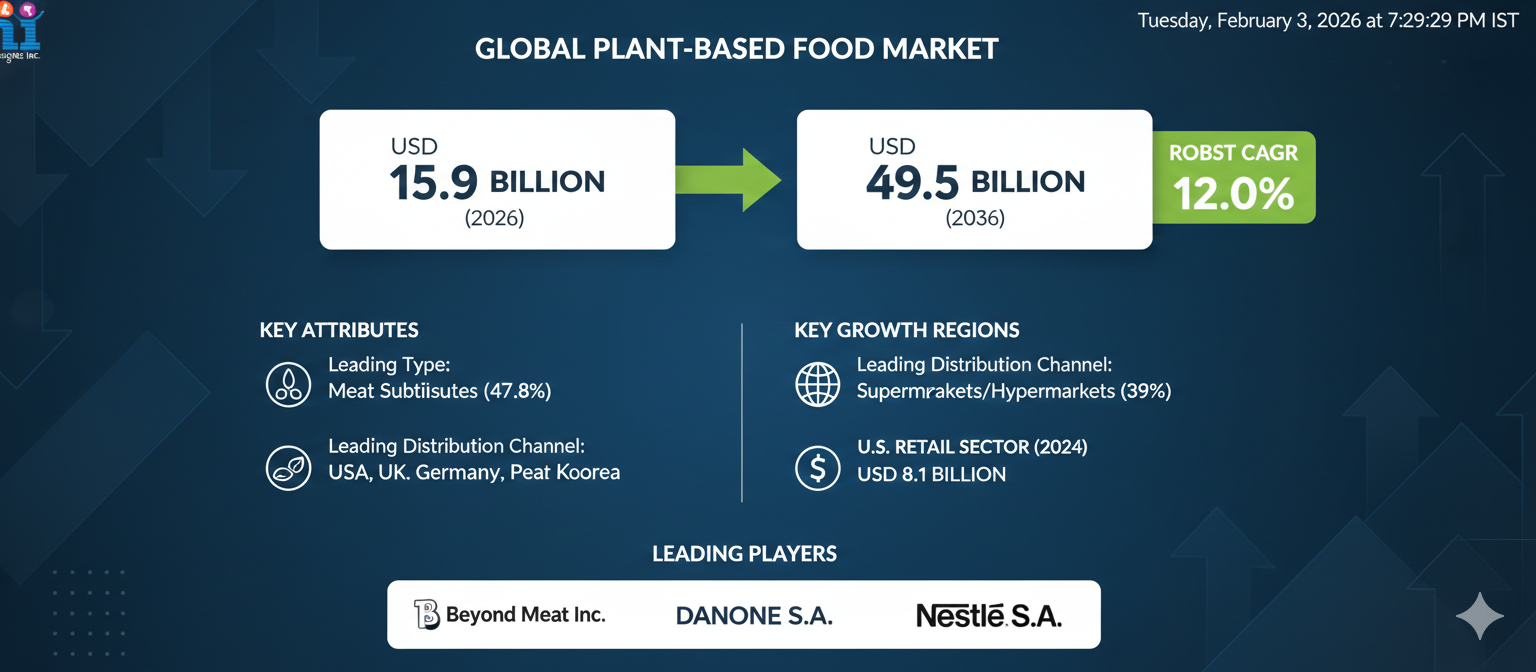
The global plant-based food market is moving decisively into a new phase of development—one defined less by novelty and more by scale, repeat consumption, and operational maturity. Valued at USD 15.9 billion in 2026, the market is projected to expand to USD 49.5 billion by 2036, registering a strong compound annual growth rate (CAGR) of 12.0% over the forecast period. This growth trajectory reflects an industry that has moved beyond early experimentation and into sustained, volume-driven expansion.
Recent retail performance data reinforces this transition. The U.S. plant-based retail market reached USD 8.1 billion in 2024, underscoring long-term category resilience even amid broader food price inflation and shifting consumer spending patterns. Rather than slowing, consumer engagement with plant-based foods is deepening across multiple product types and use occasions.
From Trend to Staple: Changing Consumer Behavior
In its early years, plant-based food adoption was largely fueled by curiosity, ethical considerations, and early adopters seeking alternatives to conventional animal products. Today, purchasing behavior reflects a more pragmatic mindset. Consumers increasingly view plant-based foods as everyday options—integrated into weekly grocery baskets rather than reserved for special diets.
Several behavioral shifts are supporting this evolution:
- Growing awareness of nutrition, cholesterol management, and protein diversification
- Increased prevalence of flexitarian diets rather than strict veganism
- Improved taste, texture, and cooking performance of plant-based products
As product quality improves and pricing gaps narrow, plant-based foods are increasingly competing on functionality and value, not just ideology.
Category Expansion Drives Market Scale
The market’s growth is being supported by steady expansion across multiple product types, including plant-based meat alternatives, dairy alternatives, ready meals, and snack formats. Rather than relying on a single flagship category, the industry is benefiting from diversified revenue streams that reduce volatility and broaden consumer reach.
Plant-based meat alternatives continue to account for a significant share of total market value, particularly in North America and Europe. However, plant-based dairy alternatives, including milk, yogurt, and cheese substitutes, are gaining faster adoption due to their familiarity and frequent consumption patterns.
This diversification has helped the industry stabilize volumes and improve shelf performance across retail and foodservice channels.
Distribution Channels Strengthen Market Penetration
By distribution channel, modern retail continues to dominate plant-based food sales. Supermarkets and hypermarkets benefit from improved in-store placement, private-label offerings, and cross-category merchandising. These strategies have helped normalize plant-based products alongside conventional food items rather than isolating them as niche alternatives.
At the same time, foodservice and online channels are playing a growing role in trial and repeat consumption. Plant-based menu offerings in quick-service and casual dining restaurants have expanded consumer exposure, while e-commerce platforms are enabling wider geographic reach, particularly in urban and semi-urban markets.
Regional Dynamics Reflect Uneven but Accelerating Adoption
From a regional perspective, North America remains the largest market, supported by high consumer awareness, strong retail penetration, and continuous product innovation. The United States leads global consumption, with plant-based foods increasingly positioned as mainstream options rather than specialty items.
Europe follows closely, driven by favorable regulatory frameworks, sustainability initiatives, and widespread flexitarian adoption. Markets such as Germany, the United Kingdom, and France continue to see strong growth across both private-label and branded plant-based offerings.
The Asia-Pacific region is expected to record the fastest growth rate over the forecast period. Rising urbanization, increasing disposable incomes, and cultural familiarity with plant-based diets in parts of Asia are accelerating adoption. Meanwhile, Latin America and the Middle East & Africa are emerging markets, supported by improving retail infrastructure and growing exposure to global food trends.
Competitive Landscape Reflects Industry Maturity
The plant-based food market features a mix of established food multinationals and specialized innovators. Companies such as Nestlé, Danone, Tyson Foods, Beyond Meat, Impossible Foods, Amy’s Kitchen, Lightlife Foods, and Vbite Food are actively shaping market dynamics through product reformulation, portfolio expansion, and strategic partnerships.
Notably, the entry and continued investment of traditional meat and dairy companies signal confidence in long-term demand. Their scale, supply chain capabilities, and retail relationships are helping accelerate category normalization.
Outlook: A Decade Defined by Scale and Stability
Between 2026 and 2036, the plant-based food market is expected to transition further into a stable, high-growth segment of the global food industry. Growth will increasingly be driven by repeat consumption, broader household penetration, and improved cost efficiencies, rather than first-time trial alone.
As the market matures, success will depend less on novelty and more on delivering consistent taste, nutrition, and value at scale. With strong CAGR momentum and expanding regional adoption, plant-based foods are positioned to remain a lasting and influential component of global food consumption.
About Future Market Insights (FMI)
Future Market Insights, Inc. (FMI) is an ESOMAR-certified, ISO 9001:2015 market research and consulting organization, trusted by Fortune 500 clients and global enterprises. With operations in the U.S., UK, India, and Dubai, FMI provides data-backed insights and strategic intelligence across 30+ industries and 1,200 markets worldwide.
Contact Us:
Future Market Insights Inc.
Christiana Corporate, 200 Continental Drive,
Suite 401, Newark, Delaware – 19713, USA
T: +1-347-918-3531
For Sales Enquiries: sales@futuremarketinsights.com

 Czech
Czech
 English
 Arabic
 French
 Spanish
 Portuguese
 Deutsch
 Turkish
 Dutch
Dutch
 Italiano
 Romaian
 Portuguese (Brazil)
 Greek
Greek