


 Android App
 About SPORTIVO Network
Last-Minute Flights to India: When Waiting Actually Pays Off
There is a widespread belief that booking flights early always gets you the best deal. Book three months out, the advice goes, and you will pay less than someone who scrambles for a seat a week before departure. For the most part, that advice is sound. But travel, like most things in life, is rarely that simple.
Sometimes, waiting pays off. Last-minute flight deals to India do exist — not as a myth or a lucky accident, but as a genuine pattern driven by the way airlines manage their inventory, fill unsold seats, and respond to shifting demand. The trick is knowing when waiting works in your favour, when it does not, and how to position yourself to catch a good deal when one appears.
This guide covers everything you need to know about last-minute flights to India — the real reasons prices sometimes drop, the routes and seasons where deals are most likely, the risks worth understanding, and the practical steps that give you the best chance of finding a fare that makes the wait worthwhile.
What "Last-Minute" Actually Means in Air Travel
Before diving into strategy, it helps to define the term properly — because "last-minute" means different things in different contexts.
In casual conversation, last-minute might mean booking a week before travel. In airline pricing terms, it can mean anything from 14 days out to 24 hours before departure. The price behaviour in each of these windows can be very different.
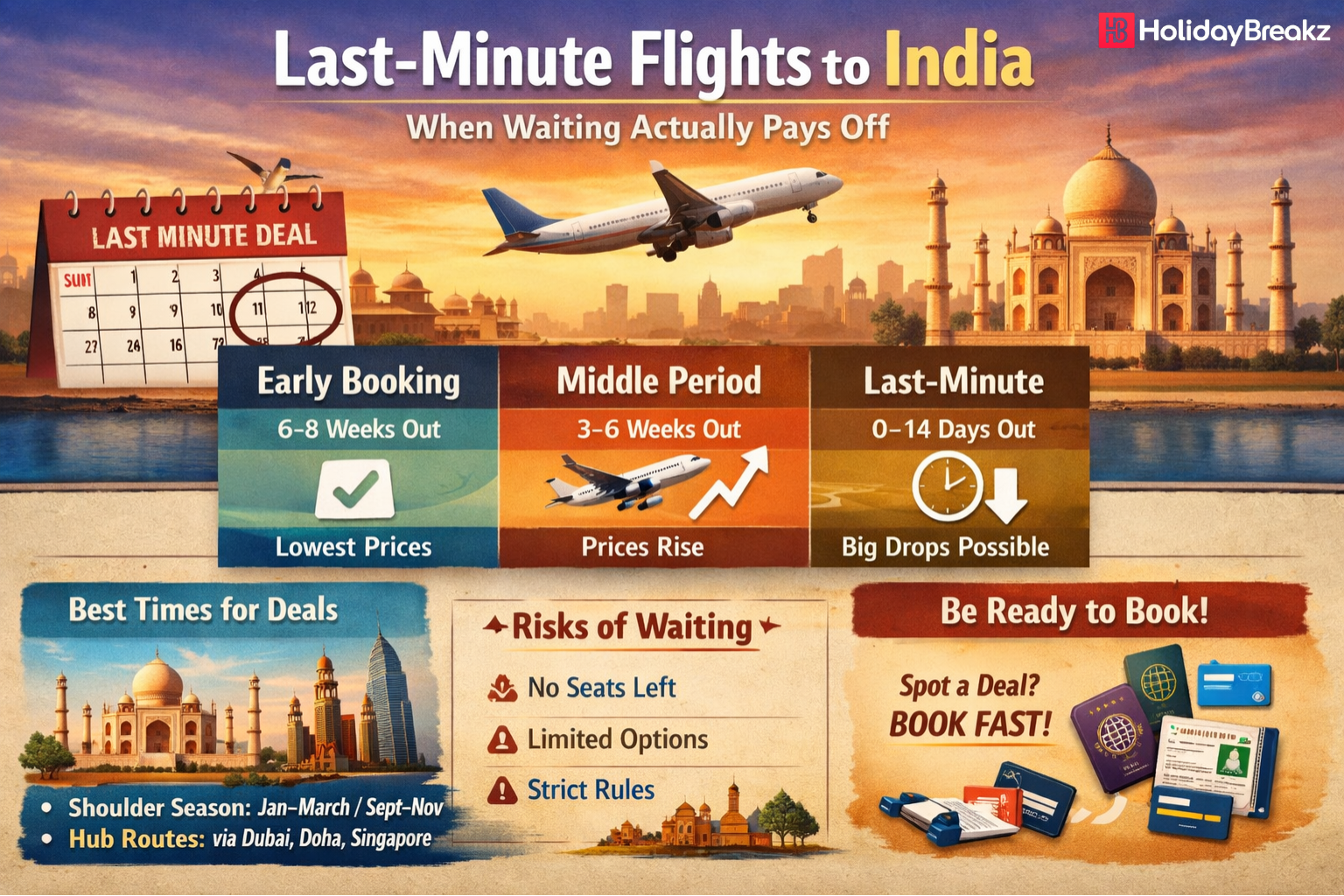
Generally, airlines operate in three broad pricing phases for any given flight:
Early booking window (more than 6–8 weeks out): Prices are often competitive as airlines try to fill seats early and generate cash flow. This is typically the best time to book popular routes and peak-season travel.
Middle window (3–6 weeks out): Prices tend to rise as the flight fills up and remaining inventory becomes scarcer. This is usually the most expensive phase for leisure travellers to book.
Late window (0–14 days out): This is where things get interesting. Prices can go either way. On routes with high corporate or emergency travel demand, last-minute fares are often the most expensive. But on routes with surplus inventory — unsold seats the airline needs to fill before the plane takes off — prices can drop substantially.
Understanding which category your intended flight falls into is the foundation of any last-minute booking strategy.
Why Airlines Sometimes Drop Prices at the Last Minute
An empty seat on a departed flight is revenue that can never be recovered. Unlike a hotel room that remains available night after night, an airline seat has a hard expiry — the moment the doors close, that seat is gone forever along with whatever it could have earned.
This fundamental economics of the airline business is what creates last-minute deals. When a flight is not filling up as expected, airlines face a choice: hold the price and fly with empty rows, or reduce the fare to attract buyers and recover at least some revenue. More often than not, they choose the latter.
Several factors can create this situation on flights to India:
Lower-than-expected demand on specific dates. A flight departing mid-week on a non-peak travel day may have seats available because most leisure travellers prefer to fly on weekends or around public holidays.
Route-specific overcapacity. If multiple airlines operate the same route — say, London to Mumbai or Dubai to Delhi — competition can create surplus capacity during quieter periods. Airlines may drop prices to outcompete each other and fill their aircraft.
Changes in travel patterns. Events, weather, political situations, or simply shifts in travel trends can leave airlines with more unsold inventory than expected on certain dates, prompting price reductions.
Revenue management adjustments. Airlines use sophisticated algorithms to constantly reprice their inventory. As departure approaches, these systems recalculate the optimal price based on remaining seats, competing flights, and historical booking patterns. This can result in genuine drops for some fare classes, even as other fare classes remain expensive.
When Last-Minute Deals to India Are Most Likely
Not every route and not every season is equally likely to yield a last-minute deal. Knowing where the opportunities tend to cluster saves you time and sets realistic expectations.
Routes with Higher Last-Minute Deal Frequency
Heavily competed routes tend to be better hunting grounds for last-minute deals because airlines are more motivated to undercut each other to fill seats. Routes connecting major Indian cities — Delhi, Mumbai, Bengaluru, Chennai, Hyderabad, Kolkata — with major international hubs tend to see more pricing competition.
Flights connecting through hub airports in the Middle East (Dubai, Abu Dhabi, Doha) or Southeast Asia (Singapore, Kuala Lumpur) sometimes produce last-minute drops more reliably than direct long-haul flights, where fewer carriers compete and the airline has more pricing power.
Seasons and Travel Windows
Shoulder season is the sweet spot for last-minute deal hunters. The period between peak seasons — roughly late January to March, and again from mid-September to early November — sees lower overall demand, which means more unsold inventory and more willingness from airlines to discount.
Avoid peak season last-minute booking entirely. During Diwali, Christmas, New Year, summer school holidays (May–June), and major Indian festival periods, airlines know demand will fill every seat without discounting. Last-minute fares during these periods are typically the highest of the year.
Weekday departures (Tuesday, Wednesday, Thursday) are more likely to have unsold seats than Friday or Sunday departures, which attract the bulk of leisure travellers.
The Real Risks of Waiting for Last-Minute Deals
No conversation about last-minute booking strategy is complete without an honest look at what can go wrong. The deal-hunting approach carries genuine risks that every traveller should weigh.
You Might Not Find a Deal at All
The most basic risk is that the deal simply does not appear. If the flight is filling up as expected, the airline has no reason to discount. You could wait, watch prices climb, and end up paying more than you would have booking four weeks earlier — or worse, finding no seats available at all.
This risk is highest on popular routes during moderately busy periods. There is enough demand to fill the aircraft, but not so much that the airline needed to price aggressively in advance.
Limited Seat and Cabin Choice
Even when last-minute deals do appear, they tend to be concentrated in the cheapest fare classes, with limited availability. You may find one or two discounted seats, but if you are travelling with family or as a couple, you might not find multiple seats at the same price. You are also unlikely to find last-minute discounts on premium economy, business, or first class cabins, which are typically filled with higher-yield passengers or frequent flyer award redemptions.
Restrictive Fare Conditions
Last-minute discounted fares often come with the most restrictive terms — non-refundable, non-changeable, with no baggage included and no flexibility whatsoever. If your plans are uncertain or your travel has any complexity, this inflexibility can create problems.
No Time to Plan Around the Ticket
A flight booked two weeks out means less time to arrange accommodation, ground transport, visas (if applicable), and all the logistical details that make a trip run smoothly. For leisure travel to India, this may matter more than for a short trip to a destination you know well.
Strategies That Actually Work for Last-Minute India Flights
Given the opportunities and the risks, here is a practical approach to last-minute flight hunting that experienced travellers use effectively.
Set Up Fare Alerts Early
The best last-minute deals go fast — often within hours of appearing. To catch them, you need to be watching. Set up fare alerts for your intended route and travel dates at least a month before you hope to travel. This way, you understand what the "normal" price range looks like and can recognise immediately when a genuine deal appears.
HolidayBreakz India allows travellers to search and compare fares across routes, giving you a clear picture of price history and current availability so you are never making a decision in the dark.
Have Flexible Dates (Even by a Day or Two)
Last-minute deals rarely land exactly on the date you want. If you can shift your travel by one or two days — leaving on a Wednesday instead of a Friday, or arriving a day later than originally planned — your chances of finding a discounted fare increase substantially. Even a small window of date flexibility multiplies the number of flights you can consider.
Know Your Absolute Minimum Requirements
Before you start looking, decide clearly what you will and will not compromise on. How many bags do you need? Is a connection of more than 12 hours acceptable? Are there airports you cannot use because of onward transport? Knowing your hard limits in advance means you can make fast decisions when a deal appears, rather than agonising over trade-offs while the seat sells to someone else.
Watch for Flash Sales and Seat Sales
Airlines periodically run flash sales — short windows of heavily discounted fares — to stimulate demand on specific routes and dates. These are not always last-minute in timing (some are announced a month in advance), but the fares themselves are often competitive with what you might find in the final days before departure.
Following airlines that serve India-bound routes on their official channels, and checking flight deal aggregators regularly, puts you in position to catch these windows when they open.
Consider Positioning Flights
If you are based in a smaller city without direct connections to India, sometimes the best last-minute deal involves positioning yourself to a major hub first. A cheap domestic or short-haul flight to London, Frankfurt, Dubai, or Singapore — booked separately — can open up a much wider range of India-bound options where last-minute inventory is more plentiful.
Be Ready to Book Immediately
This sounds obvious, but it is worth emphasising. Last-minute deals at good prices often have very limited seat availability — sometimes just one or two seats at the advertised price. If you find a fare that works, book it immediately. There is no value in sleeping on it, sharing the link with family to debate for 24 hours, or waiting to see if it drops further. It will not drop further. It will sell.
Last-Minute Business Class to India: A Special Case
One area where last-minute booking can be surprisingly effective is business class to India, particularly on routes where corporate travel demand is unpredictable.
Airlines that fly premium cabins to Indian cities sometimes find themselves with unsold business class seats close to departure — especially on mid-week flights or during periods when corporate travel is lower. Rather than fly with empty flat beds, they may release these seats at a significant discount compared to their standard prices.
These deals are harder to find and require more flexibility, but for travellers who prioritise comfort on long-haul flights and are willing to keep a close eye on fares, they occasionally represent excellent value.
Some airlines also release upgrade pricing close to departure — offering economy passengers the option to move to business class at a discounted rate. This is worth checking at online check-in or at the airport.
How Last-Minute Compares to Other Discount Strategies
To put last-minute booking in context, it helps to understand how it compares to other approaches travellers use to find cheaper India flights.
Advance booking (8–12 weeks out) remains the most reliable strategy for securing competitive fares, especially during peak and shoulder seasons. It offers certainty, full seat choice, and time to plan properly. It is the recommended approach for most travellers.
Off-peak travel — choosing dates outside school holidays and major festival periods — can reduce fares more consistently than last-minute hunting. Travelling in February, early March, late September, or October often yields better fares than any last-minute deal you might find in December or May.
Connecting via alternative hubs rather than taking the most direct routing can also produce lower fares. Flights connecting through Colombo, Kuala Lumpur, or Muscat are sometimes significantly cheaper than direct routes, even booked well in advance.
Last-minute booking works best as a complementary strategy — useful when flexibility exists and conditions are right, but not a substitute for the certainty and planning that comes with booking further ahead.
Practical Checklist for Last-Minute India Flight Hunters
Before you start watching fares and waiting for that deal to appear, run through this checklist to make sure you are genuinely set up to succeed:
- Passport validity: India requires at least six months of validity beyond your travel dates. Check this before anything else.
- Visa requirements: Most foreign nationals need a visa or e-Visa to enter India. The e-Visa can often be processed in 72 hours, but do not leave this to the last day.
- Date flexibility confirmed: Know the earliest and latest you can depart, and the range of return dates that work for you.
- Bags and essentials clear: Know exactly what you need included in any fare before you start comparing prices.
- Fare alerts active: Set up alerts on your intended route so you are tracking price movements, not just checking in occasionally.
- Payment ready: Have your payment method ready to book instantly when a deal appears. Waiting to find your card or complete a verification step can cost you the seat.
- Travel insurance sorted: Last-minute fares are often non-refundable. Make sure you have appropriate coverage in place before you fly.
Frequently Asked Questions
Do airlines actually reduce prices close to the departure date for India flights?
Yes, but not always and not on every route. Price drops close to departure are most common on routes with surplus inventory, during shoulder seasons, and on mid-week departures. During peak travel periods, last-minute prices are almost always higher than advance booking prices.
How far in advance should I start watching last-minute deals?
Start monitoring fares at least 4–6 weeks before your intended travel date. This gives you a clear picture of the price range and helps you recognise a genuine deal when one appears. Genuine last-minute drops typically appear within 7–14 days of departure.
Are last-minute flights to India safe to book?
The flight itself is no different from any other booking. The risk with last-minute fares is logistical — less time to sort visas, accommodation, and onward transport, and more restrictive fare conditions if plans change.
Which Indian cities have the most last-minute flight options from international hubs?
Delhi and Mumbai receive the highest volume of international flights and therefore tend to have more last-minute inventory available. Bengaluru, Chennai, and Hyderabad have grown significantly as international destinations and are worth checking, particularly from Middle Eastern hubs.
Can I find last-minute deals during Diwali or Christmas travel to India?
It is very unlikely. These are among the highest-demand travel periods of the year. Airlines have no need to discount because seats fill at full price. If you are travelling during peak festival seasons, book as early as possible rather than waiting.
What is the best way to track last-minute flight deals to India?
Set up fare alerts on your preferred travel platform, follow airlines that serve your route, and check deal aggregators regularly. Having flexible dates significantly increases your chances of catching a genuine discount.
Is last-minute booking better for solo travellers than families?
Generally, yes. Last-minute discounted seats are often available in small quantities — one or two at a time. Solo travellers can take advantage of a single discounted seat that would not be sufficient for a family of four travelling together.
Final Thoughts
Last-minute flights to India can and do offer genuine value — but only under the right conditions and only for travellers who are genuinely prepared to act on them. The strategy works best when you have flexible dates, clear requirements, fare alerts set up in advance, and the decisiveness to book the moment a good deal appears.
It is not a strategy for every trip or every traveller. For most people travelling to India — especially during peak seasons, or when travelling with family, or when the trip involves complex logistics — booking in advance remains the smarter, lower-risk approach.
But if your schedule allows flexibility, if you are travelling during shoulder season, and if you are patient and well-prepared, waiting sometimes genuinely pays off. The key is going in with realistic expectations, a solid checklist, and the knowledge to tell the difference between a real deal and just a price that looks cheaper because you have been watching it long enough.
Wherever and whenever you choose to book, making sure you understand the full cost of the fare — baggage, flexibility, and all — is what separates a genuinely good deal from one that only looked like a bargain at first glance.

 Czech
Czech
 English
 Arabic
 French
 Spanish
 Portuguese
 Deutsch
 Turkish
 Dutch
Dutch
 Russian
 Romaian
 Portuguese (Brazil)
 Greek
Greek