


 Android App
 About SPORTIVO Network
The Future of GDS API Integration in Travel Technology
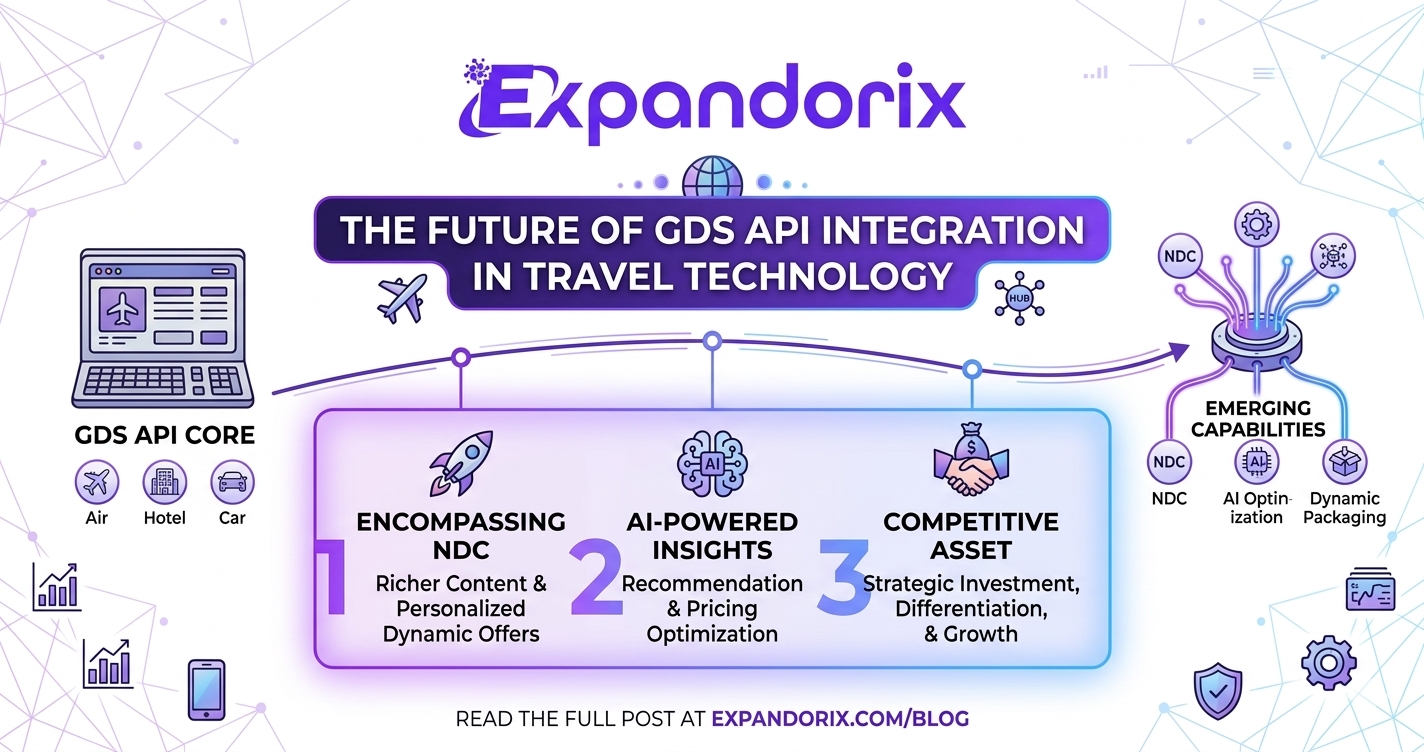
The travel distribution landscape is in a period of significant transition. New distribution standards, changing airline strategies, evolving traveller expectations, and the emergence of artificial intelligence as a commercial tool are all reshaping the environment in which GDS API integration operates. For travel technology leaders, understanding the direction of travel — where GDS API integration is going, what new capabilities are emerging, and what strategic implications flow from these changes — is essential for making sound investment decisions today.
This article examines the key trends shaping the future of GDS API integration, the opportunities these trends create for forward-thinking travel platforms, and the strategic considerations that should inform how platforms approach their GDS integration strategy over the next three to five years.
The NDC Revolution and Its Impact on GDS
The most significant structural change in airline distribution in a generation is the rise of New Distribution Capability — IATA's XML-based standard for next-generation airline distribution. NDC enables airlines to distribute their full product catalogue, including rich ancillary content, personalised pricing, and dynamic offers, through modern API interfaces that are far more capable than the legacy EDIFACT messaging that has defined GDS distribution for decades.
The early narrative around NDC suggested that it would disintermediate the GDS — that airlines would use NDC to bypass the GDS and distribute directly to OTAs, corporates, and consumers. This narrative has not played out as predicted. The logistical complexity of establishing direct NDC connections with hundreds of airlines is prohibitive for all but the largest and most resourced travel sellers. The GDS platforms recognised this and invested heavily in NDC aggregation capabilities — becoming the intermediary that normalises and aggregates NDC content from multiple airlines alongside traditional EDIFACT content.
The result is that GDS API integration is evolving to encompass NDC content, not being displaced by it. Platforms that invest in modern GDS API integration today are gaining access to richer airline content through the same GDS channel they already use, without needing to build direct NDC connections. This is a significant strategic benefit that validates continued investment in GDS API integration even as NDC matures.
Artificial Intelligence and Machine Learning in GDS-Powered Platforms
Artificial intelligence and machine learning are becoming integral to how leading travel platforms use their GDS data. The applications range from recommendation systems that surface personalised travel options to pricing optimisation algorithms that dynamically adjust markup and promotional strategies, to predictive analytics that forecast demand patterns by route and season.
GDS API integration is the data pipeline that feeds these AI systems. Every search, click, and booking generates signal data that, in aggregate, trains the models that power personalised recommendations and dynamic pricing. Platforms with larger booking volumes and richer data capture from their GDS integration have a structural advantage in AI model quality — more data means better models, which means better customer experiences, which means more bookings, which means more data.
The integration between GDS data and AI systems requires investment in data infrastructure — data warehousing, real-time streaming pipelines, feature stores — that captures GDS data in the formats and at the granularity needed for model training. Platforms that invest in this data infrastructure today are building the foundation for AI-powered capabilities that will define competitive differentiation over the next decade.
Conversational and Voice-Based Travel Booking
The interface through which travellers interact with booking platforms is evolving beyond the traditional search form. Conversational interfaces — AI-powered chatbots and voice assistants that allow travellers to describe their travel needs in natural language — are becoming a meaningful booking channel, particularly for complex itineraries and repeat bookings.
GDS API integration is what makes conversational booking interfaces useful. When a traveller tells a chatbot that they want to fly to Tokyo in March for a week, stay in a mid-range hotel near Shinjuku, and have the flexibility to change their return date, the chatbot needs to translate this natural language request into structured GDS queries, retrieve the relevant options, and present them in a conversational format. This entire workflow depends on robust, real-time GDS API integration.
Building conversational booking interfaces requires both the GDS API capability and the natural language processing capability to bridge between them. Large language models are increasingly capable of generating correctly structured API queries from natural language inputs, making the integration between conversational interfaces and GDS APIs more tractable than it was even a few years ago.
Dynamic Packaging and Bundle Optimisation
Dynamic packaging — the ability to combine flights, hotels, car rentals, and activities from multiple GDS and non-GDS sources into personalised travel packages priced and presented as unified products — is one of the most commercially attractive capabilities that mature GDS API integration enables.
The future of dynamic packaging lies in AI-driven bundle optimisation that creates packages tailored not just to the destination and dates, but to the individual traveller's preferences, loyalty programme memberships, past travel patterns, and real-time pricing signals. Achieving this vision requires deep GDS API integration across all content types — air, hotel, car, ancillaries — plus integration with activity and experience providers, all feeding into a bundle optimisation engine that can create and price personalised packages in real time.
GDS platforms are investing in the APIs and content capabilities that support this vision. Platforms that invest in comprehensive GDS API integration today are building the content foundation on which sophisticated dynamic packaging capabilities can be layered.
The Evolving Role of Hotel and Car GDS Content
While much of the strategic discussion around GDS integration focuses on airline content, the hotel and car rental components of GDS distribution are equally important and are evolving rapidly. The hotel distribution landscape in particular is undergoing significant change as major hotel chains invest in direct booking strategies and as OTA platforms like Booking.com and Expedia continue to dominate online hotel distribution.
GDS hotel content remains essential for corporate travel programmes, where negotiated hotel rates are distributed through the GDS to travel management company platforms. For leisure OTAs, supplementing GDS hotel content with direct hotel API connections and OTA platform connections creates the broadest possible inventory.
Car rental GDS content similarly remains a strong channel for both corporate and leisure markets, with the major rental companies maintaining significant GDS distribution alongside their own direct booking channels. GDS API integration for car rental is relatively straightforward compared to air, making it a high-value, lower-complexity addition to a GDS integration portfolio.
Real-Time Disruption Management as a Competitive Differentiator
Travel disruption — flight delays, cancellations, schedule changes, weather events — is an inevitable part of the travel experience. How well a platform supports travellers through disruptions is becoming a significant competitive differentiator, and GDS API integration is central to building these capabilities.
Real-time disruption management requires the ability to monitor PNR status through the GDS for schedule changes and cancellations, automatically notify affected travellers, access rebooking options through the GDS availability API, and process voluntary changes or refunds according to fare rules. Platforms that can do all of this automatically, without requiring travellers to call a helpline, deliver a genuinely differentiated customer experience.
The GDS platforms have been investing in disruption management APIs and notification services that make it easier for platforms to build these capabilities. As travellers' expectations for disruption handling continue to rise, investment in these GDS-powered capabilities becomes increasingly important.
Sustainability Data in GDS Integration
Sustainability has emerged as a significant consideration for both corporate and leisure travellers. Airlines and other travel suppliers are increasingly publishing carbon emissions data, and regulators in various markets are introducing requirements for emissions disclosure in travel booking. GDS platforms are integrating sustainability data — carbon calculations, sustainable aviation fuel information, environmental ratings — into their content APIs.
For forward-thinking travel platforms, integrating sustainability data from the GDS into the booking experience is both a regulatory compliance consideration and a customer experience enhancement. Travellers who want to understand and reduce the environmental impact of their travel need clear, accurate emissions data at the point of booking. GDS API integration is the vehicle through which this data flows from the airline's sustainability systems to the traveller's booking screen.
The Strategic Imperative: Invest Now for Future Capability
The clear message from the trends shaping GDS API integration's future is that the investments made today compound into strategic advantages tomorrow. Platforms that have invested in high-quality, modern GDS API integration — with clean architecture, comprehensive data capture, and strong engineering foundations — are best positioned to leverage emerging capabilities like NDC content, AI-powered personalisation, conversational booking, and sustainability data integration.
Platforms that are running legacy GDS integrations — built quickly, poorly architected, or maintained minimally — face an increasingly costly choice between investing in modernisation or falling further behind as new capabilities become commercially important. The cost of technical debt in GDS integration is not static; it compounds as the complexity of rearchitecting around a poorly designed foundation grows.
The strategic imperative is clear: invest in GDS API integration as a core competency, not a legacy overhead. Treat it as the dynamic, evolving capability it is — one that requires ongoing attention, investment, and adaptation as the distribution landscape evolves. Platforms that make this commitment will find that their GDS API integration is not just a cost of doing business in travel, but a genuine competitive asset that drives growth, differentiation, and long-term customer loyalty.
Conclusion
The future of GDS API integration is not about the GDS being replaced — it is about the GDS evolving to encompass new distribution standards, new content types, and new capabilities that make it an even more powerful foundation for travel platforms. NDC content aggregation, AI-powered data utilisation, conversational booking interfaces, real-time disruption management, and sustainability data integration are all developments that extend the value of GDS API investment rather than diminishing it.
Travel platforms like Expandorix that understand this trajectory and invest accordingly — building modern, well-architected GDS API integrations today and maintaining them as living assets rather than frozen infrastructure — are building the technological foundation for sustained competitive advantage in an industry where technology quality increasingly determines commercial outcome.

 Czech
Czech
 English
 Arabic
 French
 Spanish
 Portuguese
 Turkish
 Dutch
Dutch
 Italiano
 Russian
 Romaian
 Portuguese (Brazil)
 Greek
Greek