Software teams are under constant pressure to ship new features quickly while maintaining quality. Manual testing alone often cannot keep pace with frequent releases, complex integrations, and growing user expectations. That is why automation testing has become an essential part of modern software development.
Automation testing helps organizations improve speed, accuracy, and consistency across the testing lifecycle. When implemented correctly, it reduces repetitive effort, catches defects earlier, and supports faster product delivery.
What Is Automation Testing?
Automation testing is the process of using tools, scripts, and frameworks to execute test cases automatically. Instead of manually repeating the same checks during every release, teams can run automated tests whenever code changes are introduced.
These tests validate whether the software behaves as expected and help identify bugs before they reach production.
Automation testing is commonly used for:
- Regression testing
- Smoke testing
- API testing
- Cross-browser testing
- Mobile app testing
- Performance validation
- Continuous integration pipelines
Why Automation Testing Matters
As software products grow in complexity, testing needs increase. Manual testing remains valuable for exploratory and usability scenarios, but repetitive checks are better handled through automation.
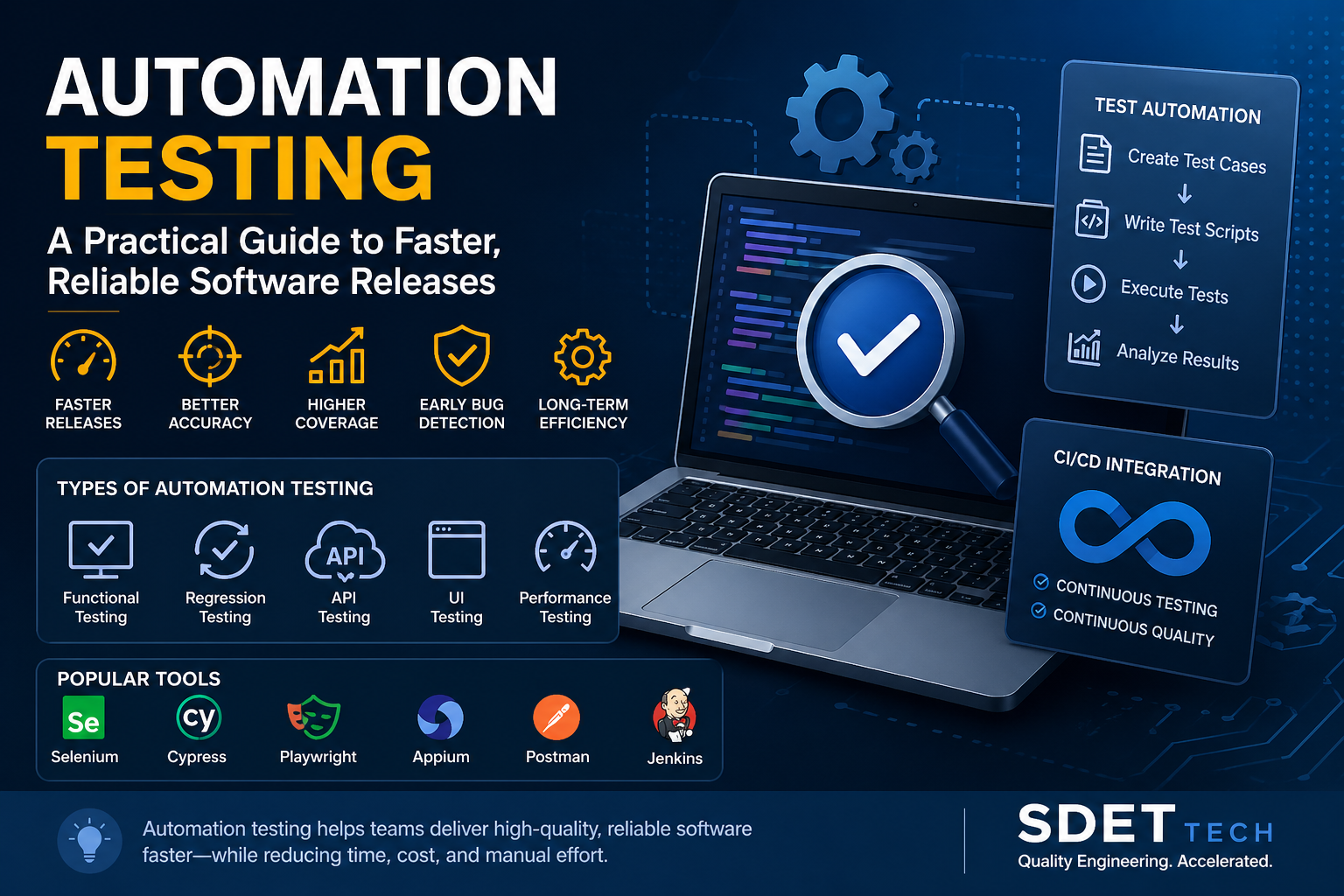
1. Faster Release Cycles
Automated tests run much faster than manual tests. This helps teams validate changes quickly and release updates more often.
2. Better Accuracy
Human error can happen during repetitive testing. Automation executes the same steps consistently, reducing missed issues.
3. Higher Test Coverage
Teams can run large test suites across multiple browsers, devices, and environments.
4. Early Bug Detection
When automation is integrated into CI/CD pipelines, defects are found earlier, reducing the cost of fixing them later.
5. Long-Term Efficiency
Although setup requires planning, automation often lowers long-term QA effort and improves productivity
Types of Automation Testing
A strong strategy usually combines multiple testing layers.
Functional Testing
Checks whether features work according to business requirements.
Regression Testing
Ensures that new code changes do not break existing functionality.
API Testing
Validates backend services, integrations, and data flow.
UI Testing
Tests user interactions such as forms, buttons, navigation, and workflows.
Performance Testing
Measures speed, scalability, and behavior under load.
Popular Automation Testing Tools
The right tool depends on the technology stack and goals.
- Selenium – Widely used for browser automation
- Cypress – Popular for modern frontend testing
- Playwright – Strong for cross-browser testing and speed
- Appium – Mobile app automation
- Rest Assured / Postman – API testing
- Jenkins / GitHub Actions – CI/CD integration
Tool choice should follow project needs, not trends.
When Should You Automate Testing?
Not every test case should be automated. The best candidates are:
- Frequently repeated tests
- Critical business workflows
- Stable features with predictable outcomes
- Multi-browser validation scenarios
- High-risk areas requiring regular regression checks
Manual testing is still valuable for exploratory testing, UI feedback, and new feature discovery.
Common Automation Testing Challenges
Many teams struggle because they automate without strategy.
Weak Test Design
Poorly structured scripts become difficult to maintain.
Flaky Tests
Unstable tests reduce trust in results.
Wrong Tool Selection
Choosing tools without considering team skills or product architecture creates friction.
Lack of Maintenance
Automated tests need regular updates as products evolve.
Best Practices for Successful Automation Testing
To get real value from automation:
- Start with a clear test strategy
- Prioritize high-value test cases first
- Build reusable frameworks
- Keep tests independent and reliable
- Review failures quickly
- Integrate tests into CI/CD pipelines
- Balance automation with manual testing
Automation should solve business problems, not just increase script count.
The Future of Automation Testing
Modern teams are moving toward intelligent quality engineering. AI-assisted testing can help with:
- Self-healing locators
- Risk-based test prioritization
- Faster test creation
- Smarter defect prediction
While tools are improving, experienced QA engineers remain essential for strategy and judgment.
Final Thoughts
Automation testing is one of the most effective ways to improve software quality while accelerating releases. It helps organizations reduce repetitive effort, catch bugs early, and scale testing across growing products.
Businesses looking to modernize QA processes can benefit from experienced partners like SDET Tech, which provides advanced automation testing services, AI-driven QA solutions, performance testing, and end-to-end quality engineering to help teams deliver reliable software faster.



 About SPORTIVO Network

 Czech
Czech
 English
 Arabic
 French
 Spanish
 Portuguese
 Deutsch
 Turkish
 Dutch
Dutch
 Italiano
 Romaian
 Portuguese (Brazil)
 Greek
Greek