


 About SPORTIVO Network
Open Banking Explained: How It Works, Benefits, Risks, and Future Trends (2026)
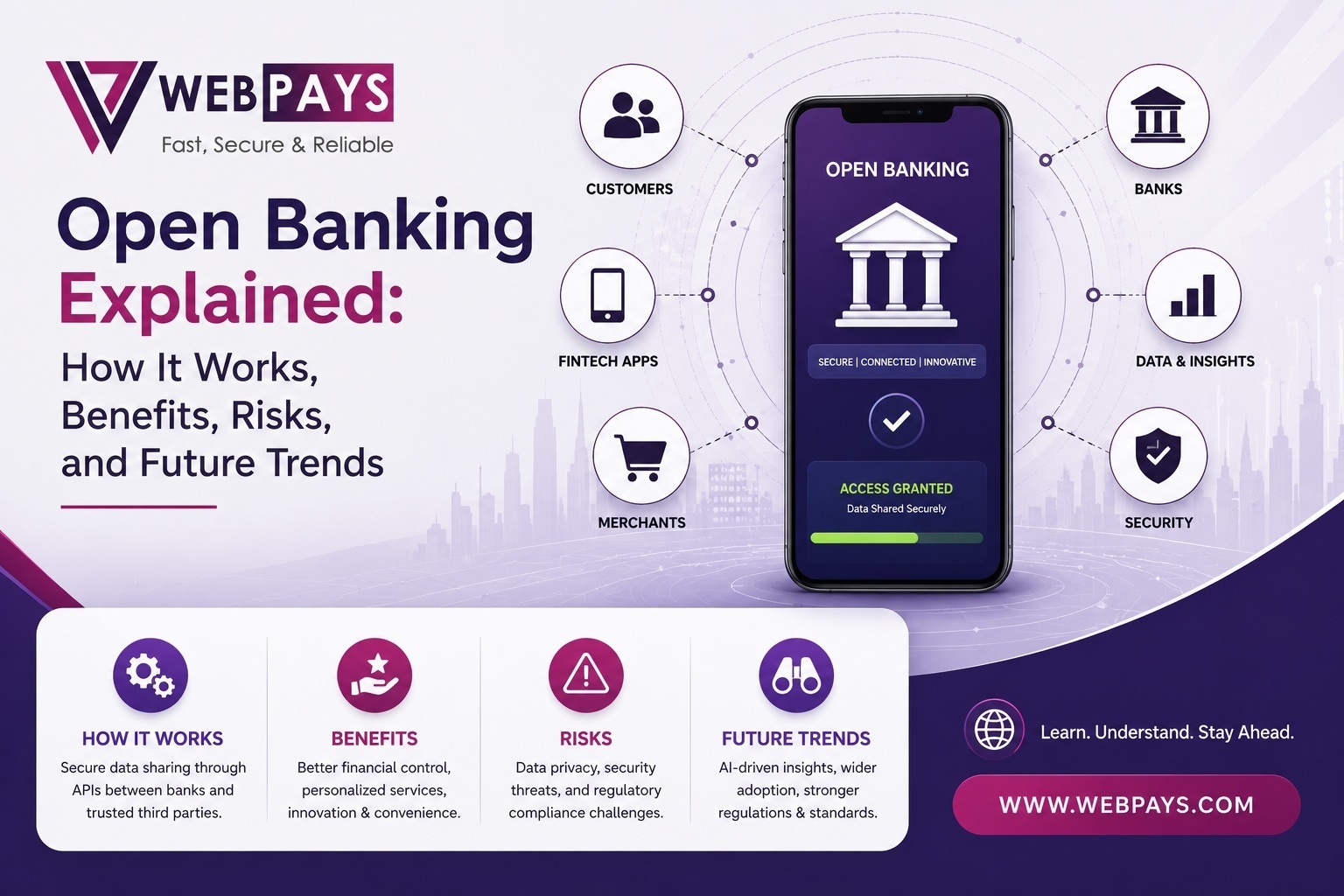
What Is Open Banking?
Open banking is a regulated framework that allows consumers and businesses to authorize their financial institution to share their account data — and sometimes initiate payments on their behalf — with licensed third-party providers (TPPs) through standardized Application Programming Interfaces (APIs).
Three elements are always present:
-
Consumer or business consent — data moves only when the account holder explicitly authorizes it.
-
APIs — structured digital connections that allow software systems to communicate securely.
-
Licensed third parties — apps, fintechs, or platforms that have passed regulatory vetting to access that data.
The key distinction from older models: in open banking, no one needs to share a username or password with a third party. The bank itself acts as the secure gateway, and the consumer decides what data flows, to whom, and for how long.
Why Open Banking Matters in 2026
For decades, a person's financial data was locked inside their bank. Switching banks meant starting over. Comparing loan offers required manual paperwork. Getting a mortgage required submitting physical bank statements that a lender would re-key into a spreadsheet.
Open banking breaks these silos. When a lender can see six months of verified transaction data in real time, a credit decision that once took weeks can happen in minutes. When a budgeting app can read balances across four different banks, the user gets a true picture of their finances in one dashboard.
This shift is not theoretical. In the United Kingdom — the world's most advanced open banking market — 351 million open banking-powered payment transactions were processed in 2025, a 57% year-on-year increase. The UK had 13.3 million active open banking users as of March 2025, and open banking payments represented approximately 1 in every 13 Faster Payments in the country.
Globally, 42% of adults made a digital payment to a merchant in 2024, up from 35% in 2021 — a macro tailwind that feeds directly into open banking adoption.
The History of Open Banking
How It Started: From Silos to APIs
Traditional banking operated on the principle that a customer's financial data belonged to the bank. When fintech companies began emerging in the early 2010s, many of them resorted to a practice called screen scraping — using a customer's credentials to log into their bank and extract data by simulating a browser. This was insecure, legally murky, and fragile. If a bank changed its website layout, the connection broke.
Regulators in Europe responded by creating a legal and technical framework to replace screen scraping with secure, standardized API connections. The result was a fundamental shift: instead of fintechs impersonating customers, banks would become active, regulated participants in data sharing.
PSD2 and the European Foundation
The Payment Services Directive 2 (PSD2), which came into force across the European Union in January 2018, is the foundational regulation behind modern open banking. PSD2 required all banks in EU member states to:
-
Build and maintain open APIs for authorized third-party providers.
-
Implement Strong Customer Authentication (SCA) — typically two-factor verification — before any data sharing or payment is triggered.
-
Allow licensed Account Information Service Providers (AISPs) and Payment Initiation Service Providers (PISPs) to access customer accounts with consent.
PSD2 turned open banking from a concept into a legal obligation. By 2022, more than 500 third-party providers had registered across Europe under PSD2.
As of 2026, the European Commission is developing PSD3 — a successor regulation designed to strengthen interoperability, close API quality gaps that slowed PSD2's rollout, and extend data-sharing rights beyond payment accounts.
The UK's Open Banking Initiative
The UK's path was shaped by a competition investigation rather than payment regulation. In 2016, the Competition and Markets Authority (CMA) ordered the nine largest UK retail banks — known as the CMA9 — to build standardized open banking APIs by January 2018. These banks included Barclays, HSBC, Lloyds Banking Group, NatWest, Santander UK, Danske Bank, Bank of Ireland, Allied Irish Bank, and Nationwide.
The Open Banking Implementation Entity (OBIE) was established to set the technical standards. The UK's approach — standardizing the API design, not just mandating openness — produced a more consistent ecosystem than Europe's principle-based PSD2 framework.
By March 2025, the UK had 13.3 million active open banking users — a new record. The country is now transitioning governance of open banking to a new entity, the Joint Regulatory Oversight Committee (JROC), as part of a broader "Smart Data" initiative extending the model to telecoms and energy.
Global Expansion
Open banking has since spread well beyond its European origins:
-
Australia: The Consumer Data Right (CDR), launched in 2020, now extends beyond banking to energy and telecommunications — one of the world's most ambitious cross-sector data frameworks.
-
India: The Account Aggregator (AA) Framework, backed by the Reserve Bank of India, now has over 100 million linked accounts. It has reduced the cost of lending underwriting from approximately $15 per application to under $1.
-
United States: The Consumer Financial Protection Bureau (CFPB) finalized data rights rules giving Americans the right to access and share their financial data, representing the country's first formal open banking mandate.
-
Canada: Canada launched a regulated open banking framework in 2026 for major financial institutions, with phased rollout for smaller players.
-
Saudi Arabia and Indonesia: Saudi Arabia's open banking mandate contributed to a 40% rise in fintech adoption in two years. Indonesia's National Standard Open API (SNAP) enabled banks like BRI to generate $65 million in direct API revenue in 2025.
-
Nigeria: The first African nation to formalize open banking regulation, with a framework published by the Central Bank.
-
Singapore: The Monetary Authority's Financial Data Exchange (SGFinDex) integrates data from CPF, IRAS, and insurers into 12+ financial applications.
As of 2025, more than 40 countries have moved from basic open banking frameworks toward broader open finance initiatives.
How Does Open Banking Work?
The Consent and Authorization Flow
Open banking is built around a simple but secure sequence of steps. Here is how a typical interaction unfolds when a user connects a budgeting app to their bank:
-
User selects their bank inside the third-party application.
-
Redirection to the bank — the app redirects the user to their bank's official website or app for authentication.
-
Strong Customer Authentication (SCA) — the user verifies their identity using two factors (e.g., a password plus a one-time code sent to their phone).
-
Consent granted — the user reviews and confirms exactly what data the app is permitted to see (e.g., "transaction history for the last 90 days from account ending 4521").
-
Access token issued — the bank issues a time-limited, scoped access token to the third-party app.
-
API call made — the app uses the token to request data via the bank's API. No password is ever shared with the app.
-
Data delivered — the bank responds with the requested data in a standardized format (typically JSON).
-
Consent managed — the user can revoke this permission at any time, directly from their bank.
This flow is fundamentally different from screen scraping. At no point does the third-party app hold the user's banking credentials.
The Role of APIs in Open Banking
An API (Application Programming Interface) is a set of rules and protocols that allows two software systems to communicate. In open banking, APIs serve three functions:
-
Authentication: Verifying that the third-party provider is licensed and that the user has consented.
-
Authorization: Controlling what data the token holder is permitted to access.
-
Data exchange: Delivering structured financial data in a machine-readable format.
Open banking APIs are standardized — meaning a fintech doesn't need to build a separate integration for each bank. In the UK, any app built to the OBIE API specification can connect to all CMA9 banks using the same code. This standardization is what makes the ecosystem scalable.
Authentication Methods
Three protocols underpin secure open banking authentication:
-
OAuth 2.0: The industry standard for authorization. It allows a user to grant a third party limited access to their account without sharing credentials. The access token is scoped (limited to specific data) and time-bound.
-
OpenID Connect (OIDC): Layered on top of OAuth 2.0, OIDC adds identity verification — confirming who the user is, not just what they're allowed to access.
-
Strong Customer Authentication (SCA): Required under PSD2 and UK Open Banking, SCA mandates multi-factor authentication combining at least two of: something the user knows (PIN/password), something they have (phone/device), or something they are (biometric).
Types of Open Banking APIs
Account Information Service APIs (AIS)
Account Information APIs give authorized apps read-only access to a user's account data. They are the most widely deployed open banking API type.
What they enable:
-
Real-time account balance retrieval
-
Full transaction history (often 12–24 months)
-
Multi-account aggregation across different banks
-
Income verification for mortgage or lending applications
-
Automated bookkeeping by connecting bank data directly to accounting software
Example in practice: A freelancer connects Xero accounting software to three business bank accounts across two banks. Each morning, Xero pulls overnight transactions via AIS APIs and automatically categorizes expenses, reconciles invoices, and updates profit/loss figures — without the freelancer logging into any bank.
Payment Initiation Service APIs (PIS)
Payment Initiation APIs allow licensed providers to trigger payments directly from a user's bank account, bypassing card networks entirely.
What they enable:
-
Bank-to-bank (account-to-account, or A2A) payments
-
Instant one-time payments at checkout
-
Variable Recurring Payments (VRPs) — automated, consumer-controlled recurring debits
-
Reduced transaction costs for merchants (typically 0.1–0.3% vs. 1.5–3% for cards)
Example in practice: A consumer shopping online selects "Pay by Bank" at checkout. They are redirected to their bank, authenticate with biometrics, confirm the payment, and return to the merchant's site with the payment confirmed — all in under 10 seconds, with no card details entering the merchant's system.
In 2025, UK open banking payments reached 351 million transactions annually — a 57% increase over 2024 — driven almost entirely by PIS API adoption.
Confirmation of Funds APIs (CoF)
These APIs answer a single yes/no question: does the user's account contain sufficient funds to complete a transaction?
What they enable:
-
Reducing failed card transactions and returned direct debits
-
Real-time balance checks before high-value purchases
-
Improved authorization rates for payment processors
Example in practice: A car rental company checks whether a customer's account holds a £500 deposit before handing over keys, avoiding both card holds and failed authorizations.
Identity Verification APIs
These connect open banking account data with identity verification workflows.
What they enable:
-
Know Your Customer (KYC) processes using bank-verified identity
-
Proof of address from bank statement data
-
Fraud prevention through account ownership confirmation
-
Anti-Money Laundering (AML) checks
Example in practice: A neobank onboards a new customer in under three minutes by using open banking identity APIs to confirm name, address, and account ownership — replacing a manual document review process that previously took 24–48 hours.
Credit and Lending APIs
These APIs bring real-time financial data into lending decisions.
What they enable:
-
Affordability assessment using live income and expenditure data
-
Alternative credit scoring for thin-file or credit-invisible borrowers
-
Instant pre-approval for personal loans or mortgages
-
Real-time income verification replacing paper payslips
Example in practice: India's Account Aggregator framework has enabled lenders to assess borrowers who have no credit score but have verifiable transaction history. The cost of underwriting a loan application has dropped from approximately $15 to under $1 — a 95% reduction — while approval times have fallen from weeks to minutes.
Benefits of Open Banking
Benefits for Consumers
Greater financial visibility. When account data from multiple banks flows into a single dashboard, consumers see their complete financial picture — all balances, all subscriptions, all spending patterns — without logging into multiple apps. This is not a convenience feature; research consistently shows that people who can see their full financial position make better decisions about saving and spending.
Faster credit access. Traditional loan applications require payslips, bank statements, and manual income verification. Open banking replaces this with a real-time data pull. For consumers with non-standard income — freelancers, gig workers, self-employed individuals — it provides a route to credit that the credit bureau model often blocks.
Better payment options. Open banking payments eliminate card fees, remove the need to enter 16-digit card numbers, and complete in seconds. For consumers, this means simpler checkouts. The instant refund expectation is shifting too: 43.6% of German consumers expect refunds within 60 seconds of initiating the process, a standard that open banking-powered instant payments can actually meet.
Control over personal data. Unlike screen scraping, where a third party holds your credentials indefinitely, open banking consent is specific and revocable. A consumer can grant access to 90 days of transaction history, for one specific app, until a specific date — and revoke it instantly. This is a meaningful upgrade in data sovereignty.
Financial inclusion. For the 1.4 billion adults worldwide who remain unbanked or underbanked, open banking provides access to financial services that credit bureau-based models exclude. Transaction history replaces credit scores as the basis for assessment.
Benefits for Businesses
Lower payment costs. Card processing fees typically range from 1.5% to 3% of transaction value. Open banking account-to-account payments typically cost between 0.1% and 0.3%. For a business processing £5 million in monthly revenue, the difference can exceed £85,000 per month.
Faster settlement. Card payments typically settle in one to three business days. Open banking payments settle immediately or within seconds under the Faster Payments scheme. For cash-flow management — particularly for small and medium enterprises — this difference is material.
Real-time cash flow visibility. Corporate treasury teams are using open banking multi-bank aggregation APIs to see consolidated cash positions across 50 or more banking relationships instantly. Tools like Kyriba and TIS, built on open banking rails, enable treasury decisions in real time rather than using overnight batch reports.
Embedded banking in business tools. A significant trend in 2026 is ERP-embedded banking. Small businesses no longer want to log into separate banking portals. Banks like Starling (UK) have integrated payment execution directly into accounting platforms like Xero. A business owner approves a batch of supplier payments inside their accounting software, and the open banking API executes it — no separate bank login required.
Improved fraud detection. Account ownership verification via open banking APIs significantly reduces first-party fraud in lending. When a lender can confirm that the account linked to a loan application actually belongs to the applicant — confirmed by the bank itself — synthetic identity fraud becomes far harder to execute.
Faster onboarding. Businesses requiring customer KYC can complete identity checks in minutes using open banking identity APIs, replacing document-heavy processes. This accelerates customer acquisition and reduces drop-off rates.
Benefits for Banks
Open banking is often framed as a threat to traditional banks, but the picture is more nuanced. Banks that participate actively in the open banking ecosystem gain:
New revenue streams from API monetization. Bank BRI in Indonesia generated $65 million in direct open banking revenue in 2025 by charging e-commerce platforms for embedded lending API access. This represents a model shift: from banks charging retail customers for services, to banks charging platforms for infrastructure access.
Deeper customer relationships. Banks that provide compelling open banking-powered tools — spending analytics, savings recommendations, payment initiation — retain customers who might otherwise switch to digital-first competitors.
Reduced operational costs. Automating data verification, identity checks, and payment reconciliation through APIs reduces manual processing. Banks that invest in clean, well-documented APIs also reduce the support burden of managing third-party integrations.
Benefits for Fintech Companies
Faster product development. A fintech building on open banking APIs accesses years of standardized infrastructure without building banking relationships from scratch. An Account Information service that would have required six months of bank negotiations and custom integrations in 2015 can now be built in weeks using off-the-shelf API libraries.
Richer customer insights. Access to real transaction data enables fintechs to understand customer behavior with a precision that survey data cannot match. Spending patterns reveal lifestyle changes, income fluctuations, and financial stress earlier than credit bureau signals.
Risks of Open Banking
Open banking creates genuine value, but it also introduces risks that consumers and businesses should understand clearly.
Data Privacy and Consent Risks
Open banking data is among the most sensitive personal information that exists. Transaction records reveal where a person shops, eats, worships, receives medical care, and donates money. They can infer political affiliation, health conditions, and relationship status.
The primary privacy risk is consent creep — a user authorizes limited data sharing for a specific purpose, but the data is used beyond that purpose, retained longer than agreed, or shared with sub-processors the user was never told about. This is not hypothetical: in the pre-regulation screen scraping era, some aggregators retained and resold customer data indefinitely.
Regulation addresses this, but enforcement is uneven. Under PSD2, third-party providers must limit data use to the specific purpose consented to and must not retain credentials. But audit mechanisms remain underdeveloped across most markets.
For consumers: Always review what data you are sharing, with whom, and for how long. Look for providers that offer granular consent controls and transparent data retention policies.
Cybersecurity Risks
Open banking APIs create new attack surfaces. Vulnerabilities in API implementations — authentication flaws, insufficient authorization controls, rate limiting failures — can expose customer data at scale. Unlike a compromised card number, which can be cancelled and reissued, transactional history is permanent.
The financial sector faces growing cybersecurity pressure. Estimated global cybercrime costs reached $12 trillion in 2025. Open banking doesn't create this threat, but it concentrates high-value data flows through new channels that require rigorous protection.
Key technical protections in compliant implementations include:
-
TLS 1.3 encryption for all API communications
-
Certificate pinning to prevent man-in-the-middle attacks
-
Rate limiting to prevent API abuse and credential stuffing
-
Anomaly detection on API call patterns to flag unauthorized access
Third-Party Provider Risks
Granting data access to a third-party provider is only as safe as that provider's security posture. A licensed and regulated provider can still suffer a breach. Not all markets regulate TPPs with equal rigor, and the global patchwork of open banking standards means a provider operating across borders may meet requirements in one jurisdiction but not another.
Due diligence questions for consumers and businesses:
-
Is the provider licensed under the relevant national regulation (FCA in the UK, BaFin in Germany, etc.)?
-
What is their data breach notification policy?
-
Do they undergo independent security audits?
-
Can you revoke access from your bank directly, bypassing the provider?
Consumer Awareness Gap
A 2025 analysis found that 40% of open banking users do not know they are using it. This is not inherently a problem — seamless infrastructure often works best when users don't think about it — but it creates a consent quality issue. Uninformed consent is not meaningful consent.
If a consumer authorizes an app without understanding that they are sharing 18 months of transaction history, they have not made an informed decision. The industry's challenge is embedding transparency into user flows without creating friction that depresses adoption.
Regulatory Fragmentation
A business operating across multiple markets faces a patchwork of open banking regulations, each with different API standards, consent formats, and licensing requirements. The UK Open Banking standard, PSD2 in Europe, the CFPB rule in the US, and Australia's CDR each impose different technical and legal obligations. Compliance across all of them simultaneously is expensive and operationally complex.
How Open Banking Protects Users (When Done Correctly)
Properly implemented open banking systems include multiple protection layers:
-
OAuth 2.0 with scoped, time-limited tokens — no open-ended access
-
Strong Customer Authentication (SCA) — two-factor verification before any data sharing
-
Explicit consent journeys — users see exactly what they're sharing before confirming
-
Immediate revocation — users can cut access from their bank's interface at any time
-
Regulatory oversight — TPPs are licensed, audited, and carry liability for misuse
-
No credential sharing — the third party never holds your banking password
Real-World Open Banking Examples
Personal Finance and Budgeting Apps
Apps like Moneybox, Emma, and Copilot use Account Information APIs to pull transaction data from multiple banks into a single interface. Users see all their accounts, categorized spending, subscription alerts, and savings progress in one dashboard.
Impact: Users who can see their full financial picture across accounts consistently show higher savings rates and lower unnecessary spending in product studies. The information advantage, previously available only to people with dedicated financial advisors, is now available to anyone with a smartphone.
Digital Lending Platforms
Alternative lenders including Oakbrook Finance and Creditspring use open banking income verification to approve loans for borrowers who have limited credit history. Rather than relying on a credit bureau score — which may not exist for someone new to credit — they assess actual income flows and expenditure patterns from the last six months.
Impact: Approval rates for creditworthy thin-file borrowers increase significantly, while default rates remain comparable to traditional underwriting because the underlying financial behavior data is more predictive than a bureau score.
Open Banking Payments at Checkout
"Pay by Bank" options powered by Payment Initiation APIs are now live with multiple UK retailers, including major grocery chains and utility providers. The user selects the option at checkout, authenticates with their bank biometrically, and returns to the merchant site with payment confirmed — typically in under 15 seconds.
Impact for merchants: Chargebacks — which can cost 2–4% of revenue in high-fraud categories — are eliminated. Card processing fees are replaced by flat-rate or per-transaction API fees typically 5–10x lower than card interchange.
Business Banking and Cash Flow Management
Corporate treasury platforms built on open banking multi-bank aggregation APIs allow finance teams to see real-time balances across dozens of banking relationships, initiate payments, and set automated cash pooling rules — all from a single interface rather than logging into multiple bank portals.
Impact: What previously required overnight batch reconciliation and manual consolidation can now happen in real time. Finance teams spend less time gathering data and more time acting on it.
Variable Recurring Payments (VRP)
VRPs are an open banking payment type that allows a user to authorize a trusted provider to make recurring payments on their behalf, within consumer-defined limits (maximum amount, frequency, date range). Unlike direct debits, VRPs give the consumer full control and visibility.
Example: A "sweeping" VRP automatically moves excess funds from a current account into a savings account at the end of each day, keeping the current account at a target balance — without the user needing to do anything manually.
Open Banking vs Open Finance
Open banking covers bank accounts: current accounts, savings accounts, and payment transactions. Open finance extends the same API-driven, consent-based model to the full breadth of a consumer's financial life.
|
Dimension |
Open Banking |
Open Finance |
|
Data scope |
Bank account transactions and balances |
Investments, pensions, mortgages, insurance, BNPL, crypto |
|
Regulatory basis |
PSD2, UK Open Banking, CFPB Rule |
Emerging frameworks (EU, Australia CDR, FCA review) |
|
Use cases |
Budgeting, payments, credit scoring |
Holistic financial planning, pension aggregation, insurance comparison |
|
Maturity |
Deployed and regulated in 40+ countries |
In development; Australia and EU most advanced |
The practical difference matters enormously. A consumer's pension, investments, and insurance policies often contain more wealth than their bank account. A financial planner working only from bank data sees a partial picture. Open finance would enable truly comprehensive financial advice.
Australia's CDR is the world's most advanced open finance implementation, with coverage now extending beyond banking to energy and telecommunications. The European Commission is developing a parallel framework under the Financial Data Access (FIDA) regulation.
Open Banking Around the World
United Kingdom
The UK remains the global benchmark. It was first to mandate standardized open banking APIs (January 2018), first to reach 10 million+ active users, and first to deploy Variable Recurring Payments at scale. In 2025, UK open banking payments hit 351 million annually — a 57% year-on-year increase — and represented approximately 1 in every 13 Faster Payments. The UK recorded 29.89 million open banking-enabled transactions in a single month (July 2025), a monthly record. Governance is transitioning from the OBIE to the JROC as part of a broader Smart Data framework.
European Union
PSD2 created the legal foundation for open banking across all EU member states, but implementation quality has varied significantly. API performance and reliability have been ongoing issues in several markets. PSD3 is in development to address these gaps, strengthen consumer protections, and expand the scope to non-payment financial accounts. Key markets — Germany, France, Spain, Italy — have lower consumer penetration than the UK, but business-to-business API use has grown significantly.
United States
The CFPB's Personal Financial Data Rights Rule represents the US's first formal step toward mandated open banking. Compliance is phased by institution size, beginning with the largest banks. The rule gives Americans the right to access and share their financial data — a right that has existed informally through fintech data sharing agreements for years, but now carries regulatory backing. Industry-led standards body the Financial Data Exchange (FDX) has also advanced a common API specification.
Australia
Australia's Consumer Data Right (CDR), launched in 2020, is the world's most comprehensive cross-sector data framework. It has expanded from banking to energy and telecommunications, with non-bank lenders and BNPL providers entering scope from 2025, with first compliance obligations in mid-2026. Australia leads the world in cross-sector open data.
India
India's Account Aggregator Framework, backed by the Reserve Bank of India, has reached a scale that surprises observers familiar only with Western implementations. Over 100 million accounts are linked. Over 200 financial entities participate. The framework enables consent-based sharing of banking, insurance, and tax data. Most significantly, it has reduced lending underwriting costs by 95% and brought formal credit access to millions of previously excluded borrowers.
Singapore and Southeast Asia
Singapore's SGFinDex integrates CPF, IRAS, and insurance data into 12+ financial applications. Indonesia's SNAP standard has enabled aggressive API monetization by major banks. The region is notable for moving beyond compliance-driven adoption to commercially-driven API revenue models.
The Future of Open Banking in 2026 and Beyond
AI-Powered Financial Services
Artificial intelligence and open banking are beginning to reinforce each other. AI can analyze the transaction data flowing through open banking APIs to deliver genuinely personalized financial services:
-
Predictive cash flow alerts: An AI model trained on 18 months of transaction history can identify with high accuracy when a small business is two weeks away from a cash flow shortfall — giving them time to act rather than discover the problem at overdraft.
-
Affordability underwriting: AI-driven open banking tools analyze not just income but spending patterns, volatility, and financial resilience — producing more accurate lending decisions than bureau score models.
-
Fraud detection: Real-time transaction analysis via open banking APIs enables fraud scoring at the payment initiation stage, before money moves.
Embedded Finance
Embedded finance — placing financial services directly inside non-financial platforms — is the fastest-growing application layer on top of open banking. Retailers embedding buy-now-pay-later, gig platforms embedding instant pay, ERP systems executing bank payments — all require open banking infrastructure.
By 2026, SMEs in particular are driving demand for ERP-embedded banking. Business owners approve supplier payments directly inside accounting tools like Xero or QuickBooks, with open banking APIs executing the payment. The bank interface becomes invisible; banking becomes a background infrastructure layer.
Variable Recurring Payments Scale
VRPs — particularly "sweeping" (moving money between your own accounts) and "non-sweeping" (authorizing controlled payments to third parties) — are expected to grow substantially. They represent an alternative to the direct debit infrastructure that has powered UK consumer payments for 60 years, with superior consumer control and real-time confirmation.
Real-Time Payments as Standard
The EU's Instant Payments Regulation mandates that SEPA Instant Payments be available at the same price as standard transfers across all Eurozone banks. Over 99% of SEPA Instant Payments already settle within seconds. As instant settlement becomes the baseline expectation, open banking payment initiation — which rides instant payment rails — becomes the obvious path for merchants and billers.
Cross-Border Open Banking
Interoperability between national open banking systems remains underdeveloped in 2026, but frameworks are emerging. The G20 has included cross-border data flows in its financial inclusion agenda. A business operating in the UK and EU currently needs separate API integrations and compliance work for each market. Standardized cross-border APIs — likely built on ISO 20022 messaging standards — are a medium-term development goal.
From Open Banking to Open Finance to Open Data
The trajectory is clear: open banking (bank accounts) → open finance (all financial products) → open data (financial plus health, energy, telecoms). Australia is furthest along this path. The EU's FIDA regulation and the UK's Smart Data programme are moving in the same direction.
The end state is a consumer who controls their data across every sector and can grant permission for services to access exactly the slice they need — no more, no less — to deliver value.
FAQs About Open Banking
What is open banking?
Open banking is a system in which consumers and businesses can authorize their bank to share their financial data with licensed third-party applications through secure APIs. Data is shared only with explicit user consent.
How does open banking work?
When you connect a third-party app to your bank account, you are redirected to your bank's official site, authenticate using two-factor verification, and confirm exactly what data you are sharing. The bank issues a time-limited access token to the app. Your actual password is never shared with the third party.
Is open banking safe?
When implemented correctly — by licensed providers, following regulatory requirements, with proper encryption and SCA — open banking is significantly safer than screen scraping (the previous alternative). The main risks are consent mismanagement and third-party data breaches. Consumers should use only licensed providers and regularly review and revoke open banking consents they no longer need.
What are the benefits of open banking?
For consumers: faster credit access, better financial visibility, lower-cost payments, and stronger data control. For businesses: lower payment costs, faster settlement, automated cash flow visibility, and faster customer onboarding. For banks: API revenue, better customer retention, and reduced operational costs.
What are the risks of open banking?
Data privacy risks (consent creep, data misuse), cybersecurity risks (API vulnerabilities, breaches), third-party provider risks (variable security quality), and consumer awareness gaps (uninformed consent).
What are open banking APIs?
Open banking APIs are standardized, secure interfaces through which banks share customer financial data with licensed providers. The four main categories are Account Information (AIS), Payment Initiation (PIS), Confirmation of Funds (CoF), and Identity Verification APIs.
What is PSD2?
The Payment Services Directive 2 is the EU regulation, enforced from January 2018, that required all European banks to open standardized APIs to licensed third-party providers and implement Strong Customer Authentication. It is the foundational law behind European open banking.
What is the difference between open banking and open finance?
Open banking covers bank account data: transactions, balances, and payments. Open finance extends the same model to all financial products — pensions, investments, mortgages, insurance. Open banking is deployed globally; open finance is emerging in Australia and Europe.
Which countries use open banking?
The UK and EU have mandatory open banking frameworks. Australia's CDR covers banking and extends to energy and telecoms. The US has implemented its first federal open banking rule via the CFPB. India's Account Aggregator framework operates at scale. Canada launched a regulated framework in 2026. More than 40 countries have some form of open banking policy.
What is the future of open banking?
The direction is toward AI-powered personalization, embedded finance, Variable Recurring Payments, cross-border interoperability, and expansion from open banking into open finance and eventually open data ecosystems. The global market is expected to grow from approximately $29.78 billion in 2026 to $59.81 billion by 2031.
Sources: Mordor Intelligence Open Banking Market Report (January 2026); Precedence Research Open Banking Market (2026); Open Banking Implementation Entity (OBIE) Annual Review (2025); Brite Payments Open Banking Trends 2026; Astute Analytica Open Banking Market Report (February 2026); SQ Magazine Open Banking Adoption Statistics (2026); Coinlaw.io Open Banking Statistics (2026); Mastercard Open Banking 2025 Thoughts & Trends; Digital API Open Banking Trends 2026.
→ Book a 15-Minute Open Banking Free Consultation — discuss your industry, processing volume, and target markets with our specialist team.
Our specialists cover every regulated vertical — including gaming, CBD, forex, adult services, and crypto — with direct relationships across acquiring banks and open banking infrastructure providers across the UK, EU, and the United States.
Disclaimer :- This document is confidential and intended solely for the recipient. © 2026 All rights reserved. Open Banking Explained: What Is Open Banking? How It Works, Benefits, Risks, and Future. | Confidential

 Czech
Czech
 English
 Arabic
 French
 Spanish
 Portuguese
 Turkish
 Dutch
Dutch
 Italiano
 Russian
 Romaian
 Portuguese (Brazil)
 Greek
Greek