


 About SPORTIVO Network
How Is Yarn Strength Controlled?
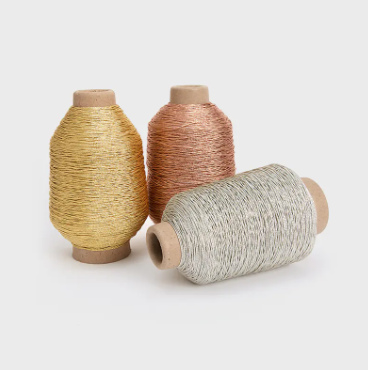
The performance of metallic yarn in textile processing is influenced by multiple structural and material factors. Among them, M Type Metallic Yarn represents a basic flat-film structure that emphasizes visual brightness while relying on precise manufacturing control to maintain usability.
One of the main performance factors is film thickness. Typically ranging from 12μ to 25μ, film thickness affects both flexibility and mechanical resistance. Thinner films provide smoother handling in fine embroidery applications, while thicker films offer improved stability in weaving environments.
Another important factor is metallization uniformity. Aluminum coating must be evenly distributed across the polyester film surface to ensure consistent reflectivity. Any irregularity in coating density can result in uneven brightness when used in finished fabrics.
Surface protection also plays a key role. The epoxy coating applied after metallization serves as a barrier against oxidation and mechanical wear. It helps preserve reflective properties during high-speed textile processing and reduces the risk of surface cracking under tension.
Width control is equally important. Standard strip widths such as 1/69” and 1/100” determine how the yarn interacts with base fabrics. Narrow strips are more suitable for embroidery threads, while wider strips are often used in decorative weaving.
Mechanical strength in M Type Metallic Yarn is moderate because it does not include a supporting filament core. As a result, production conditions must be carefully adjusted. Machine speed, tension levels, and needle size all influence yarn behavior during processing.
To improve performance in demanding applications, metallic yarn is sometimes used in combination with supporting structures in other yarn types. However, in pure M Type form, its primary advantage lies in decorative brightness rather than structural reinforcement.
Temperature sensitivity is another consideration. During finishing processes, excessive heat can alter film properties or reduce gloss intensity. Controlled heat treatment is therefore necessary to maintain consistent product appearance.
Storage conditions also affect long-term performance. Exposure to humidity or direct sunlight may gradually impact surface quality. Proper packaging in sealed cones or spools helps maintain stability during transportation and storage.
In practical applications, M Type Metallic Yarn is widely used in embroidery, ribbon production, lace fabrics, and decorative textiles. Its ability to deliver stable visual effects makes it suitable for industries where aesthetic consistency is important.
Overall, the performance of this yarn is determined by a combination of material engineering, coating technology, and process control. Each parameter contributes to ensuring that the yarn performs reliably in textile manufacturing environments.

 Czech
Czech
 English
 Arabic
 French
 Spanish
 Portuguese
 Deutsch
 Dutch
Dutch
 Italiano
 Russian
 Romaian
 Portuguese (Brazil)
 Greek
Greek