


 About SPORTIVO Network
What Is LLM and Why Is It Changing the Future of AI?
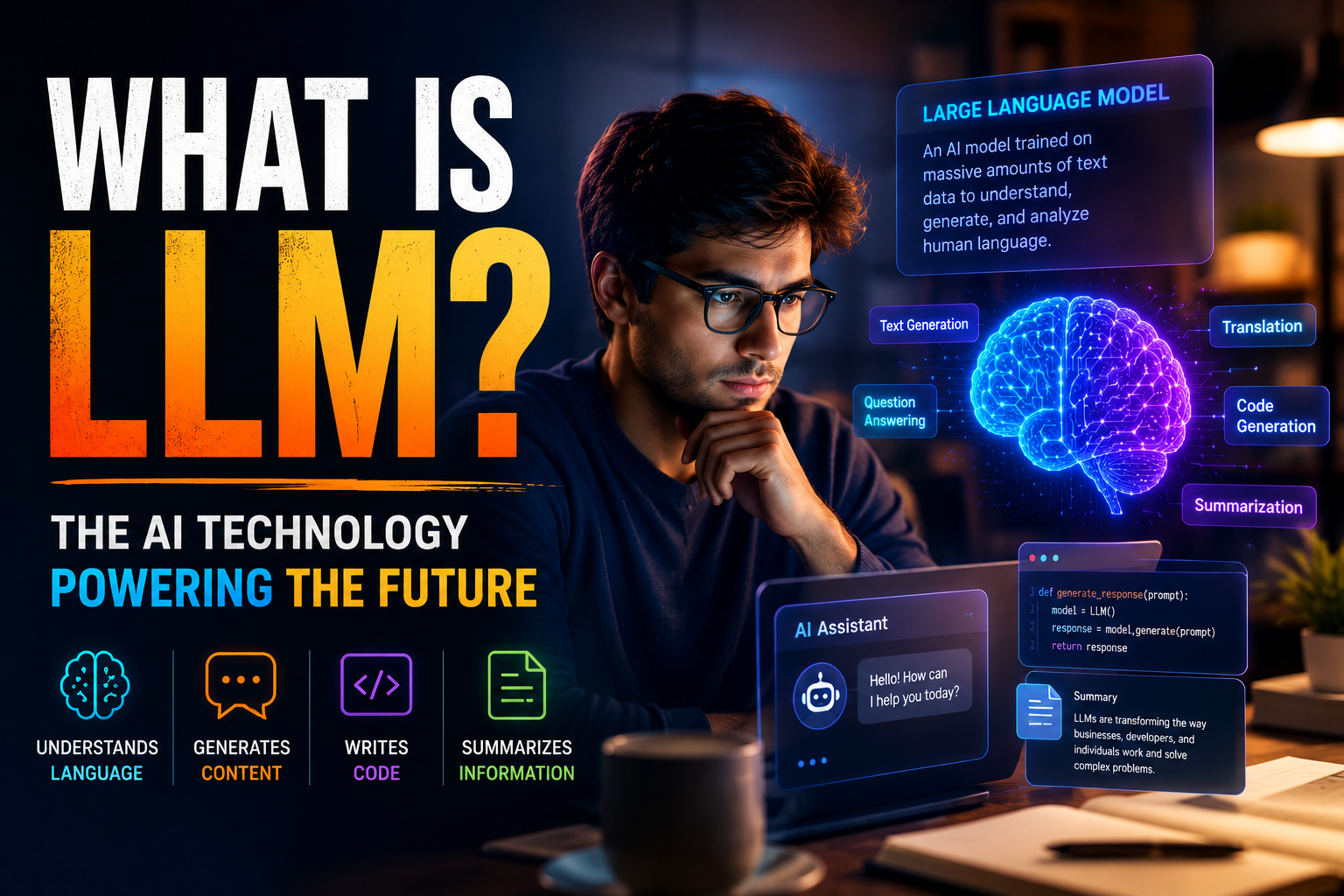
Artificial intelligence reached a turning point when Large Language Models (LLMs) began generating content, writing code, answering complex questions, and even assisting businesses with decision-making. According to the Stanford AI Index Report 2025, generative AI investment and enterprise adoption have grown significantly over the past two years, largely driven by advances in LLMs.
A few years ago, chatbots followed predefined rules and frequently failed to understand context. Today, LLMs can summarize research papers, automate customer support, generate software code, and power virtual assistants that feel remarkably conversational. That shift explains why discussions about what is LLM have become so common across technology and business circles.
What Is LLM?
LLM stands for Large Language Model. It is an artificial intelligence model trained on enormous amounts of text data to understand, generate, summarize, translate, and analyze human language.
Unlike traditional software that relies on fixed programming rules, an LLM predicts the most appropriate sequence of words based on patterns learned during training. This enables it to respond naturally while understanding context instead of simply matching keywords.
Modern AI tools including ChatGPT, Claude, Gemini, and Microsoft Copilot are all powered by advanced Large Language Models.
Businesses increasingly rely on LLMs because they reduce manual work while improving communication, productivity, and knowledge access.
How Does an LLM Work?
At its core, a Large Language Model learns from billions or even trillions of words collected from books, research papers, websites, documentation, and other publicly available datasets.
The process generally involves four stages:
- Collecting massive datasets containing diverse language.
- Training transformer-based neural networks to recognize language patterns.
- Fine-tuning the model for specialized industries or business tasks.
- Generating responses by predicting the next most likely word based on previous context.
The transformer architecture, introduced by Google researchers in the paper "Attention Is All You Need," became the foundation for nearly every modern LLM.
This architecture allows models to process relationships between words much more effectively than earlier machine learning techniques.
Why Are LLMs So Powerful?
Traditional AI systems struggled whenever conversations became longer or more complex.
Large language models changed that by learning context instead of memorizing predefined responses.
Some of their biggest strengths include:
- Natural language understanding
- Context-aware conversations
- Content generation
- Programming assistance
- Translation across multiple languages
- Document summarization
- Data analysis
- Question answering
According to the Stack Overflow Developer Survey 2024, AI-assisted coding tools have become a regular part of software development for a large share of developers worldwide.
That adoption reflects practical productivity gains rather than simple curiosity.
Anchor Text: AI Development Services
Real-World Applications of LLMs
Large Language Models are no longer limited to research laboratories. They have become part of everyday business operations.
Customer Support
AI-powered chatbots now resolve thousands of customer queries around the clock while maintaining conversational accuracy.
Software Development
Developers use LLMs to generate code, explain programming concepts, detect bugs, and improve documentation.
Healthcare
Medical organizations use specialized language models to summarize patient records, assist clinical documentation, and accelerate research while keeping professionals involved in final decisions.
Education
Learning platforms generate personalized explanations, quizzes, and study material based on individual learning patterns.
Marketing
Marketing teams create blog drafts, email campaigns, product descriptions, and advertising copy much faster than traditional workflows.
Benefits of Large Language Models
Organizations adopt LLMs because they improve efficiency across multiple departments.
Some major benefits include:
- Faster content creation
- Better customer experiences
- Reduced operational costs
- Improved employee productivity
- Smarter business automation
- Better knowledge management
- Scalable AI assistants
- Faster software development
Many companies discover that the biggest value comes from combining LLMs with internal business data rather than using general-purpose models alone.
Challenges and Limitations of LLMs
Despite impressive capabilities, Large Language Models are not perfect.
Several challenges still require careful management.
Hallucinations
LLMs occasionally generate incorrect information while presenting it confidently.
Data Privacy
Organizations must carefully protect confidential business information when integrating AI systems.
Bias
Training data may contain biases that influence model responses.
High Computing Costs
Training and deploying advanced LLMs requires enormous computational resources.
Limited Real-Time Knowledge
Unless connected to external systems, many models only know information available before their training cutoff.
Successful AI projects treat LLMs as intelligent assistants rather than replacing human expertise entirely.
Industries Being Transformed by LLMs
The influence of Large Language Models extends across nearly every industry.
Some of the fastest adopters include:
- Healthcare
- Finance
- Legal services
- Retail
- Manufacturing
- Education
- Software development
- E-commerce
- Human resources
- Customer support
Every industry shares one common goal: reducing repetitive work while improving decision-making.
The Future of LLM Technology
The next generation of large language models will move beyond text generation.
Future systems are expected to combine language understanding digital transformation services with images, video, voice, robotics, and real-time reasoning.
Researchers are also focusing on:
- Smaller and more efficient AI models
- Better factual accuracy
- Industry-specific AI assistants
- Improved security and privacy
- Multi-agent AI collaboration
- Personalized enterprise AI
According to the Stanford AI Index Report 2025, investment in generative AI continues to accelerate as organizations seek practical applications that improve productivity and create new business opportunities.
The future of artificial intelligence will likely be defined not by bigger models alone, but by smarter, safer, and more specialized LLMs.
Final Thoughts
Understanding what is LLM has become essential for businesses, developers, and technology leaders evaluating the next generation of AI solutions. Large Language Models have already changed how software is built, how customer service operates, and how information is processed. As these models become more accurate, efficient, and industry-focused, their influence on the future of AI will only continue to grow.
Frequently Asked Questions
What is LLM in artificial intelligence?
LLM stands for Large Language Model. It is an AI model trained on massive text datasets to understand, generate, summarize, and analyze human language with contextual awareness.
Is ChatGPT an LLM?
ChatGPT is an AI application powered by Large Language Models developed by OpenAI. The chatbot interface uses these models to generate conversational responses and assist with various tasks.
What is the difference between AI and LLM?
Artificial Intelligence is the broader field that includes many technologies. An LLM is a specialized type of AI designed specifically for understanding and generating natural language.
Why are businesses using LLMs?
Businesses use LLMs to automate customer support, generate content, improve software development, analyze documents, and increase operational efficiency while reducing repetitive manual work.
Can LLMs replace human professionals?
LLMs can automate repetitive language-based tasks, but they still require human oversight for critical decisions, creative thinking, ethical judgment, and domain-specific expertise.

 Czech
Czech
 English
 Arabic
 French
 Spanish
 Portuguese
 Turkish
 Dutch
Dutch
 Italiano
 Russian
 Romaian
 Portuguese (Brazil)
 Greek
Greek