


 About SPORTIVO Network
CGPA Calculator – Calculate Your Cumulative GPA Instantly (With Formula & Examples)
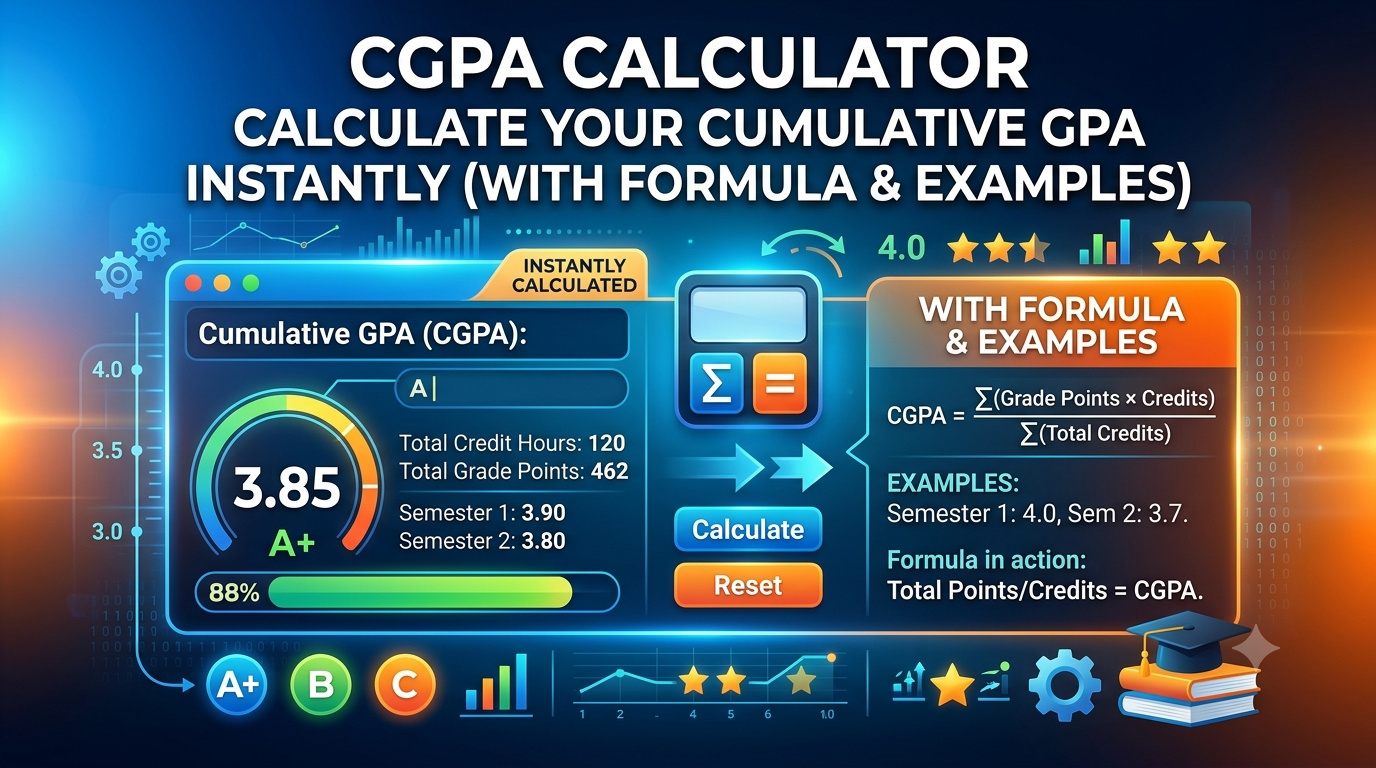
A CGPA calculator is a simple tool that helps students convert their semester or yearly grades into a single cumulative score, known as CGPA (Cumulative Grade Point Average). Whether you're a college student trying to track your academic progress or preparing your CGPA for a job application or higher studies, understanding how a CGPA calculator works can save you time and reduce errors compared to manual calculation.
In this guide, we'll break down what CGPA means, how a CGPA Calculator works, the formula behind it, and how it differs from GPA and percentage — along with answers to the most common questions students ask.
What Is CGPA?
CGPA stands for Cumulative Grade Point Average. It is the average of Grade Points obtained across all semesters or years of a course, rather than just a single term. Most universities use a 10-point or 4-point grading scale, where each grade (A, B, C, etc.) corresponds to a specific grade point.
Unlike SGPA (Semester Grade Point Average), which reflects performance in a single semester, CGPA gives an overall picture of a student's academic performance throughout the entire program.
What Is a CGPA Calculator?
A CGPA calculator is an online or offline tool that automatically computes your cumulative grade point average based on the grades or grade points you enter for each subject or semester. Instead of manually adding up grade points and dividing by the number of subjects or credits, the calculator does the math instantly and accurately.
Most CGPA calculators require you to input:
- The grade points (or letter grades) scored in each subject or semester
- The credit hours assigned to each subject (if applicable)
- The number of semesters or subjects being averaged
How Does a CGPA Calculator Work?
A CGPA calculator generally follows one of two calculation methods, depending on whether your institution uses credit-based weighting or a simple average.
Method 1: Simple Average (Without Credits)
If all subjects carry equal weight, CGPA is calculated as:
CGPA = Sum of Grade Points of All Subjects ÷ Total Number of Subjects
Method 2: Credit-Weighted Average (With Credits)
If subjects have different credit hours, the formula becomes:
CGPA = Sum of (Grade Point × Credit Hours for each subject) ÷ Total Credit Hours
This second method is more common in engineering and university programs where subjects carry different credit weightage.
Example Calculation
Suppose a student has the following grades across four subjects:
| Subject | Credit Hours | Grade Point |
|---|---|---|
| Subject A | 4 | 8 |
| Subject B | 3 | 7 |
| Subject C | 3 | 9 |
| Subject D | 2 | 6 |
Using the credit-weighted formula:
CGPA = [(4×8) + (3×7) + (3×9) + (2×6)] ÷ (4+3+3+2) CGPA = (32 + 21 + 27 + 12) ÷ 12 CGPA = 92 ÷ 12 CGPA = 7.67
So, the student's CGPA would be 7.67 out of 10.
How to Convert CGPA to Percentage
Many students need to convert their CGPA into a percentage for job applications or further education. While the exact conversion factor varies by university, a commonly used formula is:
Percentage = CGPA × 9.5
For example, a CGPA of 8.0 would roughly translate to:
8.0 × 9.5 = 76%
Note: Always check your university's official conversion formula, as this multiplier (9.5) is not universal and can differ between institutions.
CGPA vs GPA vs SGPA: What's the Difference?
| Term | Meaning | Scope |
|---|---|---|
| GPA | Grade Point Average | Usually per semester or overall, often on a 4.0 scale |
| SGPA | Semester Grade Point Average | Performance in one semester only |
| CGPA | Cumulative Grade Point Average | Overall performance across all semesters/years |
Understanding this distinction is important because employers and universities often ask specifically for CGPA rather than SGPA when evaluating overall academic performance.
Why Use a CGPA Calculator Instead of Manual Calculation?
- Accuracy: Removes the risk of manual arithmetic errors, especially with credit-weighted formulas.
- Speed: Instantly calculates results across multiple semesters or subjects.
- Convenience: Useful for tracking academic progress semester by semester.
- Planning: Helps students figure out what grades they need in upcoming semesters to reach a target CGPA.
Tips for Maintaining a Good CGPA
- Track your CGPA after every semester rather than waiting until the end of the course.
- Focus more attention on high-credit subjects, since they impact your CGPA more heavily.
- Set a realistic target CGPA based on your career or higher-education goals.
- Use a CGPA calculator regularly to see how upcoming exams might shift your overall average.
Frequently Asked Questions (FAQs)
Q1. What is a good CGPA? A CGPA of 7.5 or above (on a 10-point scale) is generally considered good by most universities and employers, though requirements vary by institution and industry.
Q2. How is CGPA different from percentage? CGPA is a grade-point-based average, while percentage reflects marks scored out of 100. They are related but calculated differently, and conversion factors vary between universities.
Q3. Can CGPA be more than 10? No, on a 10-point grading scale, CGPA cannot exceed 10. Similarly, on a 4-point scale, it cannot exceed 4.0.
Q4. Does CGPA include failed subjects? This depends on the university's policy. Some institutions exclude failed or repeated subjects from CGPA calculation, while others factor them in with a zero or minimum grade point.
Q5. How can I calculate my CGPA if I only have SGPA for each semester? If each semester carries equal credit weight, you can average all your SGPA scores together. If credit hours differ by semester, you'll need a credit-weighted calculation instead.
Q6. Is a CGPA calculator accurate for all universities? A CGPA calculator is accurate as long as you input the correct grading scale and credit hours used by your specific university, since grading systems vary across institutions and countries.
Q7. How often should I calculate my CGPA? It's a good idea to calculate your CGPA at the end of every semester so you can track your academic progress and adjust your study goals accordingly.
Conclusion
A CGPA calculator takes the guesswork and manual effort out of tracking your academic performance. By understanding the underlying formula — whether it's a simple average or a credit-weighted calculation — you can verify your results, plan for future semesters, and set realistic academic goals. Whether you're applying for jobs, higher studies, or simply keeping tabs on your progress, using a CGPA calculator regularly ensures you always know exactly where you stand.

 Czech
Czech
 Arabic
 French
 Spanish
 Portuguese
 Deutsch
 Turkish
 Dutch
Dutch
 Italiano
 Russian
 Romaian
 Portuguese (Brazil)
 Greek
Greek