


 About SPORTIVO Network
How Digital Electronics Works: Everything You Need to Know
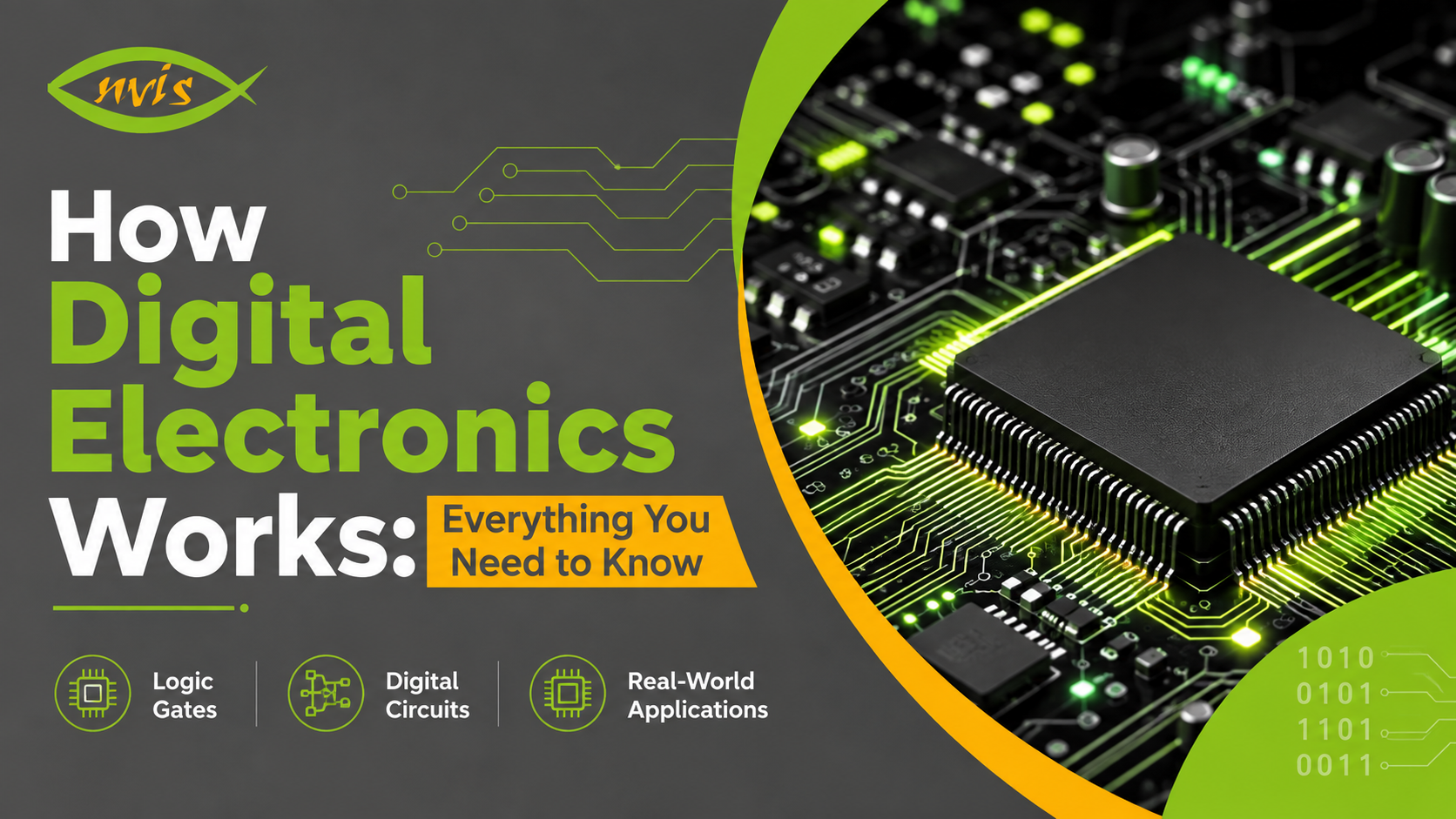
If you have ever wondered how a calculator adds numbers in a fraction of a second, or how your smartphone processes millions of instructions without missing a beat, the answer lies in a field most people take for granted: digital electronics. It sits quietly behind almost every device we touch, from washing machines to satellites, yet very few people outside engineering circles actually understand what makes it tick.
This article breaks down digital electronics in a way that is easy to follow, whether you are a student preparing for an exam, a hobbyist building your first circuit, or a professional brushing up on fundamentals before a lab session. We will walk through the core concepts, the building blocks, how circuits are designed and tested, and where this knowledge is applied in the real world.
What Is Digital Electronics
Digital electronics is the branch of electronics that deals with circuits and systems that process information in discrete, binary form, essentially as combinations of 0s and 1s, rather than as continuously varying signals. Every digital device you use, whether it's a computer, a router, or a digital thermometer, relies on circuits that interpret voltage levels as either "high" (representing 1) or "low" (representing 0).
This might sound like a small distinction, but it changes everything about how a circuit is designed, how errors are handled, and how information is stored and transmitted. Unlike analog systems, which are sensitive to noise and signal degradation, digital systems can regenerate a clean signal at every stage, which is a big reason digital technology has largely replaced analog technology across most industries over the past few decades.
Analog vs Digital Signals: Why the Difference Matters
To really understand digital electronics, it helps to compare it against its older sibling: analog electronics.
An analog signal varies continuously over time. Think of a dimmer switch on a light bulb; the brightness can be set anywhere between fully off and fully on, with an infinite number of possible values in between. A digital signal, on the other hand, only recognizes two states. There is no "in between." A switch is either on or off, a bit is either 0 or 1.
This binary nature gives digital circuits a major advantage: noise immunity. If a small amount of electrical noise creeps into an analog signal, it directly distorts the information. In a digital circuit, as long as the noise doesn't push the voltage far enough to flip a 0 into a 1 (or vice versa), the original data stays intact. That's part of the reason digital audio, digital communication, and digital storage have become the industry standard.
Digital Electronics Lab Equipment and Training Systems
Understanding and Experimentation with Digital ICs – Nvis 6550
NV6550 Understanding and Experimentation with Digital ICs is a digital electronics trainer designed to help students understand the working of various digital ICs through hands-on experimentation. It covers IC pin configurations, logic families, and practical circuit building, making it ideal for both classroom teaching and lab practice.
Parallel Adder and Subtractor Trainer – Nvis 6554A
Parallel Adder and Subtractor Trainer NV6554A is a ready to use trainer kit that demonstrates binary addition and subtraction using parallel adder circuits. It allows students to study carry propagation, overflow conditions, and arithmetic logic in a practical, easy to understand format.
SOP & POS Implementation Trainer – Nvis 6565
NV6565 SOP & POS Implementation Trainer is a compact, ready to use system that helps students implement and verify Sum of Products and Product of Sums expressions using actual logic gate circuits. It bridges the gap between Boolean algebra theory and real circuit behavior.
Encoder and Decoder Trainer – Nvis 6557
Encoder and Decoder Trainer Nvis 6557 has been designed specifically for studying the operation of encoder and decoder circuits used in digital data conversion. It gives students a clear, practical understanding of how binary data is encoded and decoded in real digital systems.
Counters Trainer – Nvis 6560
NV6560 Counters Trainer is a compact, ready to use digital trainer built to demonstrate the working of various counter circuits, including synchronous and asynchronous counters. It helps learners understand pulse counting, frequency division, and sequential logic in a hands-on setting.
Shift Registers Trainer – Nvis 6561
Nvis 6561 Shift Registers Trainer is a compact, ready to use kit that demonstrates the operation of different types of shift registers used for serial data movement and storage. It's a practical tool for understanding data shifting, storage, and timing in sequential circuits.
BCD Adder and Subtractor Trainer – Nvis 6562
BCD Adder and Subtractor Trainer Nvis 6562 is a compact, ready to use trainer that lets students perform and observe BCD arithmetic operations directly on hardware. It's especially useful for understanding how binary coded decimal values are processed in digital calculators and display systems.
Arithmetic and Logic Unit Trainer – Nvis 6563
Arithmetic and Logic Unit Trainer NV6563 is a compact, ready to use system designed to demonstrate the core functions of an ALU, including arithmetic and logical operations. It gives students practical insight into how processors execute basic computational tasks at the hardware level.
Experimentation with Logic Gates – Nvis 6551
Experimentation with Logic Gates Nvis 6551 is an elite training system built for hands-on study of basic and universal logic gates. It allows students to verify truth tables, build simple circuits, and develop a strong practical foundation in digital logic.
Experimentation with Characteristics of TTL and CMOS – Nvis 6551A
Nvis 6551A Experimentation with Characteristics of TTL and CMOS is an advanced trainer designed to help students study and compare the electrical characteristics of TTL and CMOS logic families. It covers parameters like voltage levels, noise margin, and power consumption through direct measurement.
Experimentation with Universal Gates – NAND and NOR – Nvis 6552
Experimentation with Universal Gates-Nand and Nor Nvis 6552 is an elite training system that demonstrates how any logic function can be built using only NAND or only NOR gates. It's a valuable tool for understanding gate universality and simplifying IC design concepts.
Experimentation with De Morgan's Theorem – Nvis 6553
Experimentation with De-Morgan's Theorem Nvis 6553 is an elite training system that lets students practically verify De Morgan's laws using real logic gate circuits. It strengthens the connection between Boolean algebra theory and its physical implementation.
Experimentation with Adders and Subtractors – Nvis 6554
Experimentation with Adders and Subtractors Nvis 6554 is an elite training system designed for hands-on study of half adders, full adders, and subtractor circuits. It helps students understand the building blocks of binary arithmetic used inside every digital processor.
Flip-Flop Demonstrator – Nvis 6555
The Flip-Flop Demonstrator Nvis 6555 is an elite training system built to demonstrate the working of different flip-flop types, including SR, D, JK, and T flip-flops. It offers a practical way to understand memory elements and sequential circuit behavior.
Multiplexer and Demultiplexer Trainer – Nvis 6556
Multiplexer and Demultiplexer Trainer NV6556 has been designed specifically for studying how multiplexers select a single input from many, and how demultiplexers route one input to multiple outputs. It's an essential trainer for understanding data routing and selection logic used in digital communication systems.
How Digital Electronics Is Taught and Tested in Labs
Theory only takes you so far in digital electronics. Concepts like logic gate behavior, De Morgan's theorem, flip-flop timing, or the operation of an arithmetic logic unit become far clearer once you can physically build, test, and troubleshoot a circuit.
That's why practical training kits and trainers play such an important role in electronics education. A well-designed lab setup typically lets students:
-
Experiment directly with logic gates and universal gates like NAND and NOR
-
Verify Boolean laws such as De Morgan's theorem through actual circuit behavior
-
Build and test adders, subtractors, and BCD arithmetic circuits
-
Study encoder, decoder, multiplexer, and demultiplexer operation hands-on
-
Observe flip-flop and counter behavior in real time
-
Compare TTL and CMOS characteristics on the bench rather than just on paper
Institutions that take digital electronics education seriously usually invest in dedicated trainer kits covering these exact areas, since it allows learners to move from "I understand the theory" to "I can actually design and debug a working circuit," which is a very different (and far more valuable) skill.
Real World Applications of Digital Electronics
It's worth stepping back and appreciating just how far-reaching digital electronics actually is. A few examples:
-
Computing devices: Every processor, from the one in your laptop to the one in your smartwatch, is fundamentally a massive collection of logic gates and sequential circuits.
-
Communication systems: Digital signal processing underpins mobile networks, satellite communication, and internet infrastructure.
-
Consumer electronics: Televisions, digital cameras, and home appliances rely on embedded digital circuits for control and processing.
-
Automotive systems: Modern vehicles use digital electronics extensively for engine control units, infotainment systems, and driver-assistance features.
-
Industrial automation: Programmable logic controllers (PLCs) and digital sensors keep manufacturing lines running with precision and consistency.
-
Medical equipment: Devices such as digital ECG machines, patient monitors, and diagnostic imaging systems depend on reliable digital signal processing.
Given how deeply embedded this technology is in daily life, it's easy to see why a strong foundation in digital electronics remains one of the most practical skills an engineering student or hobbyist can build.
Conclusion
Digital electronics might seem abstract at first, all those 0s and 1s, truth tables, and gate symbols, but at its core, it's built on a handful of simple, logical ideas that combine to create something remarkably powerful. Once you understand binary numbers, logic gates, and how they scale up into combinational and sequential circuits, the rest of the field starts to click into place much faster.
Whether you're a student trying to pass your next exam, an engineer refreshing your fundamentals, or someone building your first circuit at home, the best way to solidify these concepts is through consistent, hands-on practice. Pair your theoretical study with a good trainer kit or lab setup, work through the truth tables yourself, and don't rush past the fundamentals just to get to the "interesting" stuff. The fundamentals are the interesting stuff, once you actually understand them.
Build a strong foundation in digital electronics with Nvis Technology advanced training systems. Explore digital logic, combinational and sequential circuits, logic gates, flip-flops, counters, registers, and microprocessor concepts through practical, industry-ready experiments designed for engineering education and research.
Learn how digital electronics works, including binary numbers, logic gates, digital circuits, and real-world applications with this beginner-friendly guide.

 Czech
Czech
 English
 Arabic
 Spanish
 Portuguese
 Deutsch
 Turkish
 Dutch
Dutch
 Italiano
 Russian
 Romaian
 Portuguese (Brazil)
 Greek
Greek