AAC cable, short for All Aluminum Conductor, is one of the most widely used overhead conductors in power distribution networks worldwide. Known for its high electrical conductivity, lightweight structure, and cost efficiency, AAC cable plays a vital role in urban transmission lines, substations, and short-span overhead applications.
For utilities, EPC contractors, and procurement teams, selecting the right conductor directly affects network efficiency, installation cost, and long-term reliability. This guide explains what AAC cable is, how it works, where it performs best, and why manufacturers like HNBF Power are trusted partners for high-quality AAC cable solutions.
What Is AAC Cable?
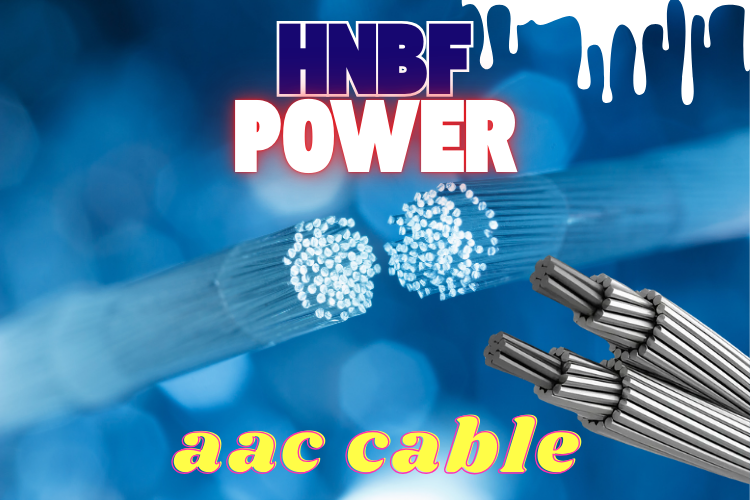
AAC cable is made entirely of electrical-grade aluminum wires stranded together concentrically. Unlike reinforced conductors, it contains no steel core. This all-aluminum construction provides excellent conductivity and corrosion resistance, making it ideal for specific overhead power line conditions.
Key Characteristics of AAC Cable
-
100% aluminum conductor
-
High current-carrying capacity
-
Lightweight compared to copper conductors
-
Simple structure and easy installation
-
Cost-effective for short and medium spans
AAC cable is commonly manufactured according to international standards and utility specifications to ensure consistent mechanical and electrical performance.
Electrical and Mechanical Properties of AAC Cable
High Electrical Conductivity
AAC cable offers superior conductivity due to its pure aluminum composition. This allows efficient power transmission with minimal energy loss, especially in low-voltage and medium-voltage overhead systems.
Lightweight Construction
Because it lacks a steel core, AAC cable is lighter than reinforced conductors. This reduces tower loading and simplifies handling during installation.
Corrosion Resistance
Aluminum naturally forms a protective oxide layer, giving AAC cable strong resistance to atmospheric corrosion. This makes it suitable for coastal areas and industrial environments with moderate pollution.
Mechanical Strength Considerations
While AAC cable provides excellent conductivity, its tensile strength is lower than ACSR or AAAC conductors. For this reason, it is best used in:
Common Applications of AAC Cable
AAC cable is widely used in power systems where conductivity and economy are prioritized over long-span mechanical strength.
Typical Use Cases
-
Urban overhead distribution lines
-
Substation bus connections
-
Short-distance transmission lines
-
Industrial power networks
-
Coastal and corrosion-prone regions
In dense city environments, AAC cable’s flexibility and lightweight design make it a preferred choice for distribution utilities.
AAC Cable vs Other Overhead Conductors
AAC vs ACSR
ACSR includes a steel core for added strength, making it suitable for long spans. AAC cable, however, offers better conductivity and lower weight, ideal for shorter spans.
AAC vs AAAC
AAAC provides improved mechanical strength using aluminum alloy, but AAC cable delivers higher electrical conductivity and is often more economical.
Choosing the right conductor depends on span length, environmental conditions, and network design priorities.
Manufacturing Quality Matters
The performance of AAC cable depends heavily on raw material quality, stranding precision, and quality control during manufacturing. Poor conductor consistency can lead to higher losses and reduced service life.
HNBF Power manufactures AAC cable using high-purity aluminum rods, advanced stranding technology, and strict inspection processes. Each conductor is designed to meet utility requirements for conductivity, dimensional accuracy, and long-term reliability.
Why Choose HNBF Power for AAC Cable?
As a global manufacturer of overhead conductors and power cables, HNBF Power supports utilities and EPC contractors with dependable and scalable solutions.
Key Advantages
-
Consistent electrical performance
-
Compliance with international and utility standards
-
Flexible production for customized sizes and constructions
-
Reliable supply for large infrastructure projects
-
Technical support for engineers and procurement teams
HNBF Power’s experience in AAC, AAAC, ACSR, ABC, and LV power cable manufacturing ensures complete solutions for transmission and distribution projects.
Installation and Maintenance Considerations
AAC cable is easy to install due to its flexibility and reduced weight. Standard stringing and tensioning practices are sufficient for most applications.
Best Practices
-
Use appropriate fittings to avoid aluminum damage
-
Ensure correct sag calculations for short spans
-
Conduct routine visual inspections in high-traffic areas
With proper installation, AAC cable delivers long service life and stable electrical performance.
Frequently Asked Questions (FAQs)
Q1: What does AAC cable stand for?
AAC cable stands for All Aluminum Conductor, made entirely of aluminum wires.
Q2: Is AAC cable suitable for long-distance transmission?
AAC cable is best for short to medium spans. For long spans, reinforced conductors are usually preferred.
Q3: Where is AAC cable commonly used?
It is widely used in urban overhead distribution lines, substations, and coastal regions.
Q4: Does AAC cable resist corrosion?
Yes, aluminum provides natural corrosion resistance, making AAC cable suitable for humid or coastal environments.
Q5: Can AAC cable be customized?
Yes. HNBF Power offers customized AAC cable sizes and constructions based on project requirements.
Conclusion
AAC cable remains a reliable and economical solution for overhead power distribution where high conductivity, lightweight design, and corrosion resistance are essential. Selecting a trusted manufacturer ensures consistent performance and long-term network reliability.
If you are planning a power distribution or utility project and need high-quality AAC cable, contact HNBF Power today. Our technical team is ready to support your project with customized conductor solutions designed to meet your exact engineering and procurement needs.



 Android App
 About SPORTIVO Network

 Czech
Czech
 English
 Arabic
 French
 Portuguese
 Deutsch
 Turkish
 Dutch
Dutch
 Italiano
 Russian
 Romaian
 Portuguese (Brazil)
 Greek
Greek