


 About SPORTIVO Network
Solar Farm Monitoring: Networking String Inverters with Rugged RS-485 Solutions
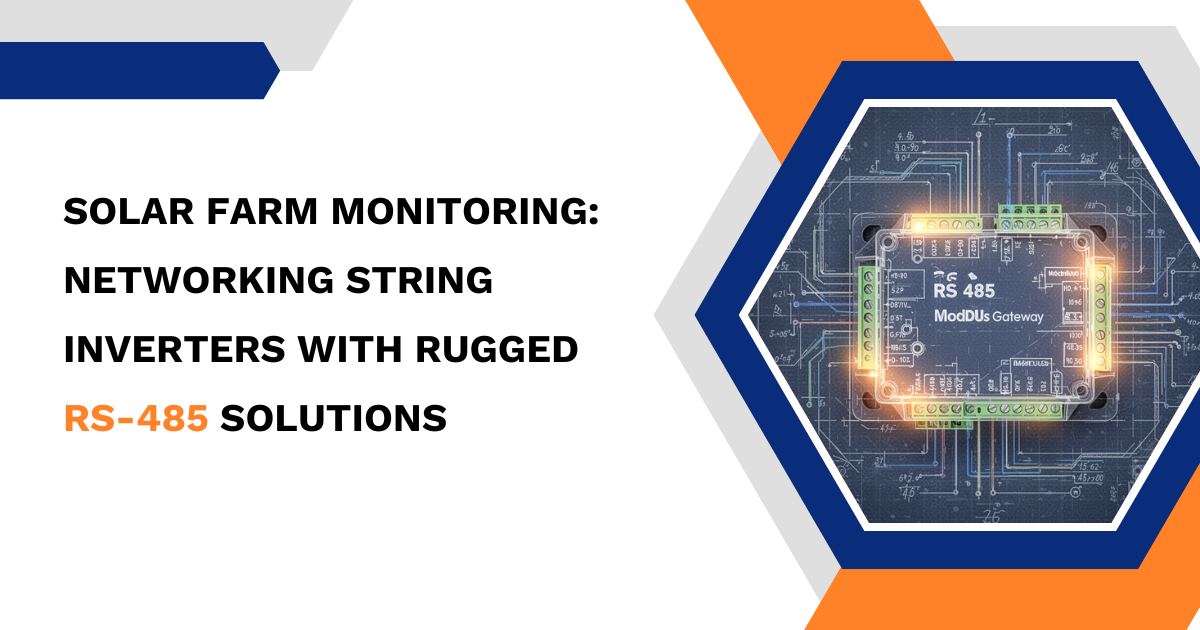
Solar energy production relies on the performance of individual string inverters. These devices convert DC power from panels into AC power for the grid. Monitoring these inverters is essential for maintaining plant efficiency. Large solar farms often cover hundreds of acres of open land. This environment presents unique challenges for data communication. Engineers must use robust hardware to ensure data reaches the central control room. The RS 485 Modbus Gateway serves as the primary link in this architecture. It connects field devices to the digital network.
The Role of String Inverters
A string inverter manages a group of solar panels connected in series. It tracks the maximum power point (MPPT) for the entire string. If one inverter fails, the farm loses a portion of its output. Monitoring systems must detect these failures immediately.
Modern inverters provide data on voltage, current, and frequency. They also report internal temperature and error codes. Collecting this data requires a reliable physical connection. Most industrial inverters use the RS-485 serial interface for this purpose.
Why Engineers Choose RS-485
RS-485 remains the industry standard for solar farm monitoring. It offers several technical advantages for outdoor installations.
-
Distance: RS-485 supports cable lengths up to 1,200 meters. This covers the vast distances found in utility-scale solar sites.
-
Noise Immunity: The interface uses differential signaling. This rejects electromagnetic interference from high-voltage power lines.
-
Multi-drop Capability: One bus can support up to 32 devices without extra hardware. With repeaters, this number increases significantly.
-
Cost: Twisted-pair copper wiring is cheaper than fiber optic cables for short to medium runs.
The Function of an RS 485 Modbus Gateway
Serial data cannot travel directly over a standard Ethernet network. An RS 485 Modbus Gateway performs the necessary protocol conversion. It acts as a translator between Modbus RTU and Modbus TCP.
Protocol Conversion Mechanics
Modbus RTU uses binary data sent over serial wires. Modbus TCP wraps this data in an Ethernet packet. The gateway receives the serial signal and extracts the Modbus payload. It then adds the IP headers required for network routing. This allows the SCADA system to communicate with the inverter over the local area network (LAN).
The gateway also manages timing issues. Serial communication is much slower than Ethernet. The gateway buffers the data to prevent timeouts and packet loss. This ensures a smooth flow of information from the field to the server.
Integrating the RS485 IoT Gateway
As solar farms become smarter, they need to send data to the cloud. An RS485 IoT Gateway provides this connectivity. These devices go beyond simple protocol conversion. They often include edge computing features.
Edge Data Processing
An RS485 IoT Gateway can filter data before sending it. For example, it might only transmit data when a value changes. This reduces the bandwidth needed for cellular or satellite links. In remote areas, saving bandwidth lowers operational costs.
-
Local Storage: Many IoT gateways include microSD slots. If the internet connection fails, the device saves the data locally. It uploads the logs once the connection returns.
-
MQTT Support: These gateways often use the MQTT protocol. This protocol is lightweight and ideal for unstable networks.
-
Security: IoT gateways include firewalls and encryption. This protects the solar farm from cyberattacks originating on the internet.
Rugged Design for Harsh Environments
Solar farms experience extreme weather conditions. Equipment must withstand high heat, cold, and humidity. Commercial-grade networking gear will fail in these settings.
1. Temperature Resistance
Industrial gateways must operate between -40°C and 75°C. Components inside the device must handle these thermal cycles without cracking. Metal enclosures help dissipate heat better than plastic ones.
2. Electrical Protection
Lightning strikes are a major threat to solar farms. RS-485 lines act like long antennas. They can pick up massive electrical surges. Rugged gateways include isolation and surge protection.
-
Optical Isolation: This prevents high voltage from crossing into the logic circuits. It stops a surge at the serial port from destroying the entire network.
-
ESD Protection: Electrostatic discharge can damage sensitive chips during maintenance. Rugged devices include built-in protection for these events.
Designing the Monitoring Network
A successful monitoring system requires careful planning. Engineers must consider the physical layout and the data requirements.
1. Bus Topology and Termination
RS-485 works best in a "daisy chain" configuration. Technicians connect one inverter to the next in a single line. Avoid "star" or "tree" configurations. These cause signal reflections that corrupt data.
Engineers must place a 120-ohm resistor at each end of the bus. This termination resistor absorbs the signal energy. Without it, the signal bounces back and interferes with the next transmission.
2. Addressing and Polling
Each inverter on the bus needs a unique Modbus ID. The RS 485 Modbus Gateway polls these IDs one by one. If the bus has too many devices, the polling speed drops. For real-time monitoring, engineers usually limit each bus to 15 or 20 inverters. This ensures the system updates every few seconds.
Statistical Impact of Effective Monitoring
Data-driven maintenance changes the economics of solar power. Industry reports show clear benefits from advanced monitoring.
-
Uptime Improvement: Systems with real-time alerts show a 5% increase in annual energy production.
-
Maintenance Savings: Predictive analytics can reduce site visits by 30%. Technicians only go to the site when they know a specific part needs repair.
-
Degradation Tracking: Precise monitoring helps owners identify panels that degrade faster than the warranty allows. This allows for successful insurance and warranty claims.
Challenges in Solar Connectivity
Building these networks is not always easy. Several factors can disrupt the signal.
1. Ground Loops
Long cable runs between different parts of a solar farm can have different ground potentials. This creates a "ground loop" current. This current flows through the shield of the communication cable. It introduces noise and can damage equipment. Using isolated RS 485 Modbus Gateway units solves this problem. The isolation breaks the electrical path between the different grounds.
2. Cable Quality
Cheap cables fail quickly in the sun. Installers must use UV-resistant, outdoor-rated cables. Using shielded twisted pair (STP) cable is mandatory. The shield must be grounded at only one point to prevent ground loops.
Future of Solar Farm Networking
The industry is moving toward higher levels of automation. Newer systems use "Self-Healing" networks. If a gateway fails, the system automatically routes data through a different path.
1. 5G and Private Networks
Some large sites are now using private 5G networks. These networks offer high speed and low latency. However, they still need an RS 485 IoT Gateway at the edge. The gateway converts the serial inverter data into a 5G signal. This hybrid approach combines the reliability of RS-485 with the speed of 5G.
2. AI at the Edge
Future gateways will run AI models locally. They will analyze the "sine wave" of the AC output in real-time. This can detect early signs of component wear inside the inverter. The gateway will send a warning before the inverter actually fails.
Conclusion
The integration of rugged RS 485 Modbus Gateway technology is the definitive solution for high-performance solar farm monitoring. By bridging the gap between field-level serial data and high-level digital networks, these devices ensure that every string inverter operates at its peak potential. The move toward using an RS485 IoT Gateway further enhances this capability, providing the edge intelligence and cloud connectivity necessary for modern energy management.
A technical approach to networking is not just about connectivity. It is about resilience against the elements and precision in data capture. Using differential signaling, optical isolation, and proper bus topology creates a communication backbone that lasts for decades. As solar installations grow in scale and complexity, the reliance on these hardware "translators" will only increase.

 Czech
Czech
 English
 Arabic
 French
 Spanish
 Portuguese
 Deutsch
 Dutch
Dutch
 Italiano
 Russian
 Romaian
 Portuguese (Brazil)
 Greek
Greek