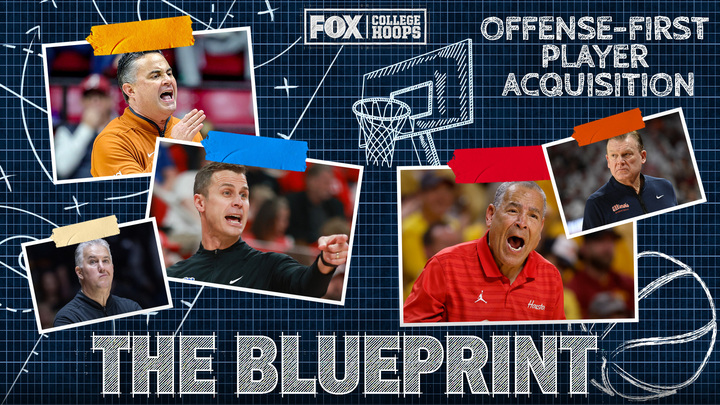
The Blueprint: How Offense-First Roster Construction Is Reshaping College Basketball
Roughly two-thirds of the way through the 2025-26 men's college basketball season, a statistical oddity seemed to be emerging: Nearly 50 teams were averaging more than 120 points per 100 possessions the standard metric used to derive offensive efficiency as the calendar turned from January to February. Intuitively, the number seemed extraordinarily high even for a year when there is so much elite-level talent across the sport that NBA commissioner Adam Silver announced the eventual enactment of anti-tanking rules to prevent teams from intentionally losing to improve their draft position. Sure enough, historical data confirmed my suspicion: Only 18 teams had completed the previous campaign with such staggeringly efficient offenses, and even that tally was some 33% higher than any other season in KenPoms 30-year archive. The average number of teams to eclipse 120 points per possession during that sample size? A measly 4.6 per season, including nine years that featured three or fewer. To soar from that degree of sustained scarcity to more than four dozen such teams seemed like an incredible change in a relatively short period of time. And now, as most conference tournaments are set to begin this week, the number still sits at 48 teams. "That statistic is amazing," Texas head coach Sean Miller told me last month. "I dont know if people really understand what youre saying there. Thats way, way too much of a change in one season." To understand the how and why behind this offensive explosion, I spoke to nearly a dozen head coaches whose offenses ranked among the top 25 nationally. Though their answers varied, a handful of common themes emerged that when pieced together began to pull back the curtain on what might be remembered as the greatest offensive season in college basketball history, at least statistically. Those coaches identified four distinct pillars that are doubling as potential explanations for this seasons renaissance: offensive-centric roster building, analytically driven shot selection, reimagined offensive rebounding principles and improved on-ball decision-making. To some degree, Houston head coach Kelvin Sampson told me, what were seeing right now is the maximization of a process that began during the 1988 Summer Olympics, which was the last time the United States built its basketball team entirely from collegiate players. Led by then-Georgetown head coach John Thompson, the Americans arrived in South Korea with the tournaments most athletic roster. But despite that advantage, Team USA (bronze medal) played a drastically different style than countries like the Soviet Union (gold) and Yugoslavia (silver), which built their offenses around the premise of "penetrate to pass versus penetrate to score," as Sampson described it. Superior ball movement sent the American defenders chasing from one side of the 3-point arc to the other until an open perimeter shot was taken. "Thats what got people thinking," Sampson told me. "And then, in 1992, was the birth of the Dream Team. So we werent going to be embarrassed anymore because yall had yalls pros, were gonna start taking our pros. But in between there, there was a glimpse into the change that basketball was on the verge of making. Their spacing was different than ours, their skill sets were different than ours and I think we learned a lot from there." Fast-forward a few decades and some of the resulting stylistic changes that gradually worked their way into college basketball are being kicked into overdrive thanks to a confluence of modern factors: From offensive-minded rule changes to the proliferation of analytics. From an influx of experienced European players who are capitalizing on relaxed eligibility rules to a wave of new coaches studying film in leagues beyond the U.S. From lucrative NIL payments that are funneling more talented players toward the sport than ever before to the last embers of COVID-year eligibility that have raised average player ages and maturity levels. All poured gasoline on an already changing flame. In Part 1 of this series, some of men's college basketballs keenest minds explain how the modern game is prompting them to reimagine how rosters are assembled. *** *** *** Jon Scheyer, Duke:What youve seen in college basketball this year [is] an incredible freshman class. Youve seen 22-, 23-, 24-year-old pros. Youve seen a lot more flexibility from a roster construction standpoint. I think coaches have gotten a lot smarter with roster construction. I think thats something thats really progressing. I think that allows, obviously, the better talent and the better fit in terms of roster. Matt Painter, Purdue:I dont know how you quite quantify that, but I think [its] just better players. We have some older players, we have some international guys that are coming in their first years that arent 17-, 18-year-olds. Theyre a little bit older, a little bit more experienced. And even the ones that are 17-, 18-, 19-years-old, their experiences leading up [to college basketball], of playing against older people, I think really help. T.J. Otzelberger, Iowa State:This is a very old year with the COVID-year still on our books for some. Theres an influx of European talent with skill and specifically skilled bigs more skill than weve seen. I think theres a tremendous talent level among the freshmen probably the best freshman group Ive seen impacting winning. So I think the No. 1 thing Id start with is the personnel piece. I think thats a huge part. Scheyer:You have the ability to build around your best players in a different way. The pool is bigger. Instead of just being able to take high school players, you can take basically anybody in college, European, now the G-League potentially. Its a hell of an opportunity as a coach. Youre able to have the right fit and the more ready-made players right away. [NCAA: Final Regular-Season Men's Top 25 Rankings] Sampson:The young coaches that are coming up in the game are more geared to offense. And they probably build their teams to that end of the court more so now than in the past. It starts with recruiting. [AJ] Dybantsa at BYU and how they built their team around him. [Darryn] Peterson at Kansas and how they built their team around him. [Christian] Anderson and [JT] Toppin at Texas Tech, how they built their team around their guys. Coaches think differently now than they did 30 years ago. It was like Big Ten football was three yards and a cloud of dust with a full backfield. Now, there is nobody in the backfield. Its all empty. College basketball has kind of followed the same theory. The game is constantly evolving. The game is constantly changing. New coaches are coming in, bringing in new ideas. Grant McCasland, Texas Tech:I definitely, 100 percent, see the game from an offensive [point of view]. I recruit from an offensive standpoint and from a competitive standpoint. Because I do think that you can help people get better defensively. And I think if people love it, you can help them get better offensively, but not at the rate at which you can help someone [on defense]. I do think its hard to teach someone to be physical, and its hard to teach someone to really put their nose in the middle of it if its not their makeup. So its almost like skill and physicality is really the X-factor. Todd Golden, Florida:A big thing for us is trying to get guys that we think will be plus-[expected value] players on both sides of the ball. And with that being said, though, gun to head, we would probably err on the side of taking a pro-offensive player than a pro-defensive player. Otzelberger:Teams are seeing more and more correlation [to] whatever their identity is. Some teams are high-volume 3-point shooting teams, and that makes them efficient. Others, like us, put more emphasis on offensive rebounding, maybe, as a way to fill a margin. So I think because theres more data, I think people are recruiting more [toward] a specific way of doing things or a system. You see the teams that are high-volume 3-point teams, and thats their model, like a Texas Tech. And then you see teams like, maybe, the Floridas or the Michigan States or the UConns or us that try to put a premium on offensive rebounding and I think recruit to it, develop it, talk about it, coach it. I think there are more specific people who are analytically building their argument that way. Ben McCollum, Iowa:Teams are recruiting to it. I think theyre recruiting shooting, obviously, number one. I do think the transfer portal hurts defense, meaning, I think over time you kind of build some defensive grit, some defensive toughness, and you do that over years and years. Some teams just have plug-and-play guys or guys that come in for a very short amount of time, and theres not a lot of defensive grit. Theres not a lot of toughness. They just kind of get by defensively. And so naturally, because of that, youre going to score more, and your efficiency numbers are going to be a little bit better. Brad Underwood, Illinois:Weve been very, very exact or trying to be that anyway in our recruiting. Positional size, very important. Shooting, very important. We look very, very hard at the character piece. We personality-test everybody. And then the other piece is processing and problem-solving. We dove heavy into that part of it in the evaluation process as well and using some other markers out there that we just tried to figure out how guys process and how guys think and basketball IQ tendencies. Its really become very exact for us in the recruiting game. Pat Kelsey, Louisville:We really, really value skill and shooting. So that really matters. Those metrics that we know fit our offensive style are highlighted and coveted when were evaluating and recruiting prospects. Painter:Weve always had good size. And now we have a great point guard. And I think thats the recipe. If youve got really good big guys, and youve got a great point guard, and youve got a bunch of guys that can shoot, that balance offensively is the recipe that we look for. Sampson:When you put together your team, the first thing youre looking at is do we have enough offense? Do we have enough shooting? Do we have someone that can create shots at the end of the shot clock? Can we space the floor and force teams to have to open up their defense to extend to our shooters? And then when the ball gets swung, can we attack the closeout [defender] and get into the paint, and then make the right decision? Miller:Sometimes, when youre in sports, you look at [how] other industries evolve and adapt and change, but [then you think] what you do doesnt change, you know what I mean? But I think as you grow in it, and you have more experience, you learn no, in the industry that youre in, it evolves, grows and changes no different than all the other industries in the world. The last five years maybe even the last three or four theres been so much change in the way the game is played, officiated. So when you look at building your roster, [its all about] skill level, versatility, interchangeable parts. Come back on Tuesday for Part 2 in this series, which focuses on the radical changes to offensive shot selection in adherence with modern analytics. In The Blueprint, our in-depth, long-form series takes you inside some of the most amazing stories in sports.






 Czech
Czech
 English
 Arabic
 French
 Spanish
 Portuguese
 Deutsch
 Turkish
 Dutch
Dutch
 Italiano
 Russian
 Romaian
 Portuguese (Brazil)