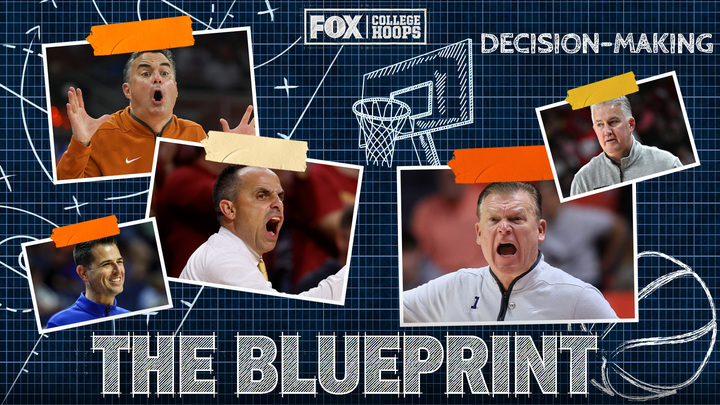
The Blueprint: Why Decision-Making Has Become College Basketballs Ultimate Skill
Now more than ever, an integral part of the recruiting process for college coaches involves piecing together the puzzle of an athletes inner circle. It still entails forging relationships with a players family and high school coach, but now there are typically a few more tentacles surrounding each potential future star: an agent, a marketing manager, a financial advisor, a strength coach. At times, the entourages seem endless. For Purdue head coach Matt Painter, the figures hes far more curious about now than at any point during his highly successful career are the private instructors, sometimes known as the "workout guys." These are the individuals responsible for sharpening a players skills beyond the confines of traditional practices or games. In an era when players are asked to think about the game at higher levels processing more options in real time than ever before Painter needs to know how that aspect of a recruits development is handled. "If they have somebody that is a valuable asset thats really helping them become a better player," Painter told me last month, "decision-making should be a part of the workout. Decision-making is so important. If your decision-making only grows during the winter, then youre probably not going to be a very good decision maker. Youre not going to get to the level that you should get to because it should be a 12-month deal in terms of getting better at reading situations, reading defenses, knowing whats going on." An absorption of offensive concepts and schematic ideas from professional leagues across the world has rewritten the traditional responsibilities associated with each position. Primary ball handlers now come in all shapes and sizes. Power forwards and centers are spending more time on the perimeter. Playmaking skills are now expected from at least four, if not all five, players in a given lineup. Glaring statistical changes reflect that. So far this season,there are 44 players listed at 6-foot-5 or taller averaging at least 3.5 assists per game, up from 24 such players 10 years ago. In terms of perimeter shooting, there are currently 30 players listed at 6-foot-7 or taller averaging at least 2.1 made 3-pointers per game, up from 19 such players 10 years ago and only four such players 20 years ago. "One part of the game that I really enjoy as a fan is watching the Euro League," Texas head coach Sean Miller told me. "I think that might actually translate to college a little bit more [than the NBA]. Their ball movement, their cutting, their concepts so much of how they play the game today is a lot of what you see in college basketball." Part 4 of our series analyzes the heightened importance of individual decision-making in college basketball, where on-court processing power is now worth its weight in gold. What used to be a game dominated by heady point guards and back-to-the-basket big men is now an exercise in team-wide basketball IQ. One of the reasons why there are 50 teams averaging at least 120 points per 100 possessions this season the highest mark in at least 30 years is because players are getting smarter with the ball in their hands. [Player Acquisition | Shot Selection | Offensive Rebounding] *** *** *** Todd Golden, Florida:That was not something teams really focused on 20 years ago when I was in college. Teams had a traditional point guard, you maybe had another guy out there that could be a secondary ball handler and decision maker, but everybody else kind of had specific roles. Your wings were trying to attack the rim or defend with size, and your frontcourt players were paint players and playing inside the 3-point line. Now, I think the best teams regardless of whether youre a team that shoots a lot of 3s or a team that really hunts to play out of the paint if you can play with multiple decision-makers on the floor, youre going to be a lot better. Miller:I think there always has to at least be four players on the court who can pass, dribble, shoot, decision-make. The best teams in college basketball certainly have that. And then when you can add that fifth player, even if he does it in a different way, it goes to [the idea] where you try to build your roster with players who can think about the game, who can have a fundamental skill level, but really understand how basketball works. The screen and rolls, the spacing, the importance of cutting, why you make one decision versus the other. T.J. Otzelberger, Iowa State:A lot of bigs now tend to step out more on the perimeter. Theres certainly the extreme example like [Nikola] Jokic in the NBA. Everyone kind of wants that. I just think youre watching guys decision-making in real time, assist-to-turnover numbers. Certainly, the better you shoot the ball as a frontcourt player, the more it opens up playmaking space for you to do things. Ben McCollum, Iowa:Having good passing bigs is more important than having good shooting bigs. Obviously, youd like to have both, but if you can have a good passing big, a high processor who works pretty fast through some of those things, thats more difficult to defend than somebody who can just stretch the floor. And so youre trying to find those processors. Painter:We get it a lot with our big guys, because if youre not good enough to [draw] a double team and you cant get position deep, then why should you have ever been a good passer? Zach Edey wasnt a guy who ever got double-teamed so we had to get to work on [his passing] right away. Are they covering down ball side? Are they coming big to big [from the] opposite [side]? Are they coming baseline-side on a double? Are they coming when you bounce it? Is there any difference when youre above the block to whether youre up the lane or outside a little bit? Now weve got to put drill work into effect on those five things and weve got to mix it up and not tell him when its coming. And then hes got to make those reads. Thats what we did every day for 10 to 12 minutes. All of a sudden, he went from somebody that was not able to make those plays and passes to someone who was probably the best in the country at it. Golden:Thats an area that weve been fortunate over these last three years to have frontcourt players that really understand how to play basketball. They all havent necessarily been able to shoot the 3, but they know how to dribble, they know how to pass, they know how to make decisions and that opens up a lot for the rest of your team. McCollum: Its not the great passes that make the difference. Its how quickly does the ball come out. You always hear the Spurs talk about half-second decisions. A lot of that is the ball comes out of their hands quicker. The timing and the rhythm and the flow increases field goal percentages [and] keeps the defense behind quite a bit more. Then you increase your 2-point field goal percentage and your 3-point field goal percentage because of how quickly each individual gets off the ball. I dont think we ever get the perfect guys to do that, but those are some things that we try to identify. Its not an objective measure, its just like, That guy has a good feel. I dont know why. He just makes sense to me. Thats probably more what we look for. Grant McCasland, Texas Tech:Theres so many variables in this that you obviously start with the basics, which is always assist-to-turnover [ratio]. Then you take into account usage and historical reference on what a coachs tolerance level is for turnovers. Some coaches dont necessarily demand [perfection] and some prefer more free-flowing [offense] and have more turnovers. Usually the guys that have a better feel shoot a higher percentage because they dont take as difficult of a shot. I think an ultimate separator, too, is how many of those guys have won. Thats an underrated part of all this, when you look at it, is just win percentage. That shows that a guy knows how to do all three: take care of the basketball, what do they shoot, and then have they won doing it. I know thats probably a simplistic approach, but that says a lot about someones understanding of the game. Golden:I think its the hardest part with evaluating, whether its high school guys or even portal players, to understand how they see the game and how they make decisions. Youve really gotta watch them. We analyze a lot of data in determining which guys were going to target, but an area that weve continued to spend more time on over the last two years is really trying to drill down in the film. After we might be intrigued by a guy from their analytical profile, we end up watching more film to make sure that profile is telling us the whole story. Jon Scheyer, Duke:When youre watching a guy, watching the shots he shoots, how he plays, does he pass to his teammates, the way he processes the game, theres an eye test component to that. But I think the most enjoyable part for me is that I ask a lot of questions with our recruits. When we show film to them, we also talk about the areas that they have to do better. I love seeing how they respond to that. I love seeing if they embrace that. And I love just asking them questions about the game. If you can find yourself just talking to them, the longer Ive done this, the more I like to ask questions and get inside their mind of how they process and what they think. Brad Underwood, Illinois:Problem-solving is the game of basketball. We do a lot of disadvantage basketball or advantage basketball. We play 5-on-4, 4-on-3, we play 5-on-4 from a disadvantage so guys have to learn to process and make decisions in all scenarios. I think its helped us and it helps guys improve. Golden: A lot of people spend time in the spring and summer working on individual player development, and we do our fair share of that. But at the same time, we expect our guys to play a lot of pickup whether its 3-on-3, 5-on-5 to put themselves in those situations outside of the season, to make sure theyre sharpening those parts of their game. From a coaching and player development standpoint, we grade every 5-on-5 possession that we play in practice. We film everything and we grade it. We give our guys feedback based on how they do in what we call our hustle stats. Its a way to give tangible feedback along with film, where not only can you show them the numbers, but you can also have film to back up whether theyre doing things well or not well. Over the course of time, when youre using playing time as the carrot being dangled, guys are going to work to do what you want them to do when you can show it to them in a few different ways. Miller:What I have found, the way the game is played today, is when a player doesnt have that [heightened] understanding, its really hard for him. The game is harder for that type of player than it used to be. Painter:Thats a real important piece of somebodys growth as a basketball player. In The Blueprint, our in-depth, long-form series takes you inside some of the most amazing stories in sports.









 Czech
Czech
 English
 Arabic
 French
 Spanish
 Portuguese
 Deutsch
 Turkish
 Dutch
Dutch
 Russian
 Romaian
 Portuguese (Brazil)
 Greek
Greek